

Mangalamkaali Dance
Mangalamkaali is a colorful tribal dance popular among Mavilans in the State of Kerala. This class offers a deep study on its roots, cultural background, rhythmic phrasing, costuming and elements of presentation. Through a mix of classic and modern elements, participants will get a full view of what sealskin dance is and how it has become what it is today. If you are dancer, educator, or cultural enthusiast, this course gives a unique opportunity to immerse in one of the richest forms of indigenous art and heritage of India, that works towards enhancing and promoting the indispensable “intangible cultural heritage of India through a holistic language and performance.
 Most Viewed

What you'll learn
- Historical Context : Learn the origin and history of Mangalamkaali and find the name meaning of Mangalamkaali as well as discover the names.
- Cultural Importance : Discover its importance in tribal ceremonies, gatherings and oral tradition.
- Dance Techniques : Master the fundamental movements, techniques, and variations associated with this popular dance.
- Rhythmic Knowledge : Understand the Taal and you get the rhythm patterns of Mangalamkaali.
- Costume & Instrumentation : Determine the meaning of the symbolic costumes and native musical instruments employed in the performances.
- Modern Influence : Learn how media, education, and modern influences shape the custom.
- Preservation Efforts : Learn about the latest efforts and best practices for preserving this art form.
Couse Features:
- Expert-Curated Content : Content prepared by cultural scholars and practitioners.
- Structured Learning Path : Thematic sections provide access to content for both the portrayal and understanding of a topic.
- Practical Demonstrations : Step by step analysis of dance moves and beats.
- Visual and Audio Aids : Use of recordings, pictures and traditional media to supplement cultural immersion.
- Community Engagement : Discussion possibilities with other learners and experts.
- Flexible Learning : Accessible study material for self-study of the Hebrew Bible.
- Real-World Application : Thoughts on how Mangalamkaali can be incorporated in instruction, composition and for cultural events.
Who Should Enroll
- Dancers wanting to delve into the Indian tribal styles.
- Cultural studies students.
- Teachers and instructors of dancing.
- Folklorists and ethnographers.
- Dance-makers seeking something different.
- Guys in the community pushing indigenous arts.
Description
Mangalamkaali Dance
Origins and History
The Mavilan tribal people of Kerala’s Kannur and Kasaragod districts perform Mangalamkaali, an age-old folk dance. Mavilan and friction between Mavilan and the Dravidian traditions. This dance represents the people's relationship to the land and to their spiritual belief system. Traditionally, it was done on auspicious occasions such as marriages and festivals, as evidence of the tribe's unity with nature and their collective identity.
Etymology The term "Mavilan" comes from the Mavilavu, a medicinal herb they specialise in traditional medical practices. The Mavilans were originally hunters-gatherers, as well as people who practiced slash-and-burn agriculture, i.e. cutting and burning dense forests over virgin land for farming. Gradually the tribe settled into agriculture, and with it new forms of expressions of their culture added on to Mangalamkaali.
Mangalamkaali shows the essence of life, nature and myths. It integrates storytelling into a fluid choreography, gestures and songs of homage to the elements of nature, wildlife and community living. The dances are performed by men and women of all ages with the beats only of drum played from a drum (Thudi) which is made up of jackfruit wood. The music and dance were always offerings in celebration and worship of a unique relationship with deities and the land.
The dance also illustrates intertribal influences on each other in the area. An example would be Malavettuvan tribal community which is closely associated with the Mavilans and they influenced Mangalamkaali whose subject matter and instruments are similar. For generations, Mangalamkaali maintained its ethos while keeping up with the changing times. It fell into disuse during the second half of the 20th century and there are attempts to reintroduce its practice as a part of cultural heritage.
Mangalamkaali is more than just an entertaining story; it offers a look at the Mavilan people, their history, the construction of their society, and the way they see the world. The rhythmic play and cultural depth, is a testimony to a tribe’s courage and creative tenacity in the test of time.
Cultural Significance
Cultural and spiritual significance Mangalamkaali in northern parts of Kerala especially in Kasaragod and Kannur is worshiped with fervour by the tribe of Mavilan. The dance is intricately related to their day-to-day living, their history, and the farming customs which they developed. Going by their archaic as well as contemporary cultural conventions, rice and milk being the staple foods of the tribe, community; and rice being preferred as a potent-libation-offer are symbolic of the wetland culture to which Mawilans revere.
Cultural significance Mangalamkaali plays a pivotal part in important life events- marriages and festivals and other important social events of the community. Danced by the men and women, the dance forms an important part of the social life of the Mavilans. It is not merely an amusement or an aesthetic; it is a spiritual ceremony through which the tribe binds itself to their land, the forces of nature, and itself. Rich rhythm of the Thudi, traditional drum resounds as the dancers proclaim their respect for the earth, forests and the animals that serve as the pillars of their lives and mythology.
At weddings, a Mangalamkaali is performed to seek blessings and celebrate the amalgamation of two persons into a sacred union. The dance is symbolic of the individual, the community and nature, the rapport between all three. It is also connected to the cycles of the fields, representing abundance, fertility, and the tribe’s kinship with the earth and its seasonal patterns. The folk songs that are sung tell stories that deal with nature and the problems of the agricultural life, in addition to local myths which embrace the popular tribe’s values, beliefs and rituals.
Mangalamkaali not only transforms into a ritualist but she has been instrumental in the revitalization of the orality of the tribe which has been marginalized and threatened by the access to the technology in the form of mobile phone for the community. This dance is performed by the Mavilan community who continues to preserve its history and traditions while transferring its history and cultural information to younger generations. This preservation was not limited to the dance, but involved the retention of the tribal language and rituals and medicine that are also part of the Mavilan heritage. This is how Mangalamkaali comes alive, as a vibrant contemporary culture, that keeps the values of the tribe thriving in a constantly changing world .
Managlamkaali, the Mavilan folks express their deep spiritual bonding with the nature and respect to their customs and socie taal values and thus secure the continuous existence and perpetuation of their culture.
Information about Mavilan Tribe
The culture of the Mavilan tribe is rich and shares the age-old connection with forest and agriculture mainly concentrated in the districts of Kannur and Kasaragod in the Kerala state. The Mavilans were traditionally a prawn-hunting and gathering community using slash-and-burn agriculture and collection of forest consumables like medicinal plants, bamboos, and non-timber forest produce. This way of life has been inextricably linked to their close and harmonious relationship with nature, adopting traditional livelihood activities, including basket-making, agricultural labouring and the gathering and trading of medicinal herbs.
Punam Kothu – The one thing that defined the life of the Mavilans was the Punam Kothu, a unique way of clearing virgin forest for wetland paddy cultivation. Their spiritual and cultural way of life were tied closely to this type of agriculture. Forest areas became more managed, patterns of land ownership changed and Mavilans gradually settled into a more sedentary agricultural lifestyle – away from their earlier hunting and gathering ways.
Socio-political factors, including the Mavilan community’s eventual grant of Scheduled Tribe status, and government policies encouraging the Mavilan people to settle in permanent agricultural spaces, also drove this transition. With the community still involved in agricultural pursuits and at the same time changing their means of livelihood, some people have accepted the government or private jobs or transformed themselves from agriculture to non-agricultural labour .
As far as the social structure of the Mavilans is concerned, it possesses a patriarchal system where the community head has always been the 'Taravad Karnavar' and is an administrator as well as task priest. Amidst the rigours of contemporary development, the Mavilan tribe still remains in the limelight keeping its separate cultural identity alive, upholding customs such as Mangalamkaali, their animated dance form, and striving for stronger and more empowered communities through the means of education and mobilization .
Famous Personalities and Contributors
Mangalamkaali, a tribal art form of the Mavilan community of Kerala: Its cultural, ritualistic and agricultural origin and development=params>Mangalamkaali, a primitive art and culture of the Mavilan community of Kerala source and development of Mangalamkaali. Throughout the years various people and groups have worked to preserve it and maintain it for continued use.
Leading Mangalamkaali figureheads are usually tribal elders, community leaders; some are believed to be caretakers of the dance. These were not only practitioners but were absolutely determined to see that the dance was sustained for future generations. Mangalamkaali danced at tribal festivals, wedding and other cultural events in the northernmost parts of Kerala and this helped to keep the art alive, in the face of pressures from modernization. The fact that their dedication to the art is especially important as the art form has suffered declining visibility since the 1970s and tribal traditions are frequently encroached upon by outsiders.
The most remarkable contribution was from the Mavilan members themselves, as during the past few years have rejuvenated interest within Mavilan people on Mangalamkaali. Younger generations and tribal-serving cultural organizations are leading the revitalization. Introduction The students from Kasaragod participating in the process of exhibiting the folk-art form, Mangleamkaali performance is a recent trend in presenting the traditional dance form itself. Sponsored by people like Kerala’s Tribal Welfare Minister K.Radhakrishnan, these performances have taken Mangalamkaali to new crowds .
In addition, a number of local culture bodies regularly ensure that the authenticity of the dance is not lost, while the dance itself is being showcased in many more platforms. They drive back the focus to the significance of Mangalamkaali as not merely a dance but a culturo-nature expression of the Mavilan tribe's unbroken bond with nature, land, and their tradition s.
Thus, even when Mangalamkaali tends to decrease on the verge of modernity, there are several people from the community, tribal leaders and cultural carriers to promote the revival of the dance, which keeps it as one of the vital segments of Kerala's tribal heritage.
Characteristics of the Dance
Mangalamkaali - This is a brilliant traditional dance presented by Mavilan tribe of North Kerala proves their close links with forest and tribal rites. The dance, which is performed collectively by both men and women, is popular occasions, including wedding ceremonies, or community celebrations. The dance comprises rhythmic movements and synchronized hand and foot work to the beats of a Thudi, a percussion instrument made of jackfruit wood.
The salient features of Mangalamkaali are its close association with the agrarian and forest-dwelling life of the tribe. The dance is usually metaphorical, representing such themes as the balance of nature, agriculture, and the relationship the tribe has with its environment. It includes folk songs that record the myths, concept, and ordeal of the tribe, perpetuating a cultural feature that is historically based in their past heritage.
Besides, Mangalamkaali expresses unique style with its energetic moves. Participants read faster-pacing body movements associated with hunting, farming, and engaging with nature. A distinctive moment of the dance comes at the end, as part of the final phase in which the dancers slap their backs with both hands as an act of resilience and self-expression. The increased resistance at this phase could be seen as a statement against a repressive society—the community has been persecuted throughout its history.
There is also varied form of Mangalamkaali and Kalyanakali which is based on regional custom that has same essence like that of celebrations and ritualistic objectives."Mangalamkaali is a harrowing dance that doesn't just entertain but serves to carry the haunting spiritual and cultural history of the Mavilan tribe.
Main Characteristics
Mangalamkaali This is an elaborate dance of the Mavilan, a community of the northern Kerala districts of Kannur and kasaragod. This century-old folk dance, which has been practiced for generations, reflects the culture, religion, beliefs, and insight into the relationship with nature for the tribe.
The prime features on Mangalamkaali, describe the symbiotic living of the tribe with the nature, environment, and their myths in daily life. The dance is highly thematic, inspired by earth, forests, wild beasts, hunting, and tribal myths. These are the central themes of the folk songs that accompany the play, and these in turn become the narrative vehicle for the dancers to illustrate the stories through their movements. The dance reflects the tribe’s respect for nature and their belief in its power. Agricultural, fertility and nature-related rituals are also incorporated into the performances, further emphasizing the symbiotic relationship between the community and environment.
One of Mangalamkaali’s unique points is that it is a performance by both male and female. Unlike the majority of other regional dances, dancers in Mangalamkaali often hold the same tempo and speed collectively through a line structure, pumping and moving to the sound of ancient drums such as the Thudi, which serves as the "clock" and tempo platform for the performance. The dancers’ movements are not simply physical; they are symbolic, representing the round of life and the mythology of their culture.
Main Forms and Variations of the Dance
Mangalamkaali also has many local variations which differ in choreography, musical aspects and sometimes, thematic representation but with a core recognition that the dance is tied to nature, myth and community rituals.
This variety of Mangalamkaali has a number of unique features which differentiate them from other local performances. The choreographyis somewhat more complex, featuring more emphasis on partner work and group synchronization. "The motifs are all based on joy, festivity, and the coming together of two people to signify the wedding.
Although the basic steps and musical pattern are constant, the dancers are free to use more flowery and expressive movements that would correspond with the larger festival atmosphere. The Thudi drum offers a solid, rhythmic foundation, but the energy is looser, as befits a wedding.
Thematic Variations
Although the general themes of Mangalamkaali (nature, hunting, and agriculture, for example) are uniform across the varieties of the ritual, the stress placed on certain themes may differ. In some locations, the relationship with the natural world and the animals in it might be more emphasized, in others the emphasis might be on the social bond or the time of harvest. The mythological stories enacted in the dance can also vary depending on the folklore and local variations of the ancestral narratives of the Mavilans community.
Mangalamkaali is a rich dance which has numerous versions, ‘Kalyanakali’ which is famous in Central Kerala is a fine example of variations seen depending on region where this beautiful art is performed. Though the dance's fundamental form doesn't change—it's all about rhythm, nature, and myth—each area imparts its own touches, informed by local customs, traditional lifestyles and the festive spirit of the community. These song variants speak of the flexibility of the Mangalamkaali to be both contemporary and full of youth in different times.
Common Steps and Their Description
Mangalamkaali Inspired by the ancient folk and ritualistic artforms of the Mavilans, a primitive tribe of Kerala, Mangalamkaali is known for its elaborate footwork, pulsating body movements and thematic emphasis on nature and the community. The danced by both men and women in a rhythmic step to the beat of the thudi, a traditional drum used. These moves are an expression of the tribe’s spiritual relationship to the land, to nature, to the earth’s myths; ways that the dancers can come to embody those myths through their movements.
Basic Steps and Movements
The dance itself contains a series of systematic steps that carry their own individual meaning and rhythm. Mangalamkaali’s movement vocabulary is based on the cycling and linear movements of the Thudi rhythm.
- Circular Movement: One of the fundament taal steps in Mangalamkaali is the circular movement. Dance takes place in a circle with all participants holding hands, stepping together to the rhythm. This circle can symbolize the cycle of life, never ending seasons or the lifespan of plants and animals – all integral to the dance. Men as well as women do this step with equally certain motion, teaching unity, balance.
- Jati (Rhythmic Steps): It is the rhythmic steps that the dancers perform. All the rhythm patterns can be used to the corresponding Thudi beat. The movements of the dancers’ feet are so elaborate, but each step and the pounding under their feet are done according to a beat, akin to a syncopated sound that is in time with the drum. The steps are often sharp and deliberate, helping create the aggressive feel of the dance style. Hence these rhythmic movements could deviate a bit, depending on the regional styles as the different tribal community’s stress on different rhythm patterns which are typical to their respective local traditions and their interpretations of the Mangalamkaali .
- Pacing and Alignment: Mangalamkaali is executed to a steady tempo maintained by the Thudi Idyakka. Between pivots, dancers must stay perfectly aligned, and the synchrony between the dancers depends on this being effective. Even if doing the identical movements, men and women slightly change how they perform the steps as a result of gender roles in the choreography. For example, women may do softer, more liquid movements, while men’s steps may be strong, sharper leg placements .
- Hand Gestures and Postures: While the poetess focuses on the feet in rhythmic movement, the Hasta-mudra plays the role in adding effective details that lead to performance and expressiveness. Dance movements are at times characterized by deft handwork – in soft, flowing movements that also synchronize with the beat of the drum. These gestures are either symbolic - of the wind or rain, for instance- or represent mythological figures and stories. The positions and arms infuse an additional layer of storytelling into the dance, making the narrative more poignant .
Synchronization with Thudi
The Thudi drum: The Perumthudi and Panathudi, two drums, are very much an integral part of Mangalamkaali’s rhythm. The steps are so fine that their stepping coincide with the beats of the Thudi. The drummers and dance group have to complement each other to keep the rhythm and mimic the energy. The Thudi is the source of the music and rhythm in performance, with the beat determining the tempo of the dancers’ movements. The correlates between the steps of these dancers and that of the Thudi is vi taal to the dance’s rhythm and ultimately results.
Thudi’s Role: Thudi forms the crux of Mangalamkaali’s sound. The rhythm of the drum beats serves as a tempo for the dancers whereby certain steps may be in time with the primary beat, double-time, or on half-time, slowing down or dragging, depending to some extent on the interpretation, intensity, and speed of the music. The Panathudi is used for slower movements and the Perumthudi is used for faster and louder movements .
Rhythm and Energy: They dance to the beat. On the slower passages they are slow and deliberate while on the faster they provide faster, more vigorous footwork. This rhythmic shift reflects the nature’s unpredictability which is a core theme in Mangalamkaali .
Symbolism of Footwork
The dancing feet in Mangalamkaali isn't only about rhythm, it holds deep symbolism. Each step can embody different elements of tribal life such as sowing, hunting, and kinship to the land. When the dancers stomp their feet to the beat of the dance, the sound is deep and reverberant, symbolizing the bond of the dancers to the earth and the environment. This movement is a sign of respect and appreciation for the land and its people, the tribe’s way of life.
The traditional steps in Mangalamkaali narrate the bond of Mavilan tribe with nature, spirituality, social life. They are so well-defined (and coordinated, in unison), rhythmic and together, each step carries the dancers' deep communion with the natural world. The circular rotations, the complex foot movements, the synchronised hand movements, everything in Mangalamkaali is crafted keeping in mind the rich culture and tradition of the tribe. The dancers keep time with the beat of the Thudi and a rhythm that reverberates from, and reflects, the earth - myth, nature and the tribe's ancestral traditions are all given honour in this movement .
Rhythm and taal
Mangalamkaali, the ancient art form of the Mavilan tribal community from Kerala, is danced in close association with the beats of the Thudi percussion. The rhythm and taal (rhythmic structure) is an essential ingredient in controlling the tempo, mood and outline of a dance, directing the dancer's movements and syncing their steps with the rhythm of the nature.
The pulse of Mangalamkaali is the soul of the performance.” Their rhythm echoes the earth’s drum in a powerful homage to Mother Earth. The drum's rhythm is more than simply background, however; it is a driving force, with the participants dancing at its pace, and performing with its level of energy. The dancers’ footwork is quick and angular, meant to correspond with the rhythm, underlining the dance’s relationship with nature, with agriculture, with mythic narrative.
Mangalamkaali is set to different types of taal. First and Second generations the two common types of Thudi used are Perumthudi and Panathudi. They each have their rhythm and role in the dance.
The rhythms in Mangalamkaali are modeled after the tribe’s relationship with nature. The beats represent the round of the earth — the planting time, the harvest time, the changing of the seasons. The dancers, who move in unison and in time with these rhythms, express the tribe’s connection to the earth and their respect for her natural powers.
Finally, the jati and taal of Mangalamkaali are also an integral part of the “sadhna” and “saanskriti” of the dance. The Thudi, with its changing rythms and cycles is the pulse that drivesthe dancers to create dynamic and meaningful performance that reflects the Mavilan tribe’s profound bond with their environment and their traditions.
Understanding Rhythm and taal in Mangalamkaali
Mangalamkaali, the traditional dancer form of the Mavilan of Kerala is characterized by its complex and syncopating steps that are related to the natural world, mythological tales and spiritual beliefs. At the very core of the dance is the rhythm of Mangalamkaali — This timing is regulated by the beat of the THUDI, a ceremonial drum which is deconstructed, the lifeblood of the beat and the spirit of the dancer, as the lamblike dancers are led by the drumbeats. For understanding the rhythm and taal (rhythmic cycle) in Mangalamkaali is very important as this can help one understand how the dance depicts life and culture of the Mavilan tribe.
Rhythm: The Heartbeat of Mangalamkaali
Rhythm in Mangalamkaali is not just an accessory to the dance, it is the heartbeat of the presentation. THUDI is the rhythmic base, the performers dance to the beats, and their feet-work, hand movements and postures synchronize to the rhythm. The rhythm is simultaneously the physical and symbolic expression of the tribe’s kinship with the earth and the natural world. The rhythms and patterns of their movement suggests natural cycles: the changing of the seasons, the plantings and harvests of agriculture, the chase. The rhythm of the dance is a sonic expression of the tribe’s spirituality, rural heritage, and connectedness to the environment.
The rhythm is what the dancers follow and its circular and linear movements as the overture comes to a close. Every thump or prance of the dancers' feet, sharp stamp or sliding glide, falls in time with the beat of the Thudi, combining to bring about a harmonious and unified rhythm which focuses on the sense of wholeness and movement of the group. This articulation of rhythm and dance is essential to Mangalamkaali, reflecting oneness between the dancers, the village and the community.
Taal: The Rhythmic Cycles of Mangalamkaali
"taal" is the cyclic rhythmical system which structures the dance. The taal used in Mangalamkaali, which is expressed as the beating of the Thudi, is usually one of two kinds -Perumthudi or Panathudi.
- Perumthudi:
It is a bigger drum, the Perumthudi, which has a loud, deep note. The drum rolls and is played in faster tempos and more energetically parts of the dance. The Perumthudi is a lively one and resonates with the faster and vigorous movements in the dance – like hunting or working in the field. The tempo of the Perumthudi is also rapid and vigorous, and the dancers are driven to perform rapid, emphatic footwork by the fast footfalls.
Rhythm by the Perumthudi contribute to build up excitement and urgency in the dance, reflecting its themes of energy, struggle and victory, which is often implied in the choreography. In a more vital and clearer manner the dancers, especially in the men's group, execute sharper movements that give a feeling of power corresponding to the rhythm of the drum.
- Panathudi:
Panathudi is a variety small size Thudi and it gives high pitch sound. This drum is for the slower, more deliberate rhythms in the dance. It has a slower pace and so the dancer’s feet perform softer and prettier foot works in this style. This pace is slower, which means the dancers can get away with more calculated movements and steps.
A more spiritual and ritualistic mood pervades the dance when the Panathudi is played. It is during these treating beats that the steps focus on unity with the land, nature and ancestors. These are usually recited in a contemplative mood reflecting the theme of fecundity, spirituality and the earth's connection which is the theme of Mangalamkaali.
In the slower beats, these steps can be more defined and can be caused to ‘dig in’ at the ground, a metaphor for spiritual attachment from the dancers to Mother Earth. These slower sections are often danced by women, and their dispositions, reflected in their movements, are soft and graceful.
Costumes and Musical Instruments
Mangalamkaali: Dance form of the Kerala Mavilan tribe The traditional Mavilan dance form in Kerala: The Mangalamkaali : The traditional Mangalamkaali is a dance form of the tribal community, Mavilan, in Kerala, India. These components are also part of the performance and represent the relationship the tribe has with nature, religion and farmer way of living.
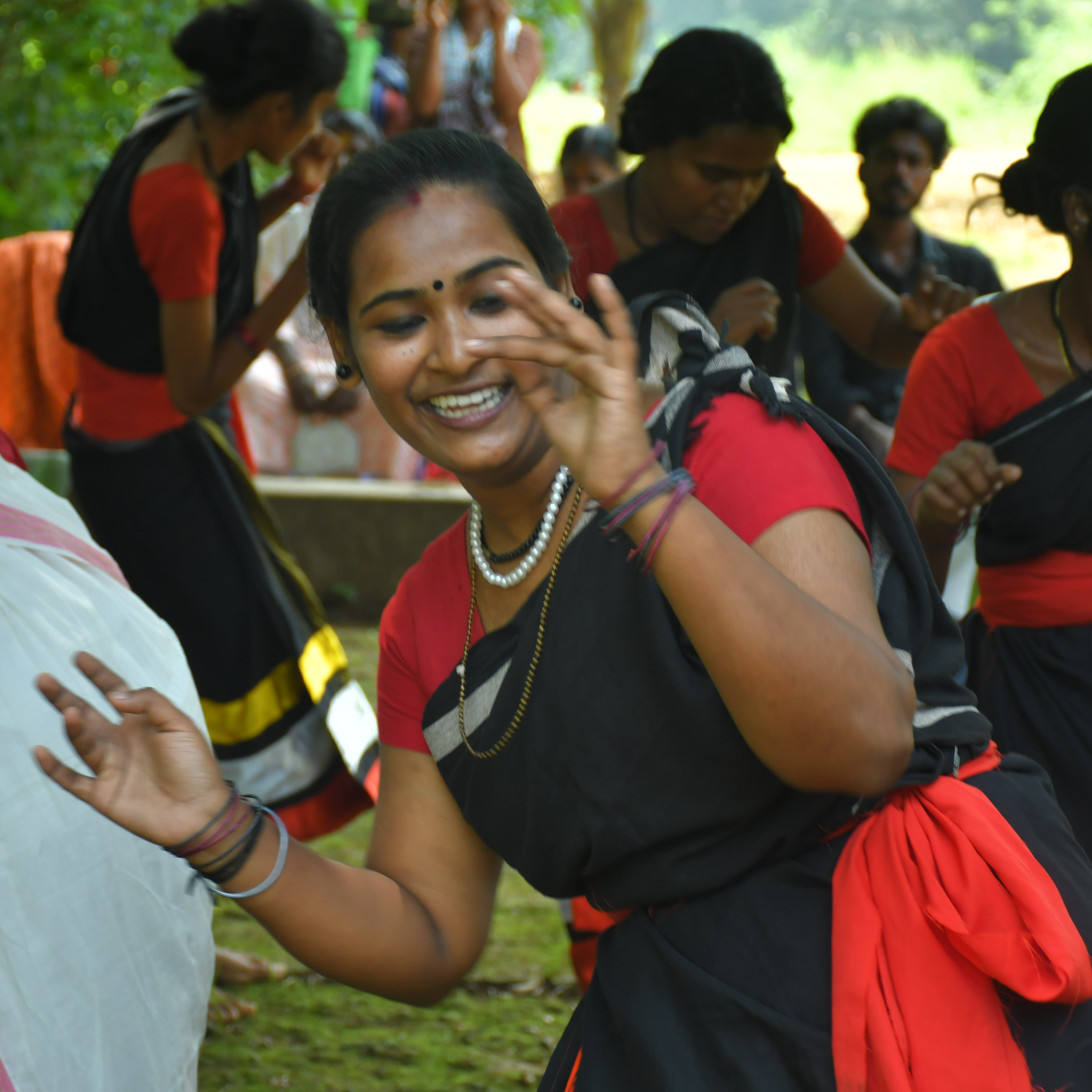
The getups in Mangalamkaali are earthy but very symbolic. Historically, the actors don outfits derived from natural fabrics, such as handloom cotton as a symbology to their proximity to nature. Men wear mundu and a plain shirt; women are normally dressed in saris in earth colours representing the soil and the forests. Jewellery Both men both wear jewellery: the women in simple but symbolic adornments such as necklaces, bangles and anklets made from local materials as well as imported silver. The anklets emphasize the dance, with notes of jingling sound which complements the thudi beats. The costumes are kept as simple– as a celebration of the natural aesthetic and for utility purposes. They are also indicative of the tribe’s history and socio-economic back ground.
Music is Mangalamkaali's lifeblood, and it pulses to the beat of the Thudi, a drum fashioned from jackfruit wood. Perumthudi (big) provides heavy music for fast pace movements and Panathudi (small) gives a light music for slow pace moments. These drums are made by expert craftsmen who hollow out the wood of the jackfruit tree and then stretch animal hide over the frames to create the drum’s sound. The Thudi determines the time of the performers, and helps dancers to keep unity and steps.
Describing ‘Sasthrikali theyyam’ the elaborate costumes and musical instruments used in Mangalamkaali, and one get a reality experience of Mavilan tribal culture, the costume ornament and musical instruments used in it makes the visual media of this art form is so beautiful and rhythm is sounding interesting.
The dance, Mangalamkaali, the most revered of the Mavilan tribe is inextricably connected with all their cultural and religious beliefs. Costumes in a performance are far more than aesthetics, they define who the tribe are, what they stand for and how they have matured. 1. Women's Costume: Women performers wear white or off-white saris with borders in earthy tones of red, green or yellow. The sari is worn in a manner that allows the body to move freely. The blouse is color matched to the rest of the costume, which adds to the costume's brightness.
2. Men’s Attire: Male dancers are dressed in dhoti-like costume knotted firmly at the waist for flexibility of action. The top is shirtless or just the simple shawls providing easy movement while showing-off the dance poses. The way they are dressed reminds us of their close contact with nature and photographic themes.
3. Accessories: Men and women further enhance their attire with beads, seeds or locally produced metal that is fashioned into tribal jewelry. Bangla, pajeb, and necklace are essentials with pajeb being a must for the rhythmic sound of dance. Helmets are rare and are generally just used for ceremonies.
Costumes in Performance Contexts
Costumes for performance may also differ slightly depending on the purpose or context of the performance:
· Marriage Celebrations: While, dancing is the main attraction of the marriage party, the dancers wear dynamic color clothes with rich embroidery.
· Festivals and Public Performances: Performances during cultural festivals and competitions such as Kerala's Kalolsavam would have more modernised looking costumes which are more visually striking to draw larger audience.
Cultural Preservation and Challenges
They are doing everything they can to keep traditional clothing true to its original form. While cultural institutions have programs and training workshops for performers and tribal weavers to help keep alive the traditional ways, it’s just not enough. But, factors like the price of handmade clothes and competition from machine-made alternatives could endanger these traditions.
Mangalamkaali Costumes The costumes of Mangalamkaali, represents the tradition, culture and the flexible nature of Mavilan tribes. Though they have changed with time, they still manifest the dance’s profound attachment to nature and to the life of the community. Combining authenticity with contemporary edge, Mangalamkaali preserves the timeless legacy of Kerala’s tribal culture through her outfits. The preservation of these costumes is therefore of paramount importance if this dazzling and living art form is to be passed on for generations to come.
Characteristics of Costumes and Their Cultural Significance.
The costume of Mangalamkaali has great cultural and symbolic meaning, epitomizing the identity, culture and beliefs of the Mavilan tribe of Kerala. The dresses not only add to the visual appeal of the dance but are also crucial to keep the tribal tradition alive and to associate the art with its roots in history.
Characteristics of Traditional Costumes
Mangalamkaali Performers Costume – Mangalamkaali is the Tribal dance form and its performers’ costume is minimal but colourful, reflecting that they are the children of nature. Men male dhotis, usually a plain white sheet of cotton, unadorned or with a simple border of natural dyes. Women dancers don earthy sarees, reminiscent of the hardwood forests of Kerala where the Mavilan tribe is settled in the forests. It is the perfect garment for the fast, vigorous dance because it not only conveys the dancing skills of the planners, but it is traditional and functional.
Accessories are minimalist, the overall feel is kept to a minimum, focusing on natural materials. Shells, beads and floral adornments are typical of the ensemble, symbolizing the link with the soil and nature. Some patterns on the costumes represent tribal rituals or status as married or non-married, and in this way the culture is interwoven into the dance.
Evolution of Costumes Over Time
The traditional Wuxi costumes remain fundamentally simple, but as a result of the modern day need to satisfy contemporary aesthetic and performance requirements, they have been a little bit altered. Shows performed at cultural festivals or for tourists may be of brighter, gaudy colors and with added decorative elements, such as mirrors or bells, to make them more interesting to touristic audience regardless of their being outsiders. But such alterations must be delicate to preserve the integrity of the dance.
Cultural Significance
The Costumes in Mangalamkaali are like the canvas of Mavilan tribe's socio-cultural expressions. They are a sign of solidarity in that their identical costumes heighten the shared bond of cast members. The fact that natural elements are integrated into the costume design also shows that the tribe respects the environment, a sentiment which appears repeatedly in its songs and dances. These features demonstrate the tribe's sustainability practices and their spiritual relationship with the land.
With such costumes, Mangalamkaali conveys a visual story that reflects the dance’s themes — weddings and myths, community living. The purposeful lack of design also highlights thecomplexity of the footwork, rhythmic stepping and the beat of the Thudi drum ensuring that the dance always remains the centrestage.
The combination of function, tradition, and meaning met in Mangalamkaali dress highlights the crucial role of clothing in maintaining the distinctive cultural heritage of the Mavilan people .
Sounds and Uses of Instruments
Mavilan Mangalamkaali, a folk dance, makes use of the Thudi drum quite significantly. Sound patterns are essential for determining the sequence and emotional tension of the dance as well as the synchronization of the movements of participants with the narrative of the accompanying folk songs.
The two different types of Thudi are: The Panathudi and the Perumthudi, which differ in size and sound. The Panathudi is the smaller and lighter of the two, and when played, the note produced is that of a relatively higher pitch; Perumthudi, when played, sounds in a deeper, lower pitched tone. These differences enable the performance to follow the continuum of rhythm in all of its movements. Generally, Panathudi is incorporated in the dances of Mangalamkaali, and you can see, how fluid and flowing the dance gets, and rhythmic as well .
Thudi’s unique sound is something that comes with the construction of the instrument itself. It is made of jackfruit-wood with the head made of tight-stretched skin and its body the hallowedout section of a drum body. Such precision in this composition means that its talas (rhythm patterns) are very clearly spelled out, drawing listeners into a feeling of being one with nature—a characteristic trait of Mangalamkaali. The rhythmic patterns direct dancers to move in unison, highlighting harmony among male and female performers as they celebrate tribal identity, myths and nature.
What does the drum represent in terms of musical part, and what does that part symbolize?In terms of pure sound, it also symbolizes perenniality and toughness. The Thudi’s rhythms were already transforming culturally with their Mavilan society shifting from a forest-based life to settled agriculture, and were to continue to evolve in sympathy with, and memory of, their native norms.
In contemporary contexts, the Thudi is used not only in the performance of rituals, but also to express tribal identity in re-enacted governmental ritual (cultural festival) and school demonstrations, connecting tradition with current recognition. In this way, its sounds are those which not only choreograph dance but that echo with the spirit of the Mavilan people, telling of the profound intimacy with heritage and environment.
Preservation of Traditional Styles and Methods
Mangalamkaali, a traditional tribal dance form of the Mavilan caste, is the living testimony of the rich cultural heritage of Kerala. Over the years, it has been confronted with the pressures of modernization, urbanization, migration, and the waning interest of the younger generation. There are, however, several projects to save and rejuvenate this art.
- Documentation Efforts: The nuances of Mangalamkaali are being regularly documented by bodies such as the Kerala Folklore Academy and cultural studies researchers. This includes filming performances, interviewing senior artists, as well as recording traditional songs and dance sequences for preservation and the benefit of future generations.
- Community-Led Preservation: The people of the Mavilan tribe are leading voices in helping preserve their heritage. Mangalamkaali is performed in various local festivals and community gatherings, where it plays a crucial role in its societal context.
- Government and Institutional Support: The Kerala government, and various cultural organizations sponsor, support and arrange tribal and folk art performances. Mangalamkaali is danced in state-sponsored programs as a result the dance and the arts as a whole receive more exposure.
- Education and Awareness: Mangalamkaali is gradually being included in awareness programmes. Workshops and seminars for students provide an insight into and appreciation for this tribal dance. Performers are regularly invited to schools in Kannur and Kasaragod.
- Integration into Tourism: Mangalamkaali is projected as a special tourist attraction of Tourism departments. This helps the dance not only by way of promotion, but also by supporting these dancers financially and so motivating them to continue.
- Digital Preservation: In the digital world, performances are being captured and circulated online. In this way the dance form itself is reaching a global audience, as well as a digital archive that future researchers can continue to analyze.
These sustained efforts will help protect Mangalamkaali, allowing it to reinvent itself with the times and thrive with the legacy that the community shall inherit.
Role in Education and Influence of Media
The traditional dance Mangalamkaali of Mavilan the tribal sect of Kerala, has passed through different stages of metamorphosis and has achieved a place in modern educational systems and communication media. This section, therefore, examines how the platforms make their contribution to the existence and propagation of HDB but it also puts special emphasis on the music-centred nature of radio and its social, educational and engagement roles.
Role of Education in Promoting Mangalamkaali
Schools in India's south coast contribute to the survival of Mangalamkaali through their curricula and activities. Schools and colleges in Kerala, especially those which teaches Performing Arts, have included Mangalamkaali in their syllabi as part of cultural studies.
- Workshops and Training: Youths generally get introduced to Mangalamkaali through hands-on workshops where they get to know her rhythmic foot movements, symbolic hand gestures and association with tribal life. They also emphasise its thematic connection to nature and spirituality.
- Interdisciplinary Learning: Mangalamkaali is the crosscutting between history, art, and social studies with the cultural lead to tribal culture and Dravidian legacy. It allows students to study Indian culture comprehensively.
- Collaborative Learning : Collaborative programs between Cultural organizations collaborates with institutions of education in an exchange of ideas for authentic representations of Mangalamkaali and re-interpreting it creatively.
- Competitions and Festivals : inter-college festivals regularly feature Mangalamkaali as an integral event awarding opportunities for both students to perform and compete and also to gain experience. Therein not only are the public educated, but the performers are made conscious of, and are also stimulated in their confidence and skill.
Media’s Influence on Mangalamkaali
Thanks to the modern media, Mangalamkaali has now reached out to many more people than earlier. Television, the Internet and documentaries have allowed this traditional art form to travel across space and cultures.
- Television and Documentaries: Television channels in Kerala regularly telecast documentary and cultural programmes on Mangalamkaali. These platforms don’t just teach the viewer but feature the nuances, artistry and community behind it that keeps it all going.
- Digital Platforms: Mangalamkaali can reach worldwide audience through the social online and video streaming sites such as YouTube. There are also short videos of performances, traditional dress and the making of instruments such as the Thudi drum, drawing views from around the world.
- Promotions Campaigns: Mangalamkali has been used as a symbol of Kerela’s rich cultural legacy as a significant character in the promotion, government and non-governmental, for the tourism of the state. Increasingly advanced visuals and social media campaigns continue to add to its notoriety .
- Hybrid Forms: With the reach of media getting explored dance has formed into a hybrid, infusing the traditional Mangalamkaali thandads into a genre relevant to the new-age masses. Some purists wouldn't aprove but this is a way to keep the art living.
Challenges and Opportunities
However, there are challenges before Mangalamkaali today in the event of waning community participation and the tendency of commercialisation driving at its cultural core. Yet more education integration and responsible media depictions might also help.
Education and media would also create such a strong platform for the stillbirth and posterity of Mangalamkaali. Through these avenues, the dance doesn’t just live on, it flourishes, evolving to new contexts but preserving its cultural heart.
Incorporation of Modern Elements in Dance
Fusing the modernity with the tradtional dance forms like Mangalamkaali has been an integral part of the preservation of art. Though rooted in indigenous tribal cultures, performances of Mangalamkaali are deeply connected with nature, legend, and the life of the Mavilan community, currents of change begin to stir the ancient art form.
The themes of the present and the future are usually presented as second version nation. Or fusions between traditional and modern music. Musicians are attempting to merge folk instruments such as the Thudi with electronic beats or other percussion instruments. This not only appeals to newer generations, but also brings the Dance of the Sugar Plum from over a century ago into the 21st century. The dance has also been modified to include modern clothes and style but keeping all its essence.
Modernisation is also seen in the choreography of Mangalamkaali. Common steps such as these are now typically danced solo or in small groups rather than for the whole community in a more ritual fashion, making it more practical to highlight in venues apart from the tribal ceremonies. Some performances also consider contemporary social themes--like environmentalism, identity or even urbanisation. This fusing of current events keeps the dance form connected to present social concerns yet unquestionably maintains its ancient cultural past. Also, with the advent of mediums like the media and world access to technology, Mangalamkaali has flourished to become a more well-known art form. Videos, workshops, and streamed performances on social media have allowed this dance to travel to the world at large, bringing much-needed attention along with a stage for reinvention and invention.
Conclusion
Conclusion Mangalamkaali is a very archaic dance form which has a bearing upon the ancient tradition of the Mavilan tribe of Kerala. "It's not an artificial culture," explains de Kruiff, "it emerged there, in the midst of those mountains, for thousands of years. Kerala’s tribal folk-art form, it is a portrayal of the spirit of their culture.It provides an insight into the reverence of the natural world, which regulates their lives. The characteristic steps of the dance, the Thudi drum and the interwoven nature of the song and dance form the main elements, which constitute Mangalamkaali for hundreds of years. But just like most traditional art, the Mangalamkaali has needed to adapt to keep up in the digital age. The efforts in education, media exposure and addition of contemporary has made it live outside its tribal niches, capturing new audiences. The dance is depicted as a cultural icon in the rich unfathomable cultural history of Kerala much to have great photo fun and joy. At the same time mix of such new elements – like modern music, dance, social and etc., doesn't let the art to fade away and die and is interesting to younger restricts of the society.
It is apparent that the future of Mangalamkaali as long as it maintains its roots firmly in tradition, also lies in how it is able to transfigure itself and connect to its cultural context. With persistent education, media representation, and fresh, thoughtful performances, Mangalamkaali has the potential to not just survive, but to thrive in an ever-changing world. Its future, strategically perched between conservation and transformation, will maintain its appeal to varied audiences around the globe .