

Meena Painting
Dive into the colorful world of Meena painting, the ancient tribal art of the Meena community of Rajasthan. The course covers the historical origin, the distinctive methods, the organic substances and the change of styles in this complicated art. You will discover how the Meena community strives to keep alive its ancient civilization even as it resists the trappings of the current era. Learn about conservation attempts, the importance of symbolism, and projects to succeed in reviving this tribal custom in a modern setting.
 Most Viewed

What you'll learn
- Cultural Origins : Learn about the history and heritage of the Meena tribe and its art.
- Symbolism and Meaning : Grasp the significance of the patterns, motifs, and colours in Meena painting.
- Materials and Tools : Discover the traditional resources used for making Meena art.
- Artistic Techniques : How to Heat and Cool your home naturally explore each detail of the painting and the unusual painting technique used.
- Style and Aesthetics : Describe important visual elements and regional types of Meena painting.
- External Influences : Explore the effects of modernization and cross-cultural exchange on the art.
- Conservation and Promotion : Learn about present strategies meant to conserve Meena painting and the ways in which it is being re-launched into modern contexts.
Couse Features:
- Rich Visual Content : Includes pictures, demos, and visuals for visual way to get a grasp!
- Expert Insights : Contributions and interviews with working artists and cultural professionals.
- Hands-On Activities : Work on guided activities and creative challenges to get the hang of the skills.
- Cultural Context : Explore insights into tribal life and its impact on dance form.
- Interactive Forums : Participate in conversations and get in contact with people from your neighbourhood and around the globe.
- Curated Learning Resources : Find links to readings, references, and templates to help you on your learning path.
- Flexible Learning : Flexible self-pacing to fit your schedule and learning style.
Who Should Enroll
- Art and design majors interested in indigenous art.
- Tribal lore fans folk-inspired art types OF folks for those who like a tribal touch
- Anthropologists and cultural studies scholars
- Those who want to broaden their stylistic horizons
- Museum and heritage practioners
- Visual or cultural arts teachers
- Anyone who has a deep love to preservation of Indian art Keeping tradition of Indian Arts.
Description
Introduction to Meena Painting
Meena Painting is a art practiced by Meena community of Rajasthan, India. It is one of the oldest forms of folk painting in the region which have its roots in some great cultural instincts and mythological aspirations. This is broadly classified into two categories as Mandana Art (painting on floor and walls) and Bhitti Chitra (murals and frescoes).Traditionally, Meena art was used in festivals, religious occasions, and special festivities, for wall and floor paintings that were made of geometric patterns, floral and bird motifs, to be seen before gods and guests in his house. Paintings are conventionally produced with natural ingredients: red ochre (geru), white chalk, rice paste, charcoal, which are eco-friendly and can be easily rejuvenated as well.The artwork is symmetrical, highly detailed and utilizes minimal color, but is meant to be a bold statement with powerful symbolism. With time, Meena Painting has come out of its ritualistic and domestic base to find a place on the contemporary surface like canvas, textile, terracotta or other handicrafts and has been acknowledged on both national and international levels.
Geographical Context and Origin
“In Rajasthan, we have a history of rich cultural heritage and artistic diversity that has been enriched by the myriad traditions of its tribal people over millennia. Of these, Meena Painting by the Meena tribe is an important and ancient style of art.Heritage Meena Painting has roots that are attributed to the Meena tribe, one of the very old and powerful indigenous community of Rajasthan. The Meena community residing in the syawa madhopur, tonk, bundi and kota and dausa districts are engaged in this traditional form of art, which has passed on from one generation to another. First, Meena Painting functioned not simply as an aesthetically pleasing activity but as a mode of religious belief, cultural tradition, and social value. The biggest patterns were geometric patterns, but they also included flora, fauna and sacred signs with spiritual meanings. These paintings eventually became a part and parcel of Meena homes, especially in those of the women, who have been the torchbearers of this tradition.One of the most amazing features of Meena Paintings is the connection it shares with the village houses and religious places. It is a common practice among Indian women to draw elaborate patterns in the form of a rangoli on the floors and the courtyards of houses as part of the ritual religious functions; this is in addition to day-to-day adornment. It was also used to decorate walls of temples, meeting places and granaries, indicating protection and wealth. Mud, cow dung, and natural white chalk mixture provided them with a subsistence surface, making them permanent and environmentally friendly for future.Therefore, Meena Painting is more than an art – it is India’s great living tradition carried out by the Meena tribe whose cultural identity is being projected by this flourishing art form.
Historical Background and Cultural Significance
The Meena tribe which is among the oldest denizens of Rajasthan, for centuries, has perfected this art from one generation to another and has preserved its organic and profound relations with nature, spirituality and social habits. Initially, Meena paintings were done on the walls and floors of the houses, for adornment and worship. The simplicity is appropriate for the natural materiality of the white chalk, red ochre, and charcoal used, which also makes it an environmentally friendly object.
Symbolism and Spiritual Significance
Meena Painting is not a mere aesthetic practice, rather it is a symbolic and spiritual act. The representations in this sort of art have significance and are relevant to festivals, rituals or the common day to day life of the people of India. For example, flowers, peacocks and shapes and symbols (like the lotus or the figure of eight) represent wealth, fertility and protection. The women of the Meena tribe paint Mandana at festivals such as Diwali, Holi and Gangaur, and believe that these elaborate designs bring good luck and good spirits into the home. Moreover, the placement of temple walls and ritual spaces with painted scenes is an act of worship to the deities, and in this way the spiritual nature of this art is continued.
Symbolic Meanings & Cultural Significance
You have Meena Painting which has its base and roots entwined in rituals, spirituality and cultural heritage aspects of various lores and beliefs with motifs having a deep layered meanings attached to it. The peacock is generally described in a conventional standing stance to symbolize beautiful, elegant and blooming, while the elephant and horse are portrayed to represent forceful power. Floral designs such as lotus flowers and creepers represent purity and good fortune. Such paintings are a common feature in many households, and are done specifically during festivals, marriages and religious ceremonies where the drawing serve as tokens of good-luck and prosperity as well as protect from evil-forces. The very act of painting is ritualized, passed down from one generation of women to another, for whom it serves as a devotional and meditative outlet. Some designs, e.g. the Lakshmi footprints, are considered to welcome in divine beings. The transitory Mandana art, redo anew every time the festival or occasion comes up, is a perfect urban context pretext for the cyclic life principle of tribal belief, its cohesion of spiritual and cultural essence.
The Role of Women in Preserving Meena Painting
Women have been instrumental in transmitting and transforming the Meena Painting, and specifically in its elaborate manifestations such as Mandana and Bhitti Chitra. Keeping this heritage alive is a very rich artistic community, where skills are passed between generations of tribes-women, using age-old techniques to create the art they have learned from their mothers and grandmothers. Not being formally taught in art institutions, Meena Painting is a skill that is handed down informally from mother to her daughter, thus a girl will grow up watching her sisters and other female relatives painting the walls and floors.The representation of animals, birds, flowers and designs in Meena Painting is not naturalistic, but is based on a symbolic language, modified for decorative and spiritual purposes. This process of form transformation (Rupantaran) testifies the creative genius of these women wherein each artwork is a visual testimony of their creative eruption.Perhaps one of the most striking characteristics of Meena Painting is its flexibility. It may be steeped in tradition, but it has changed with the times. Though early murals were largely monochromatic and painted with natural pigments made from materials like clay, lime and charcoal, contemporary versions Favor the use of synthetic paints and brushes that can create lasting works in brilliant, eye-catching color. Yet, the medium always stayed the same, with the women passing on the symbolic motifs and traditional techniques of Meena painting.The women’s role in ritualistic and decorative art is not inconsiderable.One of the most remarkable contributions of these women artists was the painting of the 'usual standing posture of a peacock. Likewise, if their habits of drawing things took the form of elephants, horses, tigers, wolves, and dogs, for instance, two of the feet of these animals would be omitted; to this kind of shape the same would be applicable accordingly to the existing rules of art.Their good aesthetic sense and craftsmanship has helped in the development of Meena painting as a recognized art, which is cherished beyond the rural areas. Today, the attempt to conserve and popularize this tradition is led by the state through exhibitions and workshops, where the tribal women are honoured as artists. Some have even found themselves the recipients of invitations to exhibit in urban markets and international forums, thereby opening up the possibility of an economic gain to the aforementioned cultural vitality.And there, in the end, the Meena women are not only artists but custodians of culture, and they keep their tradition alive by their inborn creativity, storytelling and technical skills. While the efforts to document, encourage, and celebrate Meena Painting continue, it is also important to acknowledge, and to celebrate, the hands and hearts of the women who are sustaining and growing this art form today.
Variations Across Different Regions
While Meena Painting is known as a traditional art form from Rajasthan and Madhya Pradesh, it experiences regional differences because of differences in customs, surroundings, and materials. In regions such as Shekhawati and Hadoti in Rajasthan, the patterns are larger, bolder and white lime colour-red or white line colour-ochre tinted base is used.In Madhya Pradesh, notably in the Malwa and Nimad regions, a wider range may be employed, including blacks, yellows and greens. In some villages in these areas, distinctive motifs have been evolved for the Mandana paintings, and these features can be easily identified. Designs are also simple with some communities, but others utilise complex floral and animal forms intertwined together. It can also evolve in terms of content, as local beliefs and histories can be unattractive or uninteresting to outside attendees. Others focus on protective motifs such as scorpions and snakes, which are thought to drive away evil spirits.At the same time, animals such as tigers, deer, peacocks tend to populate the mural paintings in regions close to forests. The classical ones are still quite popular in the countryside, whereas, in urban migration and the reach of commercialization, stylistic variations along with modernization have led to contemporary styles where the painter works on adapting regional styles according to the requirement of the market, thereby mixing more than one style in one painting also.
Comparative Study with Other Tribal Arts
Meena Painting is comparable to other Indian Tribal Arts though, in it’s mode of application and end use, it is different. For example, Warli Painting (Maharashtra) has geometric forms and monochrome color scheme but is more figurative representing human activities, hunting scenes, and life style compared to Meena art,which is more decorative and symbolic.Also elaborate in pattern are Gond Painting (Madhya Pradesh, Chhattisgarh), but the compositions are more narrative based, depicting mythological stories / folk tales. Pithora Painting (Gujarat, MP): Bhekasin (V.P.C.H.'s term for fourteen/horse) - this type of paintings are executed by Bhil and Rathwa tribes and are also ritualistic like Mandana, but with elaborate depictions of horse and themes. Sohrai and Khovar paintings (Jharkhand), made during marriage and harvest seasons and using natural earth pigments and strong black-and-white contrasts, share a visual language with Mandana.The most characteristic feature of Meena Painting is its free hand composition, frequently made without any fore sketch, which lends this art free flow, which is unstructured and more natural. "Meena Painting" is still a matter of painting done within a community, which is the power and charm of these Arts while most other tribal Art making has turned fairly commercial.Previous studies We obtained information about the sources, cultural significance, and historical backdrop of Meena Painting from the Meena tribe themselves. Let us read more about the Meena tribe, types of Meena Painting, popular motifs and well-known artists in the following module.
Meena Tribe, Artistic Practices, and Influences
History The Meena Community of Rajasthan is considered the ancient tribe of India with a rich culture and history. Mandana Art Mandana art is a complex motif art, usually drawn by the women on walls and floors around the region, and designs are based on their special ideas of shapes and pictures date back to the era of Neolithic age, and are a reflection of the material, intellectual and artistic base of the village community life Photo Credit: Dr. Parmpal Singh Photo Credit: Siddhartha Joshi mandana is a geometric and natural motif, which traditionally served as a sign, expressing prayer for prosperity, protection, and safe haven in the religious imagery of the village community. Bhitti Chitra, however, is a more detailed wall painting technique used to portray animals, gods, goddesses and epic scenes using natural substances like red clay, white chalk and cow dung.Nature, folklore and spiritual inspiration become the inspiration of the Meena tribe in their artistic production. Cosmic symbols, animals, and mymarid images of their daily life was depicted in these paintings with a note on the harmony with nature.“The Meena art gets exposure in urban decor, textiles and social media, making sure it has a future and is also relevant.” While it has seen its popularity wax and wane, it still stands as an enduring symbol of the Meena tribe’s tenacity and creativity.
Meena Tribe
The Meena is one of the largest and well-known tribal groups in Rajasthan, India. With claims to be one of the primeval dwellers, the Culture of the Meenas is as nearly as old as any of the existing cultures found around in Rajasthan. The word "Meena" is derived from the Sanskrit "Meen", which means a fish, and legend says that they are the descendants of the Matsya Kingdom, an important part in Indian Mythology. Historically, they were soldiers and rulers until Rajput’s took over during the medieval period. The Meena community is now largely found in Rajasthan, Madhya Pradesh and some parts of Uttar Pradesh.The Meenas have also carried forward their traditional practices in music, dance, festivals and arts. Their folk-art Meena painting, which is a practice of their culture, is characterized by intricate geometric patterns and portrayal of nature, gods, and scenes from their daily life.
Cultural Identity of the Meena Tribe
The Meena community has their own unique culture habits and traditions. They participate in festivals such as Gangaur, Teej, and Diwali with fervor The Gulab have an extensive oral history as well; storytelling has historically been the way historical narratives and traditions have been handed down.Their religious belief is heavily integrated with nature, worshipping local deities, ancestors and spirits. The Meenas adhere to animistic practices, including the preservation of sacred groves and natural places of worship.
Socio-Economic Aspects of the Meena Community
The Meenas were originally farmers, growing wheat, barley and pulses. They farmed sustainably and settled among strong communities in which land ownership was central. Many of them moved on to government jobs, business, education, taking advantage of their Scheduled Tribe (ST) status in India which allows for quotas in education and jobs.Many Meena villages are still based on traditional occupations such as cattle rearing, handcrafts and pottery even in these times of economic affluence. Women participate in management of household, farming and folk art, the most visible being Mandana Art on walls and floors during festivals.Urbanisation and modernisation have had an effect on the Meena. Younger legacies are transitioning to towns and cities for education and jobs, a process that also see a change in lifestyle. Government programmes and cultural festivals provide a much-needed boost in the form of preservation of their traditional legacies.And thus, the Meena tribe in Rajasthan continues to be an integral part of its cultural landscape, embracing their traditions while developing in a modern world.
Forms of Meena Painting
Meena Painting is regarded as one of the finest examples of Indian tribal art work and it is deeply influenced by the culture and traditions followed by the Meena Tribe of Rajasthan. It is divided in two main forms- Mandana Art and Bhitti Chitra where both have cultural, aesthetic and spiritual meaning. Mandana and Phad painting These art forms are not only part of their decorative skills but it is also a projection of the deep ties Meena community have with nature, mythology and ancestral history.
Mandana Art – Traditional Wall and Floor Painting
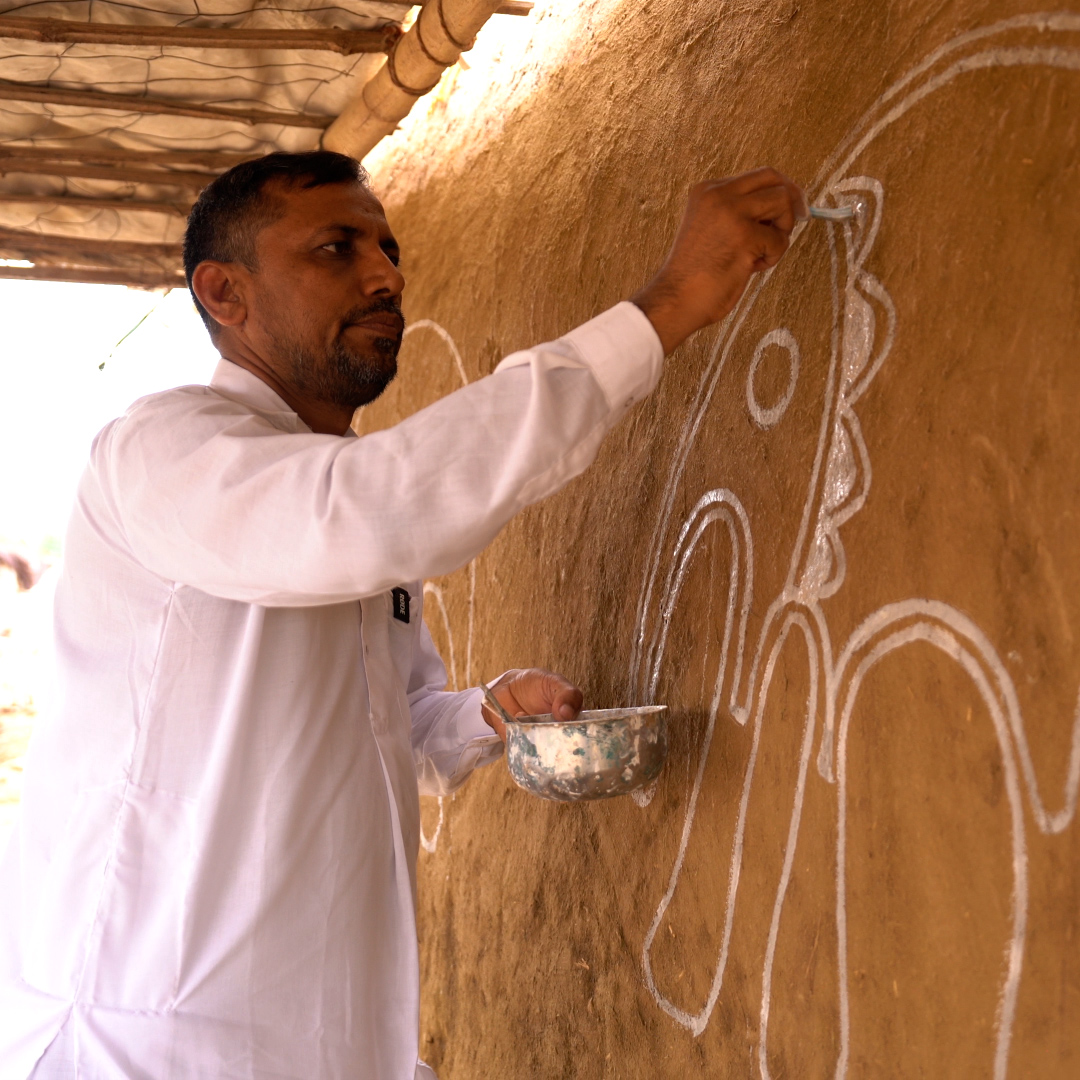
The ancient and the very significant of the traditional wall and floor painting in Rajasthan and Madhya Pradesh is Mandana art which is a part of tribal folk culture. It is mainly done by the women of Meena community and this art is believed to be very sacred and as such it is transferred from generations to generations to maintain the cultural identity and traditional legacy.The paintings, also known as Mandana paintings, are made on walls and floors using a paste of lime or chalk and red clay (geru). The painted white decorations over a brownish-red background are very bold and striking. They typically have geometrical patterns, peacocks, elephants and flowers, as well as religious symbols whose intention is to bring prosperity, extend wellbeing and repel evil spirits from the home.Process of painting Mandna is considered to be a kind of a devotion for spiritual protection or getting blessings from the Gods.However, attempts are being made to save Mandana Art from extinction in the era of modernization through various exhibitions, workshops and introduction into various modern art forms, ensuring that the art lives on, inspiring the future generations.
Techniques and Materials
- The base is made from a mix of clay, cow dung, and water, offering a rugged, natural surface for pigments.
- The motifs are sketched with lime or white chalk powder which forms a beautiful contrast colour on the red or brown floor.
- Faculty Twigs, fingers, or cotton buds are the instruments of choice for detail work.
Themes and Motifs
Geometric and symmetric designs, floral designs and animal forms are the typical subjects of Mandana paintings. Among the most frequently featured:
- The Lotus and Peacocks – Representing purity and beauty.
- Elephants and Horses – Symbolize power, wealth and imperial lineage.
- Kalash (Sacred Pot) and Swastika – Traditional symbols that bring good luck and are considered holy.
- Geometric Grids and Lines – Representing equilibrium and cosmic order.
Mandana Art is used as a painting for religious as well as housing purposes to keep the dwelling place pious and the environment graphical.
Bhitti Chitra – Murals and Decorative Art
Bhitti Chitra: The elaborate mural paintings of the Meena Painting form found on the inner and outer walls of houses, temples and community structures. This art is a double head economic ornament and a tool to tell cultural stories, which narrates stories led in folklore, myths and tribal daily life. While Mandana Art is white motifs and patterns painted on red or ochre colored background, Bhitti also uses several colors, elaborate patterns and motifs, and superimposed images, and is more colourful and expressive.The murals are made with natural, non-toxic paints made of clay, chalk, linseed oil and natural earth or mineral pigments, so they are naturally organic and environmentally friendly. The surfaces are initially painted with a concoction of mud and cow dung, to render a textured and rugged underlay for the images. And the artists mostly women of the Meena community make these using fingers, bamboo sticks and locally made brushes to paint intricate patterns, figures and symbolic motifs. These works often feature the popular motifs of deities, peacocks, elephants and flowers, all having a significant spiritual and cultural symbolism.As the traditional arts continue to be practiced with the same dedication today, there is also an increasing trend toward the addition of synthetic colors and new themes, which blends tradition with contemporary expressions of art. Today, Bhitti Chitra is a living tradition determined to uphold the culture and creative innovation, Meena identity and prevent extinction of this community.
Techniques and Materials
- The plinth wall is plastered with mud/clay/cow dung to create an even surface.
- They are hand-coloured with natural pigments from mineral, stone and organic sources.
- Plant fibers clothe brushes, and handmade tools help put detail on the artwork.
Themes and Motifs
Bhitti Chitra deals with various subjects such as:
- Mythological Narratives – Tales from Ramayana, Mahabharata and local folklores.
- Patterns Inspired by Nature – Trees, rivers, sun and birds, to reveal a sense of friendliness with the environment.
- Daily Life Scenes– Farm life, raising cattle and village life depicted artistically.
- Religious and Spiritual Symbols – Idols of gods and goddesses, heavenly bodies, temple motifs for puja rooms.
Bhitti Chitra Bhitti Chitra has developed with time registering change in colors, designs and materials to meet modern urban decor, commercial art and conservation needs of heritage.
Significance of Mandana Art and Bhitti Chitra
Bhitti Chitra and Mandana Art are also living traditions even to this day in Meena community which connects the present and the past. Mandana Art is a traditional community art form and is executed by the rural community and handed down through generations where as Bhitti Chitra is modifying to the trends in contemporary art practices, commercial usage and heritage preservation.Even as times change, these art forms still keep the identity of the Meena tribe alive, reflecting their artistic brilliance and cultural depth.
Themes and Motifs
Meena Painting is a famous Indian Traditional Painting, purely the heritage art of Rajasthan, India, the state having the most artistic culture and artistic past Meena paintings are made by Meenas of Rajasthan, a tribe famous for their art and crafts. These patterns are not just decorative but contain profound cultural, spiritual and symbolic significance, embodying the community’s beliefs and traditions.
Geometric Patterns
Geometry is one of the most characteristic elements of Meena Painting and serves to organise and balance the pictorial space. Circles, triangles, squares and diamond shapes - many times symmetrically arranged patterns. They represent balance, stability and continuity in life.
Floral Designs
Meena Painting can’t be complete with the flowers’ patterns. Artists represent lotuses, marigolds, creepers and stylised leaves to symbolise nature, bounty and beauty. These flower motifs don't only have a decorative function, they also symbolize fertility and regeneration. Fine designs of flowers and creeping vines reflect the richness and splendor of the Meena tradition.
Mythological Symbols
The influence of religious and mythological themes on the Meena painting. Iconography such as peacock, elephant, cow and gods Krishna and Durga are also prevalent in traditional compositions. These designs have religious undertones and tell tales of the Indian epics. Peacocks represent grace and divinity and elephants represent power and intelligence.
Connection to Nature, Spirituality, and Folk Traditions
Meena community is deeply connected to the Nature and the spiritual beliefs-faith, which is quite visible in their painting. The subject matter frequently deals with the seasonal changes, the cycle of crop planting and harvesting, and the festival. Some folkways are represented in scenes of village life and customary dress and behavior. A bridge between historic heritage and contemporary interpretation, the paintings keep cultural identity alive through visual narration.
Famous Artists and Practitioners
Artists and craft makers have also helped in preserving and promoting widespread tribal art phenomena such as Meena paintings in the deserts of Rajasthan. Their efforts had saved the tradition and modified it to suit the modern world.
Ramdev Meena
Leading light of Meena art whose name is indelibly associated, academically and culturally with the face of it. Presently, he is serving as Assistant Professor (Drawing and Painting) at Government College, Bundi (Rajasthan). Through his research, teaching, and ongoing involvement in old aesthetics, he is actively participating in the documenting and dissemination of the Meena painting tradition at regional and national levels. Ramdev Meena is one of the leading proponents of Meena art, who has contributed towards its academic and cultural aspects. He is currently serving as Assistant Professor (Drawing and Painting) at Government College, Bundi, Rajasthan. He signifies the documentation and popularization of Meena painting tradition on regional and national levels through his research, teaching, and regular exposure to conventional aesthetics. His painting depicting the life of a Meena Tribal community of length 120 feet long has showcased at Rajpath on the occasion of Republic Day celebration 2022 and in TRI Bhubaneshwar, TRI Ranchi, TRI Udaipur, Shilp Gram Udaipur, CRT New Delhi, Ravindra Bhavan New Delhi, Manav Sangrahalaya Bhopal, etc.
Sunita: Innovating Meena Painting for Modern Audiences
Professional illustrator Sunita has contributed greatly to the popularization of Meena Painting among the kids and youth. In her books, and also in her artwork, she has offered the Meena motifs and designs in an innocent yet genuine way. Her work has white geometric shapes, elaborate patterns and dots common to traditional Mandana art. By working with publishers such as Tara Books, Sunita has given Meena Painting the exposure it needed outside of Rajasthan, and also to the world.
Local Artisans: The Keepers of Tradition
Each competition or presentation by famous artists in the field of promotion and research programs is somewhere quietly cheering on by the local artists and craftsmen Meena community. They still make traditional Mandana and Bhitti Chitra (wall murals) on homes, temples and other public places, during festivals and ceremonies. They’re also getting experimental in new mediums, including canvas and fabric, for fresh views of traditional styles. They are keys in preserving Meena Painting for posterity.Together falling at the connective arc of traditional and contemporary, these artists and artisans are all part to the ongoing work of reclaiming, evolving and pushing outward Meena painting’s global relevance.We read about the Meena tribe, and its artistic heritage, various Meena Painting techniques, important figures and accomplished artists. In the following unit, we will investigate techniques, materials and styles of Meena Painting- both traditional and contemporary.
Techniques, Materials, and Styles in Meena Painting
To begin with the surface has to be prepared, and this is created with cow dung mixed with mud that makes it strong and even. Firstly, the sketch is delineated in finger, stick, or fine brush, soon filled with lively colors. Such patterns are painstakingly drawn filling from within the colorful sections. Shading and detail are used for more realistic effects. VectorMeena Painters are nature lovers and therefore they use natural colors in their paintings. White is produced from lime, red from brick dust, and black from charcoal or soot. Brushes are handmade with bamboo sticks and cotton.Meena Painting is characterized by symmetry and repeating patterns, with designs largely taken from nature, and depicts folklore and religious traditions. Even though the traditional forms of Patta Chitra are mono-chromatic, modern versions Patta Chitra are now done with artificial and paper and canvas to keep the art alive in recent times.
Preparing the Surface
Surface Preparation: painting is the surface preparation step, which establish the basis for the permanency of painting. The conventional Meenakari artists are known as Kundhan Meenas they use handmade colours in the Meenakari paintings to make it look very natural. The surface must be correctly cleaned, treated and prepared prior to painting.
Cleaning and Treating Walls or Floors
Cleaning is the original and arguably most important surface preparation step. It enjoys grease, dust and uneven surfaces on the material you paint. Commonly, the surface (wall or ground) such as limed or mud wall or floor is always cleaned (by sweeping and washing with water or slap of wet cloth) to ensure a dust free substrate, like dust left over the surface create problem during the chunna application. This removes impurities and allows for an even textured surface for further treatment
Basic Techniques
Meena Painting Meena Painting, adopted from the traditional art of the tribal community of Rajasthan, is characterized by intricate designs, bright hues and historical value. The craft, which is mainly practiced by the women belonging to the Meena community, has been inherited and refined from the time of their ancestors. Of these, natural brush or finger sketching, layering, and pattern filling are basic operations during creative work. It outlines the stylistic character of Meena paintings made on walls, floors, and any expanse.
Outlining with Natural Brushes or Fingers
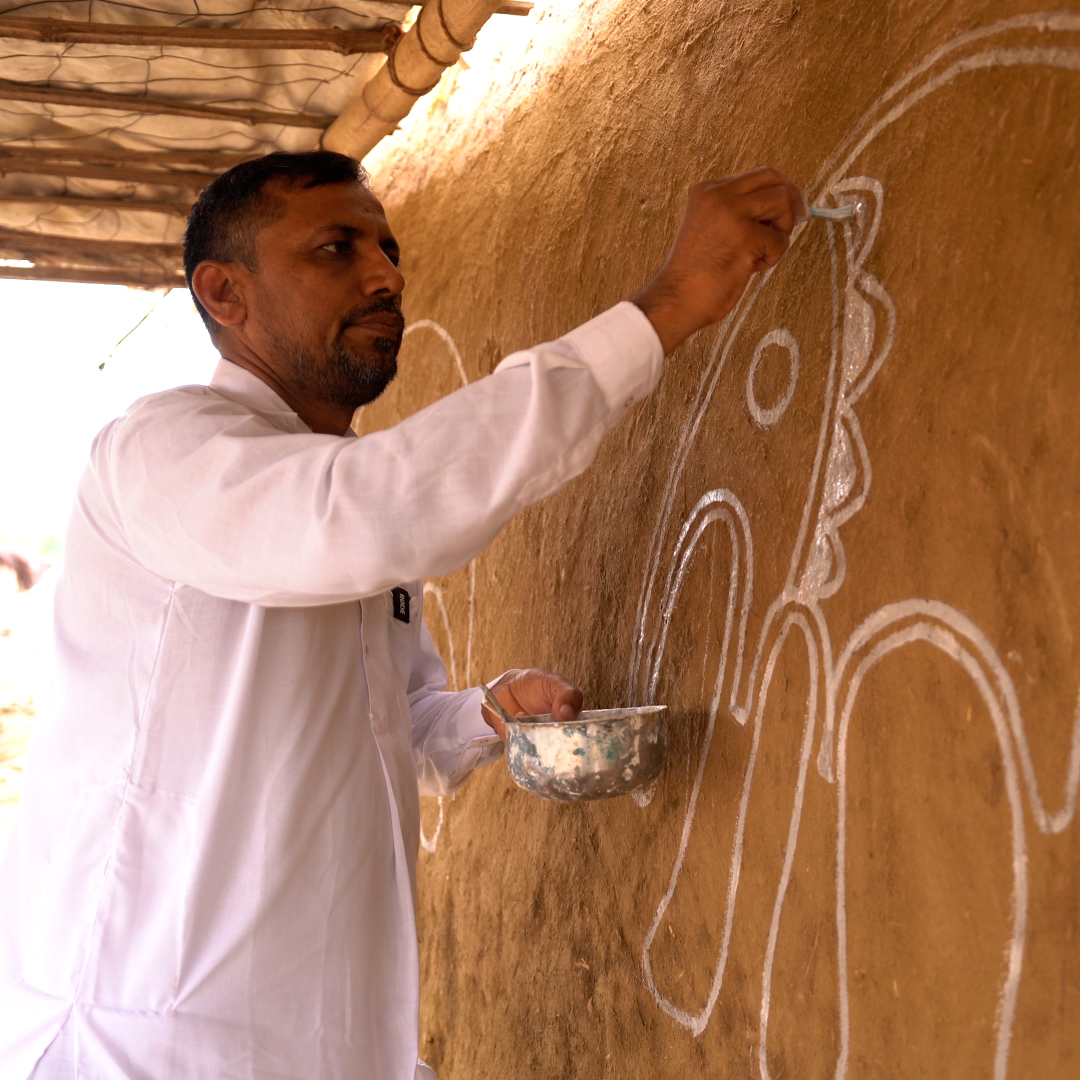
Sketching is the first and the key part of Meena Painting. It provides a skeletal structure for the design and the artist fills the patterns and motifs. The artists don’t typically use commercially manufactured brushes but make use of natural tools, such as twigs, crude brushes made of plant fiber, cotton cloth, or at times even their own fingers to draw outlines.
Process of Outlining
Preparing the Surface:
The surface (wall, paper or wood) is then washed or rubbed clean before the painting is commenced, and sometimes a thin layer of mud or cow dung is spread over the surface to prepare a smooth absorbent background. This third step is very important for bond and longevity.
Creating the Basic Sketch:
- They start with a faint outline, in white chalk, of quicklime or thin mud. They are drawn by hand for a free flowing, natural looking design paying attention to details and space.
- There are very common drawings such as peacocks, flowers, geometry, and religious symbols that have strong cultural and spiritual importance.
Outlining with Fingers:
- Some artists apply bold lines and curving forms with their fingers so that the work has an organic and primitive look.
- This form is especially popular in mandana designs, wherein white paste is applied on walls and the ground.
Use of Brushes Made from Natural Fibers:
- For the finer work, brushes of twigs or hair are employed to draw delicate contours.
- This ensures that the art is authentic and blended back to nature, which is the very essence of the tribal background.
The Process of Layering and Filling Patterns
Once the tracing is done, layering the paint and fill patterns are used to add depth, dimension and color to the painting.
Step-by-Step Process of Layering
- Applying the Base Layer:
- The background is the base color to establish the tone for the design. Commonly, the ground is a natural mud-and-cow dung mix for wall paintings, and earth colour or one dominant colour for clothes or backgrounds on paper and cloth.
- Building Multiple Layers:
- Colors must have time to dry before the next layer can be applied. This helps to make colors more vibrant and long-lasting.
- Deeper tones are generally applied first, and then lighter ones, to develop the illusion of depth and dimension.
- Adding Decorative Details:
- The art work is enriched with detailed dots, curls and little ornaments worked over the base layers to develop sophistication and elegance to the piece.
- Gold or silver ornaments are also sometimes added for a more luxurious look.
Filling Patterns in Meena Painting
Filling patters is a very important process to create the look of Meena Painting. The motifs it bears are not only aesthetically pleasing but also carry symbolic significance representing nature, spirituality, and the tribal identity.
Types of Patterns and Their Execution
Geometric Patterns:
- Symmetrical triangle, square and spiral are employed to create a sense of equilibrium in the composition.
- These may be black, filled with solid color, small dots, or parallel lines.
Floral and Animal Motifs:
- Flowers, leaves, peacocks, elephants form the main subjects in Meena Painting.
- The filling is done with environmentally friendly natural dyes and mineral pigments, either with a fine brush or fingers.
Contrast and Highlights:
- The design has been made to pop off your clothing with contrasting colours used by the artist to achive this. One example is a white design over a red or brown surface making a strongly decorative effect.
- Pure lime pastes or lighter shades are used for highlights in order to create depth.
Detailed Techniques in Meena Painting
The Meena Painting technique is highly technical and consists of multiple stages the first of which is the surface preparation, a coat of plaster using a carefully thought-out proportion of cow dung, lime and clay over walls or floors to smoothen out the base form. Outlines are drawn with traditional brushes made from twigs, chewed neem sticks, or cloth. The painting technique begins with free-hand geometric patterns or with the use of simple tools. Layering is an important process in the making, with motifs being constructed in stages from simple forms to refined components. The last step is a decorative ornament, frequently executed in delicate dots, parallel lines, or floral patterns. Natural ingredients such as white clay, red ochre, and charcoal were the norm, with more contemporary versions taking advantage of acrylics and synthetic pigment for durability. There are no pre-drawn designs, they have to be drawn on the spur of the moment, they demonstrate the artists' intuitive sense of symmetry, harmony, scales and balance. It is this well-defined yet free flowing method that lends Meena Painting its unique character amongst Indian tribal paintings.
Colors and Materials Used
Meena Painting, a rich and folk art of Meena tribe, in Rajasthan, which is done on the walls of Meenas' huts. "There's a lineage that is handed down, but also it holds onto its integrity, even if there's a modern intervention of different materials and different techniques. Traditionally employed colours and materials in Meena Painting and their modern substitutes are described in this section.
Traditional Colors and Their Sources
Traditionally, Meena Painting is done with using natural colours such as grounded minerals, plants and animal extract. The colors were selected not just for cosmetic reasons but for what they symbolized and represented culturally.
- WHITE: The most commonly used base color in Meena Paintings, the white color was made from lime(chuna) or powdered rice soak. This color is a symbol of purity, peace, and good fortune and it can usually be found used to outline patterns and to produce intricate designs.
- Red – A product of red ochre, (geru) red is the colour of virility, power, and celebration. Red ochre was naturally sourced from iron oxide rich clays were abundant the aridness of Rajasthan.
- Black – Charcoal/soot carbon was a raw material used to make the black pigment, that was required to outline motifs, patterns and bring contrast through the designs.
- Yellow – This color was derived from turmeric or yellow ochre and stood for fertility, light and prosperity. It frequently was employed in floral designs and geometrics.
- Green – Crushed leaves, plant-based dyes, or crushed stones made green, and it represented nature and renewal. It was often used for trees, shrubbery and animals.
- Blue – Uncommon in classical Meenakari Painting; The blue, which appears in some designs, it is not paint, It is lapis-lazuli dust or indigo. It symbolises the sky & the waters.
The coloured pigments were combined with water, gum or buttermilk, for them to stick to walls, floors and ceilings, etc. Rustic village homes blended in with the earthy hues and natural dies with an aesthetic that was captivating and enduring.
Materials and Tools Used in Traditional Meena Painting
- Walls and Floors as Canvas – The most traditional surfaces for Meena Painting are the floor and walls of a hut, the surfaces are plastered with a combination of cow dung and clay as an impermeable canvas.
- Brushes Made from Natural Fibers – Artisans employed brushes of twigs, bamboo and even cotton fabric with which they could make small lines or detailed designs. Too- doors were used to draw on the surface.
- Cow Dung and Clay Mixture – This would be applied before painting to increase the longevity of the picture and offer the traditional flat texture.
Modern Adaptations and Contemporary Materials
Urbanisation and commercialisation have led contemporary Meena artists to use modern, more long-lasting and vibrant or varied commercial colours. Some of these include:
- Acrylic and Synthetic Colors – Artists have turned away from natural pigments to utilize newer acrylic and synthetic paints for their expanded range of color, added durability and longevity. These kinnauri colors are widely used in Meena Paintings on paper, cloth and canvas.
- Canvas and Paper – Though Meena paintings can be painted on wet walls and floors through traditional methods, modern artists use materials like canvas, handmade paper, and cloth to create paintings that are more easily transported or sold.
- Commercial Brushes and Pens – Whole new types of brushes and pen – man-made (Real brush could not hold the ink) and fine tip pens – and now even stencils have been employed to do perfectly detailed designs in less time.
- Chemical Binders – In place of natural gum or buttermilk, chemical bonding material and fixatives are employed to preserve the colours and to improve the longevity of the paintings.
Traditional and Contemporary Styles
Meena Painting, a Majestic Tribal Art of Rajasthan Meena painting is a traditional art developed and carried on down the ages through the families of the Meenas of Rajasthan. The new look feels the perfect mix of traditional and contemporary, and has enabled it to thrive in rustic and modern settings alike.
Traditional Style
The original style of Meena Painting is highly symmetrical, ritualistic, and folk based, and connected with devotion of God. Some of the key characteristics are:
- Geometric Precision: Much of the traditional Meena art is all about geometrical shapes “circles, squares, triangles, and even petals.
- Sacred and Ritualistic Motifs: Popular motifs include peacocks, elephants, the lotus flower, the gods, and scenes from rural life, representing prosperity, protection, and other auspicious attributes.
- Natural Dyes: Lime (white), red ochre, charcoal (black), turmeric (yellow) and indigo (blue) are used by the artists which come from natural sources.
- Surface and Medium: Typically painted on walls, floors and courtyards of mud homes, the works were renewed nearly every year during festive or special events.
- Community Art: This art was mainly made by the Meena women and was a collective art form that was handed down from generation to generation.
Contemporary Style
Meena Painting has evolved with modernization, and has developed from its ritualistic origin to its current diversified use of color, materials, and themes. Contemporary style features:
- Fusion with Modern Elements: Meena patterns are experimented in canvas paintings, digital images, pottery, home decorations for example cushions, furniture and wall paintings.
- Acrylic and Synthetic Colors: In contrast to the naturals from yore, this time Meena artist use acrylic solvent based and fabric colors, as also oil based colors to bring vibrancy and longevity into their art.
- Innovative Themes: Though originating from traditional folklore, a lot of modern artists try out abstract designs, fusion art, and customize Meena patterns as per their creativity.
- Commercialization: Today, Meena art is being depicted in fashion, jewellery, and exhibition, grown its importance from national to international level.
Evolution from Traditional to Modern Adaptations
Over time, Meena Painting has been transformed from a temporary and ritualistic folk art into a respected and marketable form of art. For example, images that were once only meant for walls and floors are now being transferred onto canvas, textiles, pottery, and interior decoration objects. As a result, artists, particularly female artists, have been able to achieve economic independence by offering their work beyond their villages. When duplication became more prevalent among the employees, clearer and more robust resources were utilized to keep the images permanent. Acrylic paints, waterproof coatings, and synthetic dye are among the more efficient and less temporary materials. Additionally, digitalization and the internet have allowed Meena artisans to reach a more extensive demographic, assisting in mutual learning and financial growth. Despite the increased evidence, educational institutions and training services were established to assist younger generations in understanding and appreciating the traditional artistic legacy. While contemporary forms present certain obstacles, they will likely be a valuable way for the century-old creation designs to trace new directions. Despite these developments, the central qualities of the Meena Painting have remained unchanged and, if anything, unique as it brings its culture to the present day.
Decorative Elements and Final Touches
The appealing qualities of Meena Painting are the added ornamental features and the concluding phases. The concluding phases and ultimate results give a more splendid and country background to the artwork....
1. The Use of Dots, Fine Lines, and Repetitive Patterns
Meena artists employ a variety of detailed techniques to create stunning compositions. Some key elements include
- Dots and Fine Lines: Small dots and thin lines outline the motifs, adding depth and texture. These delicate strokes highlight intricate patterns and create a rhythmic flow within the painting.
- Repetitive Patterns: Geometric and floral patterns are systematically repeated to maintain balance and symmetry. Popular designs include concentric circles, parallel lines, zigzags, and checkered patterns, which symbolize harmony and unity.
- Contrast and Layering: Dark and bright colors are strategically put down and a thin latter is added on top in order to give the work a measure of depth in rendering the painting.
- Intricate Borders: The periphery of meena paintings is mostly painted with floral vines, scalloped borders and sometimes symmetrical designs that gives the picture a perfect finish.
2. Additional Embellishments with Natural Elements
Natural objects are also used to give the painting an authentic look and to show its cultural roots. Some special touches are:
- Rice Paste (Chawal ki Leepan) - A rice/flour and water paste is applied before the cement floor or wall is painted and is embossed to give a three-dimensional effect to wall and floor paintings.
- Flowers and Leaves: Fresh flowers and leaves are also decorated around the art work on festive occasions like, marriages, festivals and religious functions as a symbol of prosperity and faith.
- Cow Dung and Mud Structure: The cow dung and mud mixed surface for structure not only ensures the organic feel but also increases the durability.
- Charcoal Highlights: Charcoal or burnt wood can also be used to emphasize patterns – this works very beautifully as it creates nice contrast with the much lighter background.
These flourishes and finishing touches help to maintain the integrity of Meena Painting, while also adding artistic value, to make your artwork not just stimulating, but visually and emotionally engaging.We were taught how to prepare the surface, how to paint, work with the traditional colors, and use modern colors and styles while learning about the difference between traditional and modern art. In the next module, we'll look at the conservation and promotion of Meena Painting and its relevance in the present times.
Conservation, Promotion, and Future of Meena Painting
Meena Painting, an art heritage of Rajasthan, hashuge cultural & historical importance. But with the passage of time, due to urbanization, there’s been some pressure on its conventional practices.” Conservation policies should focus on maintaining the originality of this art by promoting the traditional rural artists, by documenting traditional craft techniques and by raising public awareness by means of educational programs. Financial and material support to the artisans in the form of government policies, cultural institutions, NGOs etc. has to be extended so that it reaches to the next generation of the craftsmen.The promotion is given a significant priority for the Meena Painting to survive. Art fairs, online formats and pairing with designers can bring international attention to this tribal art. By integrating Meena patterns into fabrics, home furnishings and public art, it can ensure a place in modern design while preserving its roots.
Contemporary Relevance
The meena painting, Meenakari is now done in walls and the floors of the rural houses has mingled with the modern art and Décor. The oldest of arts continues to and change and stay the same, and to keep up with the modern age.
1. Role in Modern Home Décor and Commercial Art
- Interior Design & Home Décor: Meena Painting has found its place in wall paintings, furniture, decorative panels or fabric prints and can be seen in various contemporary homes.
- Fashion & Accessories: Urban lifestyles of metros are finding this craft being imprinted on outfits, jewelry, handbags and also home accessories.
- Commercial Art & Branding: Several companies and artists use Meena Painting on product packages, logos, or in advertisement to appeal to modern sensibilities yet keeping intact the ethnic significance of the folk art.
2. Revival Efforts and Artisan Workshops
- Government and NGO Support: Several organisations organise workshops and training programmes which teach the techniques of traditional Meena Painting and try to sustain the same to future generation.
- Artisan Empowerment: Websites and fairs have also helped tribal artisans give to recognise and earn from their work.
- Fusion with Contemporary Art Forms: Today Meena artists are branching out into canvas paintings, digital and mixed media art and taking this tribal art form outside Rajasthan.
With these efforts, Meena Painting is alive and well in a new world, harmonizing tradition with avant-gardism.
Maintenance and Conservation
The Meena Paintings are a vivid and culturally rich heritage; however, they are under threat of extinction for a variety of reasons including urbanisation, dwindling interest amongst the younger generation, and changes in the environment. But there are several attempts to keep this art alive and take it to the masses.
1. Challenges in Preserving Traditional Techniques
- Declining Use of Natural Materials: Traditional colors made of red ochre, lime, or charcoal are being replaced by synthetic paints, which affects the original appearance and environmental consciousness of the art.
- “Loss of Wall and Floor Canvases: The mud-walls of our houses (with cow-dung smeared floor- as Meena used to paint on these) had been replaced by the modern architecture.
- Limited Transmission of Knowledge: There are less and less young artisans entering the profession, which is resulting in a generational vacuum of the application of skills.
2. Efforts by NGOs and Cultural Organizations
- Workshops and Training Programs: Organisations such as Rajasthan Rural Arts Initiative organise workshops to teach and involve craftsmen so that traditional practices are preserved.
- Digital Documentation: Researchers, as well as cultural organisations are documenting and archiving Meena Paintings, to save the designs as well as methods for future generation.
- Government and Private Sector Support: Handicraft fairs, exhibitions and online marketplaces- these have all played a role in promoting Meena artists and their art/craft and in providing economic security and recognition.
Together they protect Meena Painting and ensure that this ancient art form is able to survive in a modern world.
Promotion of Meena Painting
Meena Painting, a significant Rajasthan's traditional art, getting new lease of life through government intervention, museum shows and digital platforms. There are several attempts at spreading this art worldwide and to keep it alive.
1. Government Initiatives and Museum Exhibitions
- The Government of Rajasthan and cultural department also have initiated handicraft fairs, workshops and financial aid projects to assist Meena artists.
- Meena Paintings are being exhibited in national museums like National Museum New Delhi and city museum like City Palace Museum Jaipur to educate the tourists in this regard.
- State-supported art residencies and fellowships also motivate artisans to innovate and to protect traditional skills.
2. Digital Documentation and Global Recognition
- Meena Painters are now digitizing designs for future records, in the form of database which is helping in documentation.
- Artist collectives including India Handmade, Amazon Karigar and Rajasthan Haat enable craftsmen to sell their creation through online platforms, even exporting it worldwide.
- International exhibitions and festivals of culture have been witnessing to Meena Paintings, which has become a major part of the cultural heritage of India.
These efforts are important to the sustainability of Meena Painting in both the domestic and international markets.
Conclusion
Culture of India Meenakari Painting, a type of enamel painting on metal which was introduced to India by the Mughals, is one of the ancient and most delicate art of the Rajasthan. This course has taken us through its historical origins, the classic essays, the contemporary adaptations and marketing of this most peculiar of art forms. From the Meena tribe, this style of painting is closely related to religious preferences, social habits, as well as their day-to-day existence. Now it has grown beyond its ritual origins and transformed into an art form in contemporary spaces and aesthetical renditions, and transcended to mediums such as canvas, paper and fabrics.One important message in our conversation was the careful tension between tradition and innovation. With the dominance of the acrylic colorbreeds, and other tools for modern art artists are coming forward with the new means of expression. Either it can be a piece of web art holding the vital essence of present art form virtual galleries are representing but the real essence actually lies in the natural form of Eco-friendly piece of art which can only rise to the occasion without many efforts put to it with traditional form of art. Problems, such as the development of cities, reduced enthusiasm of the younger generation for the crops and commercialization put traditional methods at risk. But with the help of NGOs, Government-funded projects, museum exhibitions and crafts workshops, this art form is being slowly brought back to life! Its reach has certainly expanded through digital documentation and online platforms, enabling local artisans to present their craft on a global platform.