

MOONJ ART
This advanced course will provide in-depth knowledge of indigenous Moonj craft, which is a traditional form of grass weaving completed by the Tharu tribal women of Bihar. Participants will have the opportunity to participate in hands-on and experiential modules exploring its ecological roots, cultural and social significance, traditional weaving method, ritualistic use, and current initiatives used to preserve and promote this sustainable medium into associate it sustainable form in today’s marketplace.
 Most Viewed

What you'll learn
- History of Moonj Craft : All about the history and geography of moonj grass weaving in the Terai region of Bihar
- Materials and processes : All about the harvesting, processing, dyeing and weaving processes of moonj grass
- Ritual and practicality : All about how moonj items are engaged in weddings, festivals and everyday use in the household.
- Community and Transmission of Knowledge : All about how how values, techniques and skills are passed from mother and daughter, and mother to daughters.
- Importance of cultural and eco-mapping : All about how moonj art connects with eco-consciousness, ways of being and identity.
- Arts and crafts revival : All about how NGOs, governments and designers are making changes to incrementally innovate and place the cultural artefact in a contemporary market.
Couse Features:
- Four foundational modules : Each module will help you examine the history, material, cultural meaning, and evolution of the product.
- Practical learning : Hands-on activities in weaving, craft design, and basket-making.
- Cultural contexts : Learning about songs, stories, and traditions surrounding Moonj craft.
- Eco-craft awareness : Appreciating the sustainable rural economies surrounding Moonj and the environmental considerations involved in making it.
- Reflective learning : Acknowledge Moonj's role in showcasing women agency, in cultural preservation, and as a reference for modern eco-design.
- Sessions with craftswomen : All sessions will be facilitated by Tharu weavers, cultural facilitators, and sustainability experts.
- Capstone project : Develop a case study, product, or awareness campaign that highlights the relevance of Moonj in a contemporary context.
Who Should Enroll
- Craft enthusiasts and designers interested in indigenous weaving techniques
- Cultural anthropologists studying tribal material culture
- Environmentalists focusing on sustainable practices and livelihoods
- Art historians and heritage professionals working on grassroots tradition
Description
Introduction to Moonj Art
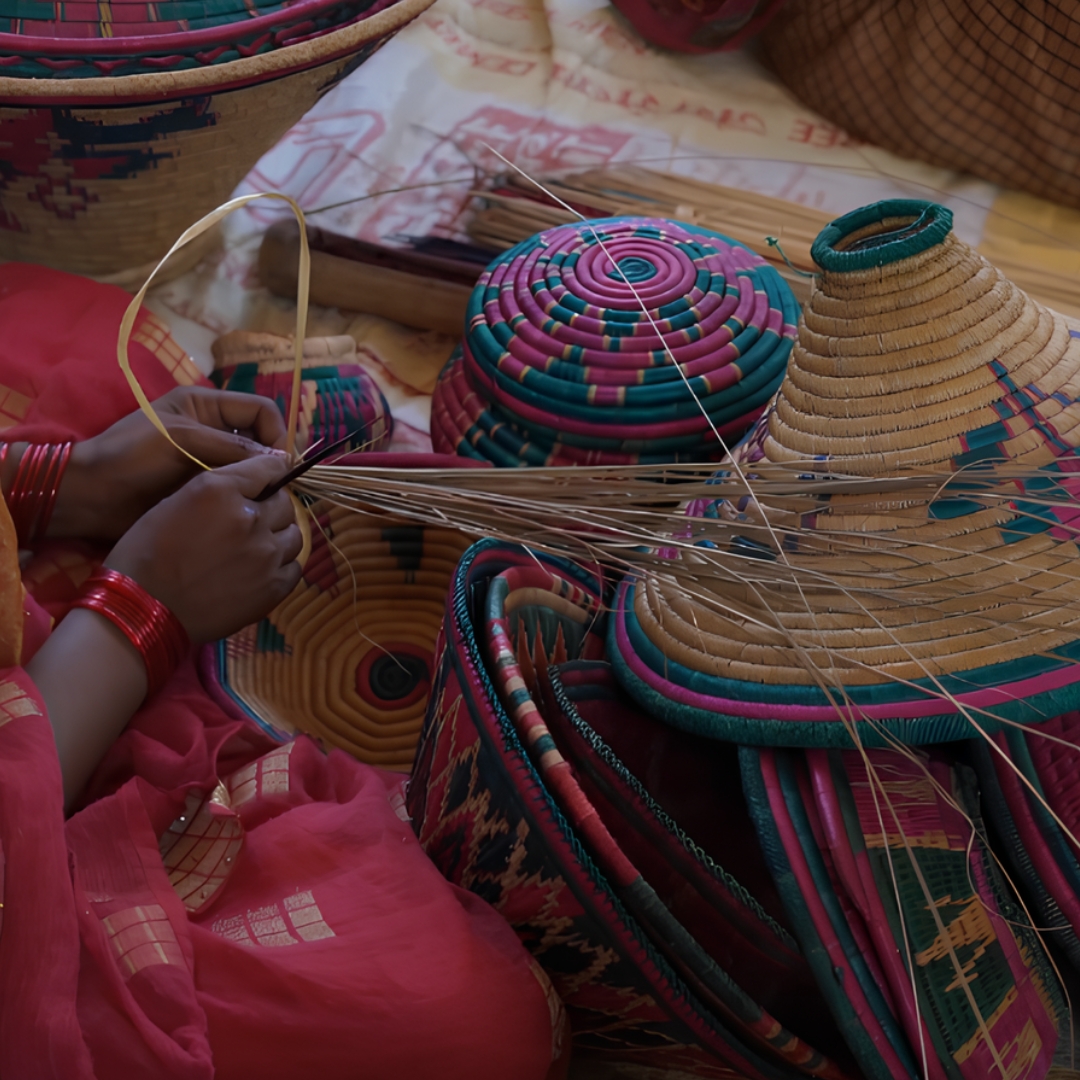
Moonj Art is an age-old system of weaving grass, or Moonj (Saccharum munja) - a wild, strong, grass that grows abundantly in riverbanks and marshy areas of the Terai region. Moonj Art is an inseparable aspect of the Tharu women's way of life and their environment. A process that begins with the sun-drying of the Moonj grass stalks, which are then cut into thin strands, and dyed either with natural or man-made colors, Moonj grass is then intricately woven into a plethora of functional and decorative products, baskets, mats, storage containers, ritual objects etc. Moonj Art is more than a craft and a livelihood opportunity for rural women that the craft is passed onto generation to generation; mothers and grandmothers often teach young women in the community. presented. Moonj weaving is more than a craft or livelihood opportunity - it symbolizes culture and is a sustainable craft born out of a close connection to nature.It is not just an eco-friendly process but it is also rural women's livelihood stemming through the art. In our world of sustainable and handcrafted products, Moonj Art is continually gaining recognition, both nationally and internationally. It remains today as a living homage to Indigenous Knowledge Systems and the vitality of traditional crafts in today's modern world
Geographical Context and Origin
This artform has its genesis in the fertile, green landscapes of Bihar, mostly in the West Champaran district and nearby Terai areas adjacent to the Indo-Nepal border. This area is inhabited by the Tharu tribe, an aboriginal tribe famous for its culturalism, agrarian culture, and strong bonding with nature. The geographical location is important for the practice of Moonj weaving because it directly corresponds to the accessibility of natural raw materials—particularly the Moonj grass, commonly referred to by its botanical name Saccharum munja. In this part of the world, Moonj grass can be found in high populations along riverbanks, grasslands, and floodplains. This wild plant is perennial, grown from the sandy to loamy soils that make the Terai's riverine ecology an ideal habitat. It is harvested at maturity, after the monsoon season, during the dry part of the year. It produces long, fibrous stalks, and is harvested, sun-dried, stripped, and split to become the base material for Moonj weaving.Traditionally, Moonj grass was utilized for day-to-day items like ropes, floor mats (chatai), and baskets employed to transport grains, vegetables, and festival offerings.The women of the Tharu tribe gradually evolved the skill of coiling and binding Moonj into intricately designed baskets, containers, ritual objects, and even art pieces. The art form is usually transferred from mother to daughter and is an essential aspect of domestic knowledge and cultural transmission among Tharu households. The availability of Moonj grass naturally, along with the subsistence living pattern of the Tharu community, prompted the creation of an art form that is both economic and ecologic, yet strongly cultural in nature.The utilization of Moonj was not merely utilitarian—it also symbolized ritualism. Most Moonj items were presented as gifts at weddings, utilized for festivals of seasons, and served in community ceremonies. The ruggedness, lightweight, and thermal insulating ability of Moonj products rendered them a staple for rural household existence. Now, this ancient craft, born out of the ecology and geography of Bihar's Terai region, still lives on and learns to adapt. With increased interest today in sustainable and handcrafted products, the history of Moonj Art reminds us of how local materials and traditional ways of knowing generate works of beauty and sustainability.
Historical Background and Cultural Significance
Moonj Art is a craft that dates back centuries and is strongly embedded within the household, cultural, and religious life of the Tharu tribe, and more so its women. Transmitted from mothers to daughters over generations, Moonj weaving as a craft has been a vital home tradition, representing not only expertise, but association with identity, sustainability, and community life. Traditionally, Moonj weaving used to be seen in Tharu villages, with women sitting together in groups—talking, singing, and weaving—so it was very social and group-oriented.Items made from Moonj grass, like coiled baskets, containers for storage, mats, and trays, were used in domestic life but were also of ceremonial importance. Moonj items would be included during weddings as a part of the bride's dowry. Ornate baskets served as gift carriers, clothing, and provisions. Special Moonj containers were made to hold sacred objects or offerings during rituals and festivals. They found usage during birthday celebrations, harvest festivals, and religious ceremonies to bind them closely to the cycles of rural life and the agricultural calendar.Beyond creating decorative items, Moonj products represented purity, practicality, and independence. That these products were produced from locally found, renewable materials made them part of an ecologically sustainable lifestyle decades before green became the new global awareness. The whole process—gathering the grass, drying it, colouring it naturally, to the end product—is environmentally friendly and involves few tools or outside inputs.From a cultural perspective, Moonj Art depicts the Tharu people's aesthetics and cultural values in a way that is colourful, practical, sustainable, and eco-friendly; each item is produced with intent and care, usually employing geometric or spiral patterns, handed down from elder to younger generations. Patterns and importance have been assigned to them as artifacts, which in some cases symbolize the cycle of life, fertility, or agricultural abundance.Importantly, Moonj Art has been an avenue for empowerment for Tharu women; it afforded them a voice in cultural maintenance and economic empowerment.. Within recent decades, where the craft attained recognition beyond their region, the opportunities opened to women working with cooperatives, training opportunities, and exhibitions.The cultural and historical context of Moonj Art represents an embodied fusion of craft, culture, and society. These days it is an inspiring example of how traditional knowledge can also be sustainable while bearing heritage and identity.We unravelled Moonj Art's origins, history, and its significance to Tharu women in the Terai area of Bihar. We will go deeper into the culture of the Tharu tribe, roles played by women, Moonj processes of weaving, and traditional as well as modern Moonj items.
Description of the Tharu Tribe and Moonj Craft
The Tharu ethnic group is recognized as a Scheduled Tribe in India and is primarily represented in the Terai strap and the Indo-Nepal border, for instance, West Champaran (Bihar). The Tharus are simplified societies and mostly involved in agriculture, their age-old relationship with nature has allowed them to maintain their exceptional cultural identity for thousands of years. Their traditions are linked to a lifestyle of living within nature, which is central to their food, celebrations, apparel, and crafts. The Tharu people have had multiple crafts, and Moonj Art is deeming to be one of the unique expressions for women. Moonj Art is traditional in that, it requires the weaving of Moonj grass, or Bulrush, from local sources. Moonj grass is typically harvested, sun dried and processed, which involves splitting the grass into longer units before weaving, and Tharu women develop their art from Moonj grass, dry grass that is combined into 3 cord strands, standard tools, and the women's trained hands to manipulate, cut, splice, and weave the grass. This process allows the women to produce durable, lightweight, and designed products such as baskets, mats, coiling bowls, vessels, and decorations for a broad range of uses. The products are not only applicable for everyday use but often is required for religious purposes or are given as gifts.Moonj weaving is not just a source of livelihood—it's a reflection of the ingenuity, sustainability, and cultural continuity of the Tharu people. With the world becoming more and more conscious about eco-friendly and handmade products, Moonj Craft provides both artistic beauty and rural economic empowerment.
Tharu Tribe of Bihar
The Tharu tribe of Bihar is the oldest and most recognized indigenous people of India and is a Scheduled Tribe, as they primarily inhabit the districts of West Champaran and other Terai regions along the Indo-Nepal border. The Tharus exhibit a way of life that is unique to the Tharu culture that has a strong connection to nature, tradition, and a sense of being part of a limited social group.Tharu society is, in its features, simple, durable, and ecocentric. Social organization for Tharus revolves around the idea of community with collective decisions generally made by local panchayats and other elders. According to gender relations, there are high levels of social equality. They also consider Tharu women who, as the managing body of family units, active steaming members in agriculture activities and many ancient crafts like Moonj weaving, contribute and fully embrace their lifestyles. Working as the mainstay in any economic survival and Perpetuation of cultural archaeology of their communities.One of the most constant features of Tharu life is all is in their relation to Nature. Tharu people generally relied on farming, resources from the forest, fishing, and livestock. All of the knowledge they possess and use around herbal medicines, the eating of forest foods, and seasonal rhythms shows a remarkable sense of ecological awareness. As cultivators they were growing paddy, maize and mustard often through subsistence farming, and taking advantage of their availability of local materials and traditional know-how.Most of the Tharu houses ae made of mud, bamboo and thatch as it is less expensive and facilitate the climate of the area. Tharu paintings have diverse forms and architecture which are rich in symbolism and mostly has naturally depictions of trees, animals and celestial bodies.Tharu life is exuberant in song and dance, festivals, and rituals that constitute their identity in large measure. Tharu women dance Jhamta in all agricultural and festive occasions. Oral traditions and music continue to be the main modes of cultural transmission.The colourful clothes are beautifully patterned." Traditional Tharu attire is colourful with beautiful designs. For the woman, there is handmade jewellery, and the dress, such as it is, has Tibetan influences and is embroidered with designs that represent tribal marks and religious beliefs.Coming to the present, while there are issues with land rights, deforestation, and migration, attempts are being made for the conservation and development of their cultural heritage. Moonj-Art-like products serve not only as a means for livelihood but also as a voice to affirm identity, keep traditions alive, and enter into bigger markets. The Tharu tribe in Bihar can show how indigenous knowledge and sustainability can still endure despite contemporary pressures.
Role of Women in Craft and Culture
Women in the Tharu community of Bihar are at the heart of culture conservation, and the whole essence of the conservation rests in the context of handicraft, specifically with Moonj Art. They are craftsmen, but they are also the best stewards of knowledge, technique and tradition to ensure these skills are passed from generation to generation. Moonj weaving, in particular, is a craft anchored in women's lives and women have been given the opportunity to participate in its practice and therefore development should not be underestimated.Tharu girls learn the art of Moonj weaving at a young age by watching and helping their mothers, grandmothers, or other female relatives. This learning, which ultimately takes place at home as informal intergenerational learning, occurs when women come together. Women usually work in a group while sharing stories, songs and suggestions to each other. This gathering of weaving session is not merely a simple making and producing activity but a space for social connection and cultural continuity.Moonj weaving benefits Tharu women in several aspects. This allows them to be economically self-sufficient where they can earn a contribution to household income without actually leaving their villages. The trend is that women's artisans and the market for eco-friendly and handmade goods are expanding and connecting women to self-help groups, cooperatives, and NGOs that enable women to sell their products at fairs, exhibitions, and on online retail sites.Aside from economics, the craft is a vehicle of self-expression and identity. The designs, forms, and colors used in Moonj products are imbued with symbolic meanings that relate to nature, spirituality, or community celebrations. Women crafts people are proud of being able to turn an ordinary natural grass into usable art that speaks of their cultural heritage.Notably, the place of women in Moonj Art is not limited to ritual and cultural life. Besides the weaving of baskets and other artefacts - which are utilitarian during matrimonial, festival, and ceremonial occasions usually made for the sanctity and purpose of that act - the art of making these objects can be construed to be a caring, dedicated, and creative act to complement the communal and religious connotations of women's work that are delivered in Tharu culture.At the general cultural level, Tharu women also have important roles as bards, musicians, dancers, and custodians of culture. Their contributions uphold the oral and artistic traditions of the super-family's ethnicity. Being custodians of the tangible and intangible properties of culture, the very embodiment of community living memory by Tharu women maintains the continuation of the values, competencies, and history of the community within an evolving and changing context.
Process of Making Moonj Artefacts
1. Harvesting the Moonj Grass: The process begins with the harvesting of Moonj grass (Saccharum munja). This is a tall and wild grass that grows abundantly in the Terai region of the Himalayan foothills, in the floodplains, marshlands, and on riverbanks. The material is harvested right after the monsoon to ensure the best quality stalk that is matured and strong. While weaving, the woven product only uses the outer coverings of the stalks because they are fibrous and strong, and very flexible.
2. Drying the Grass: After harvesting the Moonj grass, it is dried in the sun for a few days to dry the stalks and make it more durable. This drying method also ensures that the base colour of Moonj i.e. natural yellow-beige is preserved, which is what the weaver will override when dyeing. Drying is an important step to preventing the growth of mould or breakage while slow weaving.
3. Splitting and preparing: Once the Moonj grass stalks are dried, they can be cut into narrow strips the thickness of an old (cross section cut) silver dollar. This is typically done by hand (or a simple hand tool) to cut the dried stalks into thin and uniform strips. The split strips can be done according to the size or dimension and type of the item to be constructed (baskets, trays, mats, ritual pieces, etc.). It is important also to maintain evenness, both in splitting and in the width of the stripped product. While some consistency is ideal, it requires a firm hand to ensure consistency since the quality of the split product is the key indicator of delicacy of the final item..
4. Dyeing the Grass: Next, the separated strands of Moonj are dyed using either natural or chemical dyes. Natural dye is made with colors derived from turmeric, indigo, henna, and flowers, while chemical dyes are used to create brighter and longer-lasting color. The strands are placed in hot dye-infused water and then dried again. Then symbolism of color is invoked—red represents fertility and celebratory aspects, yellow represents wealth, and green represents nature and life.
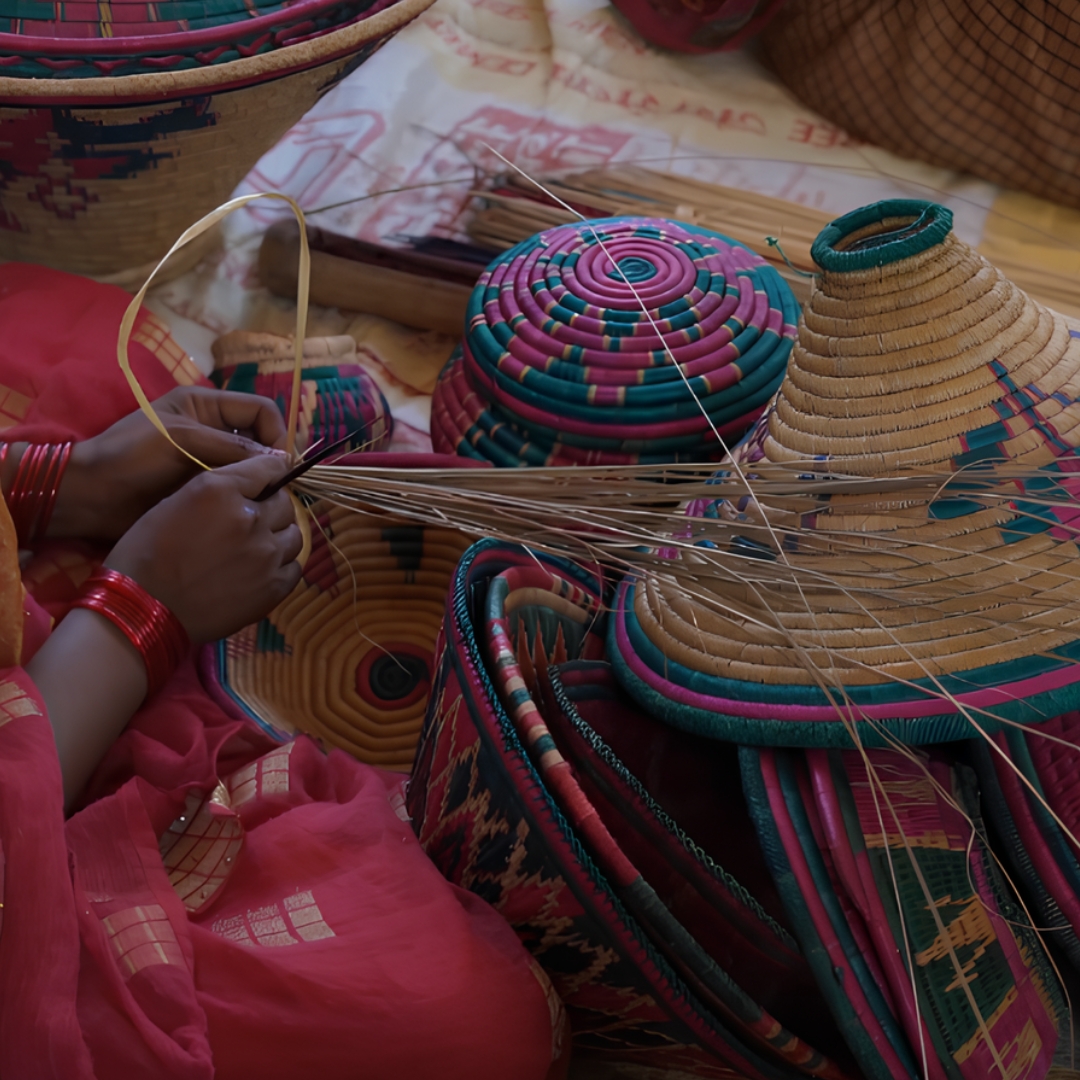
5. Weaving and coiling: The strands are dyed and now prepared to weave. The coil weaving method is the most commonly used method. With coil weaving, the Moonj is used to wrap a core of thicker straw or grass tightly in spirals or concentric circles. The artisan continues to coil and stitches the materials in place with a strong thread and needle or other tools (such as an awl).The stitching is done in a way to bind the layered materials together so that the artefact can take shape—whether a flat tray, cylindrical vessel or dome basket. All work is done by hand and requires a rhythm of wrapping, shaping, and stitching.
6. Equipment Utilized: Moonj weaving relies on minimal equipment which is why it is sustainable and inexpensive. There are basic equipment used that includes:
- Needles for stitching
- Awls for making holes or guiding the thread
- Scissors for trimming
- Thread or jute twine for binding
- Water containers to soften grass if needed
Even with the simplicity of equipment, the craftsmanship is in the hands and experience of the artisan. Every item may take hours to days to finish depending on its size, intricacy, and detail level.
Final Products
Once finished, Moonj items are tough, bio-degradable and versatile. They can be anything from baskets, mats, and trays to utility boxes, pen cases, wall hangings and even clothing accessories. Each item is custom-made and features bright patterns, cultural design, and symmetrical motifs, making Moonj craft as functional as it is artistic.In this way, Moonj weaving is a rural craft, as well as an engagement with nature, a tradition and art—as something woven into-being through tradition.
Products and Their uses
The Moonj craft of the Bihar Tharu women produces a broad range of products that demonstrate practical utility as well as aesthetic appeal. They are used for domestic, ritualistic and commercial purposes which make Moonj art a versatile tradition that harmonizes functionality with cultural expression. Since the demand of eco-friendly, handmade products are increasing, Moonj products are gaining popularity in rural and urban markets.
Functional Items
- Baskets: For carrying vegetables, grains, clothing, and other household items. They come in different sizes, are sturdy, and long-lasting.
- Mats (Chatais): Placed on the ground to sit or sleep on. Soft, light, and naturally cool—ideal for the humid Terai climate.
- Storage Containers: With lids or an open top, they are utilized to store dry food, grains, clothing, and small appliances. Their stack ability makes them convenient in homes in the countryside.
- Slippers: Environmentally friendly footwear designed from closely woven Moonj strands. Soft and decomposable, they're gaining popularity among green fashion enthusiasts.
- Stools and Seating: Compact utility stools and cushioned seating made of Moonj are designed too, typically employed in traditional kitchen or outdoors.
Ornamental and Ritual Pieces
Moonj is also utilized in the crafting of ornamental and ritualistic pieces, an integral part of the social and spiritual existence of the Tharu people:
- Bridal Gift and Dowry Items: Baskets and vessels that are embellished are used to be traditionally given to brides as gifts in the context of marriage, along with clothes and sweets.
- Festival Wares: Trays, platters, and containers for offerings on the occasion of harvest festivals, religious ceremonies, and village events.
- Symbolic Items: Certain products are moulded or patterned to depict fertility, abundance, or defence. These are usually stored in hallowed spaces in homes.
Local and Urban Market Demands
Moonj products, traditionally made for household use in the neighbourhood, are now penetrating larger markets because of their eco-friendliness and handcrafted value. In urban craft fairs, green stores, and internet sales sites, there is increasing demand for:
- Designer baskets and décor items
- Eco-gift packaging
- Sustainable home accessories
- Fashion products such as bags and jewellery
Moonj art today is not just about functionality—it is a combination of tradition, sustainability, and contemporary sensibility, and has the potential to succeed both in rural and international markets.We understood Tharu culture, women’s role in Moonj weaving, and detailed crafting methods of traditional and modern Moonj products. Next, we will study Moonj Art’s aesthetic styles, sustainability practices, economic aspects, and the challenges faced by Moonj artisans today.
Artistic Elements, Sustainability, and Innovation
Moonj Art is a stunning synthesis of aesthetic appeal, environmental knowledge, and creative adjustment. The artistic aspects in Moonj weaving are apparent in its patterns, colors, and symbols. Geometric patterns, spirals, and symbols taken from nature are commonly applied by Tharu women artisans. Everything is made in balance and harmony, with generations of practiced craftsmanship. The items' beauty is enriched through the use of natural and synthetic dyes that produce brilliant reds, greens, yellows, and blues to embellish baskets, rugs, and coiled containers.Moonj Art is rooted in sustainability. The grass, Saccharum munja, is a perfectly natural, biodegradable product prevalent in the region, including the harvesting, as they cut it from the wild rather than using cultivated grass. Almost all of the weaving is done by hand and does not require electricity or machinery, so the carbon footprint is kept as low as possible. The colours and dyes are also trending back towards more natural options as knowledge expands.Moonj Art innovation is occurring through product development and the emergence of available markets. The artisans are now learning to produce new utility products, such as laptop bags, jewelry, home decor products, and fashion accessories. Through partnerships with designers and other NGOs, the artisans are able to access urban and international markets, while state and central government initiatives, workshops and tradeshows support the craft sector. With its focus on both heritage and innovation criteria, Moonj Art keeps pace with the prevailing sustainable design practice of today.
Design Patterns and Aesthetics
The aesthetic language of Moonj Art is founded on simplicity, symbolism and symmetry.
Common Motifs and Symbolic Patterns
These are realized through differences in the position of colored strands, stitching method, and color order. Most of these forms possess symbolic significance:
- •Circles signify wholeness, cycles of nature, and continuity of life.
- •Triangles usually signify fertility or strength.
- •Chevron or wave motifs may illustrate water and movement.
In ritual and wedding objects, designers may also add symbolic shapes, like images of flora, fauna, or abstract symbols of protection and prosperity. These symbols are not merely ornamental but convey cultural values that are transmitted from generation to generation.
Symmetry and Visual Balance
This symmetry represents order and harmony both in terms of art and Tharu worldview.In order to create symmetry, craftsmen have to sustain:
- Equal tension while wrapping and stitching
- Equal allocation of color and pattern
- Impeccable alignment of coils and layers
Tightness and Finishing
The tightness of the weave is another very important aesthetic element. A tightly coiled and neatly stitched product is not only more durable and longer-lasting, but also more smooth-looking. Sloppily constructed products are regarded as unfinished or inferior. Artisans complete their work by:
- Neatly trimming loose ends
- Smoothing the surface for a high polish
- Achieving a smooth color and coil transition
Sustainable Craft Practices
Moonj art is a great example of green and eco friendly craftmanship. Founded on traditional systems of knowledge and sensitive to the cycles of nature, the entire process of Moonj weaving—raw material acquisition to product manufacturing—is in sync with contemporary norms of environmental sustainability. As the globe moves towards greener options, Moonj art is an obvious natural, biodegradable, and renewable craft tradition.
The Use of renewable Natural Resource
The primary raw material, Moonj grass (Saccharum munja) grows abundantly in the wild—especially along river banks, marsh and wetland habitat in the Terai region of Bihar. Moonj grass is a fast growing, perennial grass that artisans harvest seasonally and do not require extensive cultivation, irrigation or chemical inputs. Moonj is thus a low-impact and renewable resource.Artisan harvesters ensure they do not remove the whole grass plant, so it can continue to grow in the next season. The cultural knowledge of °when° and how to harvest Moonj grass has been passed among artisans for generations. It has ensured ecological sustainability and has maintained and fostered the craft of Moonj grass weaving for generations.
Biodegradable and Eco-Friendly Products
The Moonj product made including baskets, mats, trays, containers and, yes, even slippers are 100% biodegradable! The most appealing aspect of Moonj is that it will degrade in nature, like Oak trees, Nile grasses and living organisms like us; leaving no toxic residues behind, and packing up no plastic or synthetic pollutants behind:
- Turmeric for yellow
- Indigo for blue
- Henna or beetroot for red and brown shades
These dyes are free from toxins, safe for use on skin, and environmentally friendly. The strands have been immersed in naturally made solutions and sun-dried, after which they are used for weaving.By being careful to use these historic dyeing techniques, practitioners of Moonj art assist the planet by minimizing chemical pollution and ensuring that their surroundings are conducive to sustainable working conditions, especially for women and children involved in the craft production.Moonj art is a heritage craft, but it also is a thriving example of sustainable living that illustrates how communities can generate economic value from nature while also conserving nature and protecting tradition.
Modern Adaptations and Innovations
While Moonj art is still deeply rooted in the traditional practices of the Tharu women of Bihar, it has undoubtedly evolved with the times to incorporate new inventions and modern adaptations to remain relevant in the fast-paced world of today. New market demands and interest in sustainable living, Moonj artisans are finding new forms, expression and customers for their art.
Modern Designs and Practicality
In the past few years, Moonj weaving has increased its presence of products in the market beyond traditional baskets and mats. Weaving styles are being adapted for a wider array of contemporary lifestyle and fashionable products that cater to the urban consumer, green consumers, and design enthusiasts. These products include:
- Handbags and clutches with leather or fabric
- Laptop sleeves and document folders
- Home decor items such as lampshades, wall adornments, and plant holders
- Fashion and jewellery accessories like bangles, earrings, and necklaces.
While these items draw upon more traditional Moonj weaving of coiling or stitching, consideration of contemporary tastes makes them valid for modern aesthetics as well as function, typically in a minimally-stylized way that ignores cultural place and speaks to international taste.
Market Dynamics and Economic Impact
The Moonj traditional craft of Bihar's Tharu women has branched out of its traditional roots to become an important economic pursuit, augmenting rural incomes and the countrywide handicraft market in India. At a time when there is a rise in eco-responsible consumerism and hand-made credibility, Moonj art has an unparalleled capability to meet the country's requirement of sustainable, locally rich, and functional merchandise. The dynamics of this changing market are a strong synergy between enterprise and tradition.
Local Sales and Craft Fairs
Moonj products were originally traded in the local community, mainly during harvest time, festivals or weddings. The role of local haats (weekly markets) and seasonal fairs soon became serious venues of sales for artisans. These informal systems established direct trading opportunities for rural women, which has allowed them to earn some money from their competent display of work.
During the past few years, handicraft fairs at state and district levels have provided broader publicity. Initiatives like:
- Saras Fairs (conducted by the Ministry of Rural Development)
- Dastkar Nature Bazaars
- Handicraft exhibitions sponsored by the state have helped provide access to city consumers interested in hand-made, eco-friendly products. Not only do these create additional sales avenues, but they also help to raise awareness on the cultural significance and hand craftsmanship involved in Moonj art.
E-Commerce and Digital Market Opportunities
The digital revolution has been a game changer for Moonj artisans. With the help of NGOs, government schemes, and social enterprises, Moonj products are now reaching national and global markets through:
- Online craft marketplaces (e.g., Amazon Karigar, Okhai, Gaatha, GoCoop)
- Brand collaborations with sustainable lifestyle labels
- Social media marketing via Instagram and Facebook
Digitization has enabled artisans to enhance presentation of the products, online management of payments, and packaging, thus making Moonj products competitive. For consumers in urban areas looking for biodegradable, plastic-free, and handmade products, Moonj products have gained popularity.
Synergy with the ODOP Initiative
In a few districts of Bihar, Moonj craft has been recognized under the One District One Product (ODOP) program—a major initiative under the Ministry of Commerce and Industry. The program aims to promote traditional crafts and associate them with:
- Skill development programs
- Design and quality improvement
- Export facilitation
- Branding and geographical indication (GI) labelling
Overall Economic Impact
Moonj craft is transforming from a subsistence occupation to a viable livelihood source.
- Employment for hundreds of rural women
- Local economies are stimulated through input purchases, logistics, and marketing
- Adds to the handicraft export basket of India, particularly in eco-product niches
As consumer awareness about sustainability and heritage grows, the prospects for Moonj craft shine bright—especially with policy, technology, and innovation backing it up.Essentially, Moonj art is no longer a cultural phenomenon—it is a rural economic force, fuelled by women's initiative and buoyed by the collective wisdom of generations.
Challenges faced by Artisans
While contemporary understanding of traditional crafts and the sustainability inherent in Moonj art continues to gradually grow, artisans - namely Tharu tribal women of Bihar - face considerable logistical, infrastructural large and small issues as well as structural impediments. These barriers prohibit artisans' capacity for scaling, innovating, and consistently accessing financial livelihoods. Addressing these structural issues is perhaps important not only for artisan welfare, but for the future sustainability of the Moonj craft.
1. Seasonal Availability of Raw Material
- Harvesting is available only once or twice a year, commonly post-monsoon.
- Unfavourable monsoon or climate change affects the quality and availability of the grass.
- Artisans must pre-stash raw material, but most do not have proper storage facilities, and hence it gets damaged or runs short.
The reliance on a natural resource without well-planned harvesting or cultivation means that the craft is extremely sensitive to environmental changes.
2. Inability to Access Larger Markets
Although local fairs and small exhibitions offer some scope, many artisans are isolated from large, stable markets, both domestic and international. Reasons include:
- Geographical remoteness of tribal areas such as West Champaran.
- Insufficiency of transport infrastructure and limited digital literacy.
- Lack of intermediaries or cooperatives to link rural artisans to online channels or urban customers.
This non-integration of markets results in excessive dependence on local customers, usually resulting in lower sales prices and volumes.
3. Low Prices and Profit Margins
Moonj products, although time-consuming and beautiful, tend to be under-priced in the market. This is because:
- Limited consumer knowledge regarding the time and cultural significance invested in the products.
- Mass-produced, plastic substitutes being more affordable and readily available.
- Middlemen appropriating most of the profits, leaving the artisan with only a portion.
Thus, despite lengthy working hours, artisans, particularly women, receive token wages that just manage to sustain their families.
4. Inadequate Training and Design Exposure
While the fundamental weaving techniques are transmitted from generation to generation, most weavers do not have access to contemporary design training, which constrains:
- Innovation in color palette, pattern, and product offerings.
- Customization for international or urban markets.
- Knowledge of quality control and customer requirements.
There is also a skill gap in branding, pricing strategy, digital sales, and packaging, which are paramount in current competitive handmade markets.
5. Financial Constraints and Institutional Gaps
Moonj artisans are confronted with several financial obstacles that limit expansion:
- Limited loans, subsidy, and working capital access, particularly in the absence of collateral or formal banking relationships.
- Expensive dyes, particularly natural dyes, and equipment such as awls and needles.
- Inadequate cooperatives or registered collectives that can assist in pooling resources and lowering costs.
To overcome these challenges, the following are needed:
- Raw material banks and storage facilities for off-season stability.
- Skill-building programs in design, marketing, and digital literacy.
- Direct-to-market linkages through cooperatives and e-commerce platforms.
- Financial inclusion through SHGs, microcredit, and government grants.
With appropriate interventions, Moonj art can transform from a peripheral craft to a successful rural industry—enabling women and keeping India's cultural heritage alive in the process.We discussed Moonj design patterns, sustainable practices, innovations, market trends, and economic issues related to artisans in growing their outreach. In the next part, we'll discuss how Moonj Art is conserved, its promotion strategies, its modern-day relevance, and attempts for broader recognition.
Conservation, Promotion and Conclusion
Conservation of Moonj Art is crucial to protecting the cultural heritage and sustainable tradition of the Tharu tribe. This indigenous art, based on eco-friendly lifestyle and traditional knowledge, is under threat due to lack of interest among the young generation, small market outlet, and competition from artificial products. To combat this, government agencies, NGOs, and cultural organizations are making an attempt to record techniques, skill training for artisans, and financial and infrastructural aid. Incorporating Moonj Art in school curricula, cultural festivals, and handicraft fairs also helps in reviving and respecting it.Marketing of Moonj Art is gaining steam with e-commerce sites, craft fairs, and designer collaborations. Social media marketing and visual narrative are assisting in building awareness about the worth of hand-made, environment-friendly products. Agencies are also assisting artisans in getting their product lines more contemporary to appeal to city markets without discarding traditional techniques.
Contemporary Relevance
In today's world where sustainability, cultural identity, and mindful consumerism take center stage, Moonj art seems to have acquired fresh meaning and significance. This beautiful and sustainable craft—originating from the living experiences of Tharu tribal women—has become a central issue on global discussions about sustainable living, indigenous knowledge, and empowering women.The modern relevance of Moonj art is largely attributable to growing need for biodegradable, environmentally friendly substitutes for plastic and synthetic materials. Moonj products stand for sustainable choices as they are handwoven with utmost care from grasses that regrow year after year, most time dyed with colors extracted from nature; this way of life allays one's conscience with respect to earth and is minimalistic through and through, be it via baskets, storage solutions, coasters, or home decor.
Maintenance and Conservation
The conservation of Moonj art, the rich craft culture of the Tharu tribe of Bihar, involves a multi-pronged intervention that addresses sustaining the natural resource base as well as the strengthening of the knowledge systems related to the craft. With the increasing demand for green, handmade products, it becomes critical to provide assurance that the craft is preserved from over-commercialization, erosion of skills, and depletion of resources.A very important step towards conservation is the creation of raw material banks. As Moonj grass is seasonal and highly variable with local environmental conditions, there is a need to harvest, store, and distribute the grass in a systematic manner throughout the year. Raw material banks managed by the community can provide artisans with regular access to quality grass, particularly during off-seasons.Training workshops and capacity-building programs are also crucial. While family traditions pass on the traditional knowledge, formal training helps to improve techniques, bring in quality control, and make the craft contemporary by adding modern design inputs. Such workshops can also generate awareness of sustainability, reasonable pricing, and entrepreneurship.To conserve the intangible cultural heritage of Moonj weaving, documentation of techniques, anecdotes, and motifs is also on the upswing. Documenting the histories of master weavers, documenting design patterns, and preparing instructional materials will guarantee that the rich oral tradition of Moonj art is not lost over time.Also on the cards is Geographical Indication (GI) tagging of Moonj products from Bihar. A GI tag would not only offer legal protection and geographical recognition but also enhance marketability with authenticity and quality being associated with the craft.At its core, the preservation and conservation of Moonj art need to be based on community engagement, ecological consciousness, and institution-based support, so that this living tradition is able to survive from generation to generation.
Promotion of Moonj Art
Marketing Moonj art successfully involves concerted efforts integrating older traditional craftsmanship with new platforms and viewerships. NGOs, government programs, and new media have all been important factors over the past few years in providing exposure, awareness, and marketplace entry for the Moonj craftspeople of Bihar, specifically from the Tharu tribal populations.Regional and national exhibitions like Dilli Haat, Surajkund Mela, and India Craft Week have provided artisans an opportunity to display and sell their products directly to consumers, bypassing middlemen and creating awareness. These events also expose urban consumers to the aesthetic and ecological worth of Moonj crafts. With the advent of the digital age, social media and e-commerce websites have emerged as great promotional tools. Eco-lifestyle brands and curated craft shops increasingly showcase Moonj products as an emblem of green and ethical living.By weaving Moonj products into the fabric of sustainable lifestyle branding—using creative packaging, engaging storytelling, and collaborations with eco-designers—these handmade items can be showcased as not just functional and stylish, but also as eco-friendly alternatives to plastic and synthetic goods.By broadening the reach of these marketing strategies, Moonj art can flourish not only as a cherished heritage craft but also as a vital component of India's cultural economy and its journey toward sustainable development.
Conclusion
Moonj Art is an incredible case of how indigenous wisdom, nature balance, and cultural identity coalesce into a single art.It's acolorfultradition thatexpertlyintertwinessustainability,interpersonalrelationships, andartisticstyle. MadeofMoonj grass, a natural,sustainable fiber, andmadeusinggenerations-oldtechniquesofweaving,everyproductisatestamenttothe artist'sstrongaffinitywith nature. Theprocess,fromcuttingthegrasstodrying it, fromdyeingtoweaving,iscarriedoutwithaminimumimpact,usingnaturalmethods. In a worldinneedofsubstitutesforplastics and mass-produceditems, Moonj Artisashiningillustrationofgreeninnovation.Apart from it’s environmental aspect, Moonj weaving transformed the life of people involved in its making. It enables them to achieve sustainable livelihoods. Their passing on over generations preserves their culture and creates new economic possibilities from design creativity and digital presence. With growing consciousness, policy encouragement, and shifting market forces, Moonj Art is slowly moving from the margins to the mainstream. It is not only a cultural artifact but a blueprint for sustainable rural development.Having the tradition preserved, active engagement is required-free going with-the flow support and funding for the artisans and their villages are equally important. Holding onto this practice is not about a mere regret for the past; it is about taking a positive step toward the future that is sustainable and fair. Moonj Art is not just a casual craft or pastime. Rather, it is a full-package solution of sustainability, real empowerment, and possibilities for an enormous cultural resurgence.