

Jhamta Dance
This course introduces learners to the vibrant cultural tradition of Jhamta Dance, a unique folk dance performed by Tharu women of Bihar’s West Champaran region. It explores the origins, tribal lifestyle, sub-group identities, and artistic expressions embedded in dance, music, and costume. The course blends cultural theory with practical insights, aiming to promote awareness, appreciation, and conservation of this tribal heritage through interactive methods and community storytelling. Ideal for those passionate about India’s folk traditions and cultural preservation.
 Most Viewed

What you'll learn
- Cultural Roots : Understand the historical and ecological context of Jhamta and its tribal significance.
- Tribal Identity : Explore the lifestyle, language, social structure, and beliefs of the Tharu community.
- Dance Form & Expression : Learn the symbolic movements, formation, etiquette, and spiritual aspects of Jhamta.
- Music & Instruments : Discover the role of folk songs, traditional themes, and instruments like madal and dhol.
- Artistry in Costume : Examine colorful clothing, silver ornaments, tattoos, and aesthetic symbolism in performance.
Couse Features:
- Interactive Activities : Group discussions, folk song analysis, and performance-based engagement.
- Field-Based Visual Content : Video clips and images from real performances and cultural settings.
- Practical Demonstration : Basic steps and rhythm patterns taught for immersive understanding.
- Community Voices : Insights from Tharu artists, elders, and practitioners featured throughout the course.
- Multimedia Integration : Use of visual storytelling and social media awareness for cultural promotion.
Who Should Enroll
- Students of folk culture, performing arts, or anthropology
- Cultural content creators and researchers
- Folk dance instructors and enthusiasts
- Social workers involved in tribal empowerment
- Educators and heritage tourism professionals
Description
Introduction and History of Jhamta Dance
Jhamta is a dance form of Tharu women of West Champaran, Bihar which is usually performed after transplantation of paddy. Embedded in the rural life and seasonal cycles of the Tharu, this dance is the image of a cultural identity and a communal mutual understanding. The Tharu people, who are declared as the 'Scheduled Tribe' by the Government of India, are spread along the Terai belt. The traditional Jhamta dance is performed to the beat of Jhamta "dholak" (drum) and the sound of clapping or gesticulation of hand and feet.
It’s a graceful and earthy dance—representing not just joy and celebration but our connection between the earth and the harvest. As a symbol of group identity Jhamta is an important source of oral tradition collection, social cohesion building and celebrating the intricate connection between nature, labor and culture in the life of indigenous.
Origin, Geographical Context and Cultural Background of Jhamta Dance
The Tharu, an indigenous people who have lived in this land for generations, have adapted to live and make their living in harmony with its forests, rivers and verdant fields. Their natural habitat made that part of the country as West Champaran District (Bagaha-2, Ramnagar, Gaunaha and Mainatan Blocks) known as “Tharuhat” (the land of Tharus). It is more than a geographical border, it is a cultural heartland, a spiritual and communal space in which knowledge, ritual practices and art forms have flourished for centuries.
It is the Jhamta dance which grew out of this and a co-dependence with nature and the agricultural season. Jhamta is a dance to celebrate collective joy, thanksgiving and strength. It is typically undertaken after paddy transplanting, a laborious chore that is at the heart of Tharu life. Circumambulating expresses the unity, harmonization and rhythm of the agrarian way of life and the dialect in which folk songs are sung suggests notions of nature, harvest, fertility, and religious attachment to the earth. Every movement, step, rhythm, is inspired by daily life, sowing seeds, planting, rain and the prayer for bounty.
Also, the place where the Tharuhat is located is not just a stage for the dance - it is an inspiration and symbol of the dance.
• Historical Background and Cultural Significance
The Jhamta dance is of historical and cultural significance among the Tharu people . Spread across the Terai belt of Nepal and Bihar, the people of this community have kept their unique traits of culture based on the nature, society and agriculture which to make their living.
Jhamta dances are performed at various social occasions like festivals, harvests, weddings, and other festivities. It’s a semi-circular configuration where about 8 to 20 women get together, holding hands and swaying in the circle, singing traditional songs and dancing in elegant rhythms in tandem with each other, on occasion accompanied by supporting live traditional music. They serve to not just bond the community but also effectively communicate their culture, values and information to their young in a very interesting and dynamic way.
Jhamta becomes the medium of collective identity and expression where the role of Tharu women is pronounced not only in the domestic but also in the public sphere. It promotes social u--nity, offers a common ground for mutual enjoyment, and ensures that the oral and performing culture of the Tharu tribe survives in changing times. The dance thus serves as homage and defiance.
The Jhamta is not only a cultural and artistic treasure, but it also carries spiritual and symbolic importance to the Tharu culture. It is said to attract the spirits of ancestors and deities of fertility and the harvest. This dance is not just for fun—it's a ritual, a show of thanks to nature for the bounty of what she brings.
Tharu Tribe, Subgroups and Other Dances
The Tharus are not homogeneous, as they comprise a dozen sub-groups, such as the Rana, Dangaura, Katharia and Chaudhary, which have some variations in costume, dialect, customs and culture. Both music and dance play an important role in their daily life as well as in public festivals held during certain seasons. Besides Jhamta, a self-performed round dance by women after transplanting of paddy, Tharus also have other traditional folk dances like in form of Sakhiya, Lathi Naach (men's stick dance) Chhokra Naach. These dances are not only for pleasure, but a form of giving thanks to mother nature and keeping tales of the past alive and carrying them through lifetime to lifetime. It provides images of the kinds of balance in nature and religious belief the community achieves.
• Lifestyle, Social Structure, Language, Diet
The Tharu language is an Indo-Aryan dialect with some regional variations. They have a meagre diet: rice, lentils, forest vegetables, fish and their own produce of fruits and vegetables. Mud, bamboo and thatch houses, suited to the moist climate, are also seen. They practice a combination of animism, nature worship and Hindu rituals, and have a deep belief in ancestor spirits and local gods.
Their life revolves around their culture and is an amalgamation of music, dance, celebration, and oral traditions which lays emphasis on the community and respect toward nature. The Tharus have successfully resisted threats posed by modernization, and their knowledge offers us valuable lessons in the future of sustainable living and cultural survival.
• Major subgroups of Tharu: Rana, Dangaura, Kathariya etc.
The Rana Tharu are also mainly from western Nepal and eastern Uttar Pradesh, and most of them are known for their exciting cultural practices, colourful dresses and modest culture. The Kathariya Tharu, who live predominantly in the state of Uttar Pradesh, are one of the oldest sub groups and noted for their various oral traditions and perculiar dialect features. The Dangaura Tharu live in the bordering Terai areas of Nepal and in West Champaran district of Bihar and are well known for their folklore and the Jhamta dance.
Every subgroup has his own contrasting clothes, jewellery, idiom, ritual, tradition. For instance, Rana Tharu women's subgroup are popular due to their heavy silver ornaments, and multi-stripe traditional outfits, while Dangaura women tend use simpler and less colourful attire while working on farms and doing group performances. Marriage, festival and religious practices differ slightly even among these subgroups, although they are closely tied to nature and farming.
• Other major Tharu dances: Sakhiya, Lathi Naach,
Sakhiya is a young girl/boy dancing generally performed by man or woman, who is not married during the time of any festivals (Diwali, post harvest season). It includes reciprocal stepping, echo singing and play rhetoric in social interaction and courtship game.
Lathi Naach, or stick dance, is the livelier and comparatively martial form, performed primarily by men. It shows self-defense, rhythm, team cooperation, etc., and is performed in the events such as ceremony and celebration, showing brave and strength.
Jhamta Dance Style, Music, Instruments and Costumes
The dance of Jhamta is commonly performed by 8 -20 women in circular formation is rhythmed with coordinated steps that involve gentle swings and movements resembling various agricultural and seasonal activities done by them, especially post paddy transplanting. The dance draws its inspiration heavily from the daily life of Tharu and each step in the dance echoes the unison with nature. The music associated with Badi songs is all traditional and folk, with songs being sung in the local language and the song being harvest, festivals, thanksgiving and social bonding.
• Dance Etiquettes: Discipline, Collectivism, Respect for Elders
One of the key value that is kept intact throughout the dance is the respect of elders and adherence to traditional norm. The dance is normally led by the older women of the village who conducts it, while the younger dancers will go to the older women and ask their permission and blessing to start. This is consistent with the wider Tharu social order where elders are revered as symbolic repositories of knowledge and custom.
It is the practice and cording of the performance. Jhamta is generally performed in an open court yard or around a field, especially after paddy transplantation or during social gatherings. They perform in a ring, This dance’s tempo gradually speeds up, and it has a rhythm both joyful and reflective.
Etiquette In Jhamta, the etiquette is, in general, a combination of rules regarding discipline, unity of people, humbleness and respect; through the dance, then, is represented not only an art form, but also the identity of the Tharus and their values.
• Dance style: Circular formation, reflection of agricultural work
The Jhamta dances epitomize a blend of simplicity, rhythm and symbolism closely related to the agricultural way of life and the environment of the Tharu people. Unlike the much more stern classical dances, what is delightful about Jhamta the way it is rooted in everyday life, particularly planting and harvesting and the passage of seasons.
The movements in Jhamta are primarily free flowing and choreographed with graceful swaying, synchronal hand movements and nimble foot nodes. Each step is an act of farming – of sowing seed, planting paddy, watering the fields – as hard labor makes way for graceful, celebratory art. The dancers lend a hand which not only contributes to the rhythmic quality but also to the realization.
• Music: Traditional Folk Songs, Fundamental Themes
Jhamta's folk songs are unique to this dance and they are also an important aspect of the Tharu peoples' daily life and agricultural cycle. These are practical as well as poetic songs, sung in the Tharu dialect. Lyric songs often reflect the rustic beauty of the Terai, the rhythm and cycle of agriculture and the pleasures, sorrows and travails of agricultural life. Paddy harvesting festival the most apparent of these is paddy harvesting festival as Jhamta is practiced following transplanting of paddy i.e. the most strenuous work of the agricultural year.
Most songs brim with thanks to nature and the spirits of ancestors for a good harvest, healthy cattle or the well-being of the family. Other songs are exuberant, filled with laughter, teasing words, and a sense of communal solidarity, particularly among women. Some of the verses also contain a spiritual underlying theme, referred from village deities and the elements in nature like sun, rain and earth.
Jhamta music is commonly accompanied by moderate clapping or light dholak/mandar. Its minimalism serves to highlight the raw truthfulness and emotional weight of the show. In summary, music in jhamta dance is not a ‘cognitive back ‘up but it is lived experience of Tharu identity Personality’; It is land, labor, love and legacy nestled in a sonic tapestry.
• Instruments: Madal, Dhol, Manjira, Harmonium etc.
Musical instruments The most popular music instrument in Jhamta is Madal – a double headed hand played drum made from wooden hollow surface and leather covering. Known for its buoyant, heavy bass on one side and slap, high pitch on the other, it allows the players to develop rich, percussive conversations. The Madal beats form the primary beats of the Jhamta dance to which the footwork and swaying body movements are performed.
The important drums here are the large drum dhol, either played with sticks or hands, and in general provides the rich and the ceremonial accent to the performance. Usually the dhol is reserved for special occasions or festivals and signals the opening or closing of the dance routine.
High-pitched chinking sounds are created by small cymbals known as manjiras who, in addition to bolstering the rhythm, add to the rhythmic foundation. As with any musical ensemble element, Hiwars and Manjiras can be played by grandmothers and side players, adding some flash and speed to the rhythm.
The harmonium, is basically a melodic instrument, that brings a lyrical and an emotional element to the show. Holding notes and playing fluid melodies support the vocal aspect of the dance, which mostly involves folk songs being sung during Jhamta. The instrument then acts to join rhythm with tune, so that the dance stands on a base of both beat and melody.
• Costumes and adornments: Colourful clothing, silver jewellery, godna
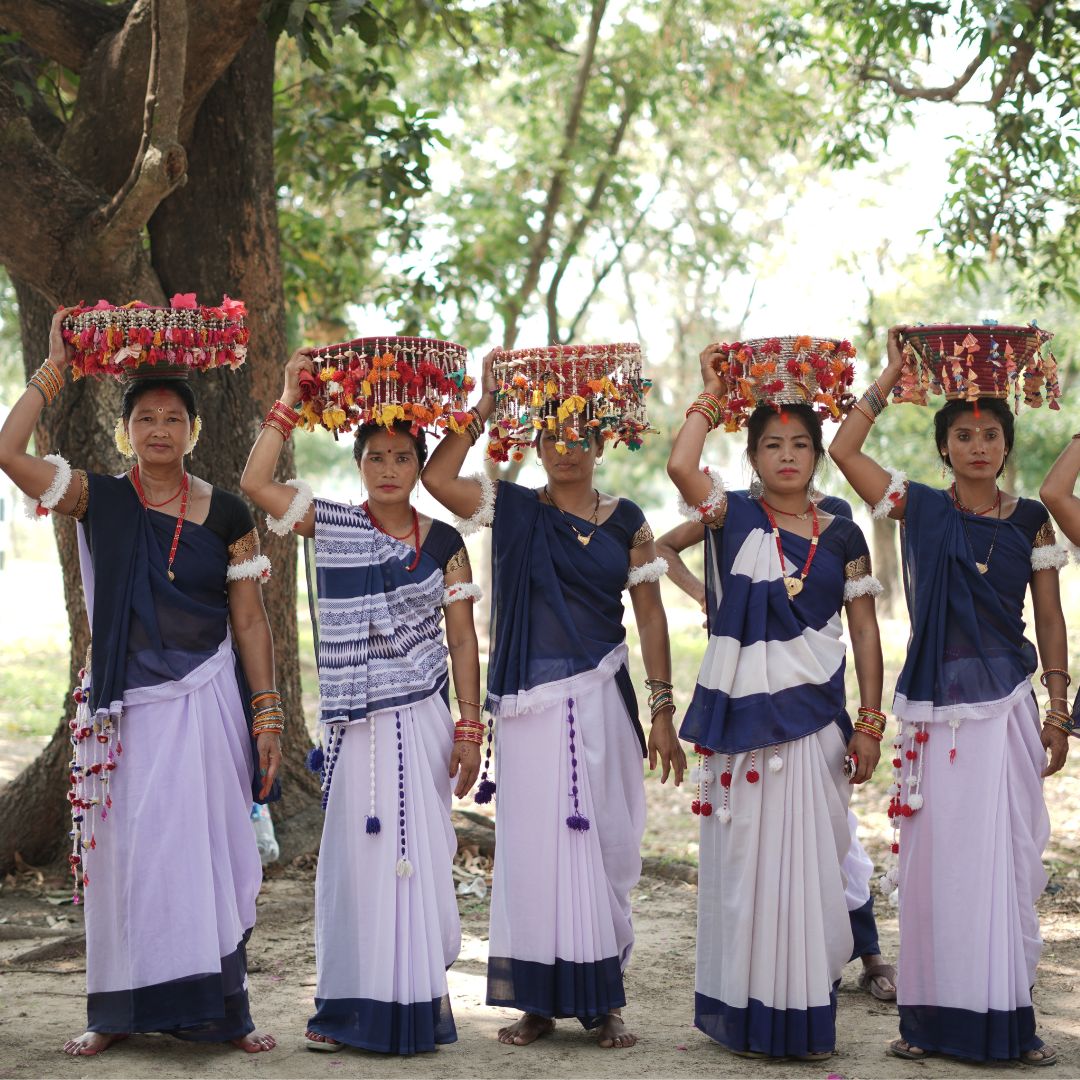
Heavily laden costumes and ornaments used in the dance are so rich in symbolic and cultural value. They are the epitome of the age-old aesthetics, craft and customs among the for Tharu women, primarily in the Terai region of West Champaran, Bihar. They also contribute greatly to the general atmosphere and authenticity of a performance of Jhamta.
Tharu women wear colorful and meticulously embroidered clothes that are not only practical but also eye-catching. The outfit comprises of a handcrafted lehenga, a blouse and a dupatta that is draped over the shoulders or head. It is typically of cotton or locally produced material suitable for the hot, humid climate of the Terai. Garments are typically accented with regional designs, embroidery and mirror work, depicting the influence of nature, agriculture and spirit.
The most distinctive ornament of the Tharu costume is their heavy silver jewelry the dancers are adorned with. Women are loaded with heavy neckpieces, bangles, anklets, toe rings and beautiful earrings, a lot of which are family heirlooms. The jewelry does not only serve as a dazzling visual addition to the dance but also symbolizes the birth and protection and heritage. Some women wear glass bangle jewelry, which sets off the silver.
Godna, or tattoos, are another sign of being Tharu. They typically adorn their arms, hands and feet, and sometimes their face, with godna that have culturally symbolic meanings related to marriage, fertility and social convention. These are prominently exhibited while dancing on the dance floor and embodies a personal and spiritual performance on the Jhamta dance.
Together, costume and ornament constitute a living museum of Tharu culture. They beautify the Jhamta dance of course, but they themselves are a people’s homage to womanhood, to work and to the timeless love between the Tharus and their earth.
Conservation, Promotion & Propagation
Tharu traditions have been documented as ethnographic studies, visual documentation and academics and folklorists, especially from domestic academic and cultural departments have recorded Tharu traditions as scholarly works. His documentation of dances like the Jhamta, his oral histories, and the identification of local sub-variations in subpopulations such as the Dangaura and Rana Tharu are notable.
The government programs— the Ministry of Tribal Affairs, the Bihar State Tribal Welfare Department and regional cultural centers—have initiated schemes and festivals to promote tribal arts. NGOs working in Terai region are also working on this with a mission to enhance cultural sustainability by networking community workshops, dance preparation programs, awareness programs.
In order to safeguard the intangible cultural heritage of Tharu tribe, conservation and promotion of Jhamta dance needs to be done. It was changing times and urbanization that came soon after, and with it indigenous arts forms are prone to be forgotten. However, a number of community and institutional projects have been introduced to guarantee the continued importance of Jhamta in Tharu identity.
Bihar's State Tribal Welfare Department has also been instrumental in making Jhamta survive. Through funded workshops, training camps and cultural programs, the department provides incentives to community and traditional artists to pursue practicing Jhamta.
Promotion Strategies
Jhamta dance, a unique folk art of the Tharu tribe of Bihar, needs to be popularized for its rightful place beyond the borders of the state. With a renewed attention to indigenous cultures and traditional knowledge systems on the rise, there are ongoing initiatives to disseminate the Jhamta through digital, institutional and grassroots media.
The digital documentation has been the best of the modern approaches. Jhamta Performances and interviews of the Jhamta artists and curated content on social-media platforms and YouTube have made Jhamta popular within and beyond the country. (They also keep the dance moves’ music, costumes, instruments and oral histories — and they make them available to researchers, students and fans of the culture.)
Cultural festivals Cultural boards Cultural events state level competition and educational organization and culture academy etc has also contributed a lot the cultural development. Participating at events like Sanskriti Mahotsav, Adivasi Mela and school-level heritage programs enables the Tharu community take pride in their dances and contribute to cross-cultural understanding and appreciation.
Jhamta has been encouraged at the grassroots level with the help of the NGOs. The prevailing view has been that most NGOs organizing themselves for tribal development in some form or the other are using folk arts in their programe schedules - generally as a part of their livelihood or women empowerment initiatives. Thus they can't keep alive the culture, also they can lead to overall economic development.
Furthermore, the print and electronic media has played a significant role in the spread of information regarding the Tharu culture. Documentaries, radio documentaries and local news have reflected Jhamta as role model of culture survival and collective identity.
Together, these efforts are helping to turn Jhamta from a solitary tradition into a cultural landmark, keeping the tradition alive and the Tharu proud.
Conclusion
Jhamta dance, one of the most vibrant and vigorous expressions of the Tharu culture, is deeply influenced by their agricultural practices, the natural surroundings of the plain and their social beliefs. Performed by Tharu women mainly of West Champaran in Bihar, but is not merely a folk dance Jhamta is a living culture that brings people together in joy, peace and gratitude for the land that sustains them.
"Jhamta": with its circular form, fluent gesture, period dress and rhythmic melody, "Jhamta" mirrors the spiritual and ecological visions of the Tharu. It is carried out at significant agricultural junctures - especially after paddy transplantation - to signify social cooperation, community bonding and merry making.