

Meena Painting
A traditional tribal art of the culturally rich state of Rajasthan, the world of Meena painting is filled with colorful and vivid expressions that have changed and preserved over the centuries. This course will take you on a journey where you will explore the vibrant world of Meena painting, its origins, natives, use of materials, and evolution in style. Additionally, you will learn about the techniques employed by the Meena artists, the social and spiritual relevance of their art and some present-day efforts that are being made to save and promote this the art form. For a person who is interested in art or a professional artist, this course is a visual treat that seeks to appreciate the colors, patterns, and stories of the Meena community.
 Most Viewed

What you'll learn
- Origins and Identity : The origin of the Meena tribe and how their identity is reflected in their form of art
- Artistic expression : The use of symbolism, motifs, and community stories in the art
- Techniques and materials : The use of tools, natural pigments, and a surface where the art is done
- Styles and evolution : The different styles from different parts of Rajasthan and how they have evolved over time
- Conservation and promotion : Conservation initiatives and how the painting is being promoted to fit in the present world.
Couse Features:
- Experts-led : Faculty familiar with the indigenous and rural art of various communities will deliver the content.
- Visual learning : Images, step-by-step demonstration, and recreations for easy understanding.
- Self-paced : The content will be easily accessible and can be done anytime.
- Immersion : Learn insights of the Meena natives, their lifestyle, and the everyday use of the art.
- Interactive : creative tasks to reflect the appreciation and learning gained.
Who Should Enroll
- Art and culture lovers
- Learners of traditional and tribal art forms
- Heritage preservation professionals
- Artists who want to explore new styles
- Students and teachers of visual and related fields of studies
Description
Introduction to Meena Painting
Meena Painting, a tribal art from Rajastan called Meena. It's an age-old form of folk art, inspired by cultural rites, mythology, and everyday life. These art forms can be categorized in two forms for easy research: Mandana Art (Floor and wall paintings) and Bhitti Chitra (murals and frescoes).
Geographical Context and Origin
Rajasthan is one of the places in India which is famous for artistic diversity and rich culture, and several tribal communities are residing there since ages who have been nourishing various art forms. Meena tribals have an outstanding tradition of painting which makes a lasting impact.Meena Painting The painting form can be said to have originated from one of Rajasthan’s oldest and influential tribes- The Meenas. The members of Meena community residing in those primarily districts constituted in Sawai Madhopur, Tonk, Bundi, Kota, and Dausa have been applied this art from ages. Meena Painting was not just an aesthetic endeavour but also a manner of articulating religious beliefs, cultural practices and social attitudes. There were geometric designs, as well as flora, fauna, and other religious symbols that carried deeper meaning. With time, these paintings have got assimilated into the Meena homes and more by the women as they are the custodian of this tradition.A Meena Painting is mostly remarkable by its relevance to village homes and temples. The walls, floors and courtyards in their homes bore traditionally decorated women especially during festivals, wedding and religious ceremonies. The art was also applied to temples, communal meeting areas, and grain houses to express protection and prosperity. These traces were laid out on a durable surface using a mixture of mud, cow dung, natural white chalk, thereby making the paintings long lasting and keeping the eco-friendly aspect in mind too.
Historical Background and Cultural Significance
This art form that has been inherited by the Meena tribe, one of the Rajasthan’s oldest indigenous communities, which has retained its close association with nature, spirituality and social customs down the generations. A typical Meena painting is that on the walls and floors of mud houses which were made as a part of home decoration and ritualistic purposes. Its natural and sustainable nature puts emphasis by the use of natural materials such as white chalk, red ochre, and charcoal.
Symbolism and Spiritual Significance
Meena Painting, however, is not only a form of art, but it is a symbolic and spiritual act. The motifs employed in this artwork are rich in symbolism and are associated with festivals, rituals, ceremonies and day to day life of the Malakars. For example, florals, peacocks, and geometric designs represent wealth, fertility, and protection. The women from the Meena tribe paint Mandanas during their festivals like Holi, Diwali and Gangaur, because they consider such designs to be an invitation of divine blessings and good energy at their doorsteps. Also, pictures drawn on temple walls and ritual pavilions are offerings in honor of deities, embodying the divine nature of art.
Symbolic Meanings & Cultural Significance
Thus it has remained deeply wedded to societal rituals, spirituality, and cultural heritage and the motifs still in the present day display symbolic meanings. The peacock is frequently shown in a standard standing posture and is associated with beauty, grace and wealth; the elephant and the horse, with strength and power. Flowers such as lotuses and creepers symbolize purity and good luck. A lot of these images are drawn during festivals, weddings and religious rituals and are a visual offering of prayer for fertility, prosperity and protection from evil spirits. It is a ritual process passed down between women for generations, viewed as a type of devotional, meditative expression. Certain patterns, such as Lakshmi feet motifs, are considered to attract divine energy into the household. The fact that Mandana art is short lived for after each festival and such events the motifs are drawn new, creates the sense of cycle of life in tribal outlook which adds mystic and spiritual flavour and depth to them.
The Role of Women in Preserving Meena Painting
Women have been instrumental in the revival and metamorphosis of Meena Painting, notably the complex art of Mandana and Bhitti Chitra. Tribal women have inherited and passed on their culture and tradition from generation to generation, conserving the art from of this land. Unlike formal art education in a school or art institute, Meena Painting is learned by watching one's mother or grandmother paint for hours, often beginning in childhood when girls watch their elders paint complex patterns on walls or floors.All human and animal figures have been simplified and abstracted, as in nature or subject in the Meena Painting, In Meena, the representation of animals, birds, flowers and geometrical designs are not only true but they also undergo certain modifications apart from losing natural proportion in the interest of aesthetic and spiritual principles. This process of transformation of form (Rupantaran) manifests the artistic wizard of these women thereby making every painting unique in its conception.About the geographical source, cultural importance and historical background of Meena painting within the Meena tribe. In the following module, we will learn about Meena tribe, various types of Meena Painting, popular motifs, and eminent artist.
Meena Tribe, Artistic Practices, and Influences
Meena Tribe
Some of the most notable tribal communities in Rajasthan are taken from the Meena tribe. Believed to be the first settlers of the area, the Meenas are a tribe with a history stretching back to prehistoric times. Meena is originated from the Sanskrit word “Meen,” which means fish, and according to legends, the descendants of the Matsya kingdom are believed to be the Meenas, which is a key element of Indian folklore. Traditionally, they are warriors and rulers but they were defeated by Rajput’s in medieval period. Today, they are concentrated in Rajasthan, southern Haryana and pockets of western Madhya Pradesh and Uttar Pradesh.Culture The Meena maintains their traditions, music, dance, and festivals. Meena Paintings, a major part of their fiercely independent tradition and identity, consists of complex triangular, square and bird-shaped designs, replications of the nick and corners of village huts replacing the photo framem and animals are lapidarian in tone with houses, trees, the sun, the moon and religious people.
Cultural Identity of the Meena Tribe
Meena community has a tradition of celebrating Plateau festival in a unique way of life, following certain customs and traditions. Festivals They celebrate events such as Gangaur, Teej and Diwali with fervour. The centre of activity for Nagarchi people is the oral tradition, where storytelling to the rhythm of tambura, pays a significant role in establishing history and moral values.They feel a deep connection to nature, and venerate local gods, ancestors and nature spirits. Meenas follow animistic customs and venerate their deities in their sacred groves, natural features, and temples.
Socio-Economic Aspects of the Meena Community
Traditional occupation The Meenas were traditionally agriculturists, growing crops such as wheat, barley, and pulses. They farmed sustainably and clustered in close-knit communities that were focused on ownership of land. Many have now moved to government services, business and teaching, availing of their official “Scheduled Tribe” (ST) status in India which offers them reservations in education and jobs.For all their economic progress, most Meena villages continue to support the traditional occupations of cattling, handicrafts and pottery. Both men and women take an active role in household management, agriculture and folk art such as the decorations on both the walls and floors known as Mandana Art created during festivals.Urbanization and the process of modernization have affected Meena society in the recent times. Young people are leaving the villages to study and work in the cities, with lifestyle somewhat changing. But the preservation of their heritage through government programs and cultural festivals is ensuring that their vibrant culture flourishes.On the whole, the Meena clan is still an integral component of the cultural landscape of Rajasthan, living in harmony with their historic tradition and becoming part of the modernity.
Forms of Meena Painting
Meena Painting is a traditional tribal art of Rajasthan that is significantly influenced by the customs and beliefs of the Meena tribe of Rajasthan. It is categorized into two major forms namely Mandana Art and Bhitti Chitra, both with unique cultural, aesthetic and religious significance. It is not only a method of decor but it also symbolizes the deep-rooted link of the Meena tribe with environment, mythology and heritage.
Mandana Art – Traditional Wall and Floor Painting
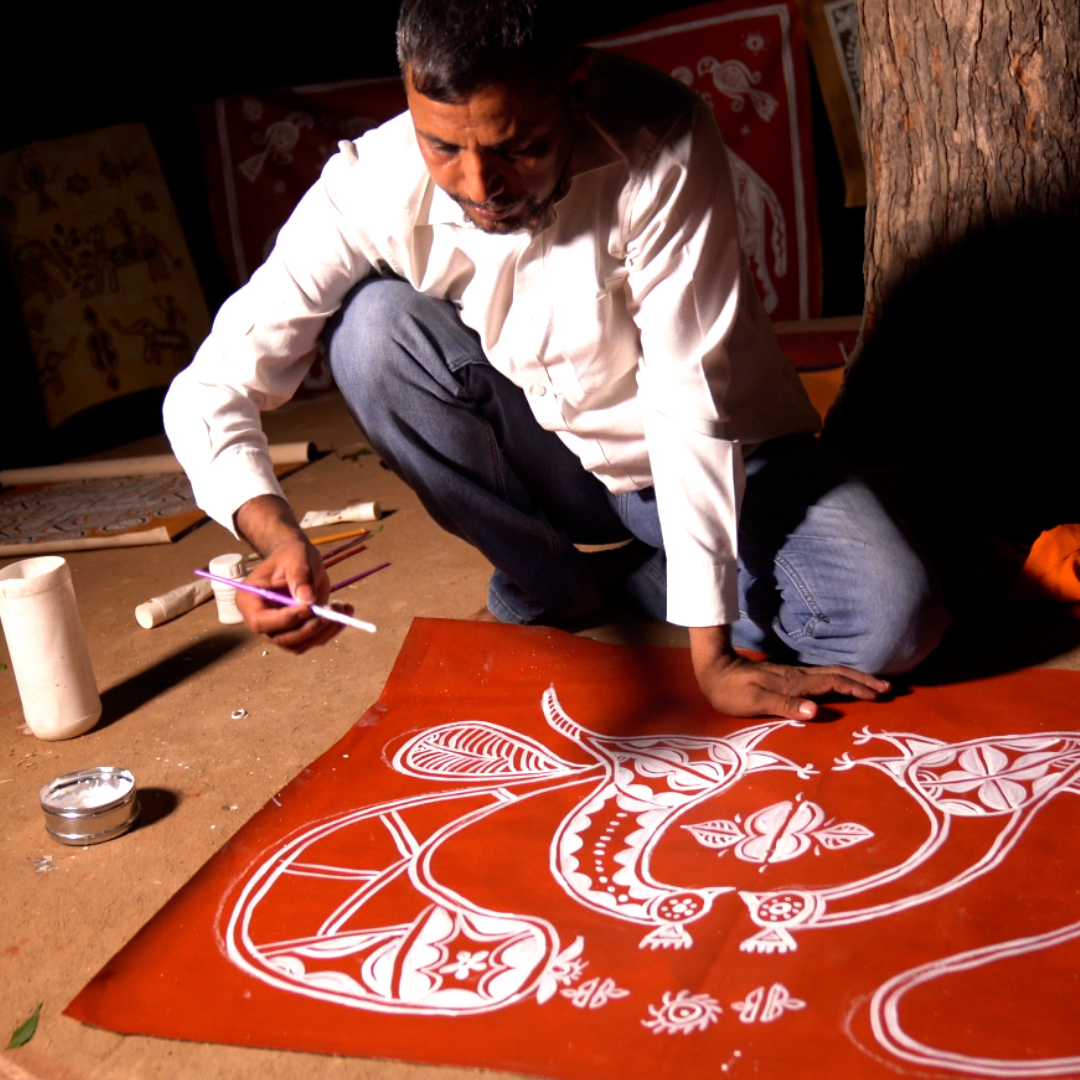
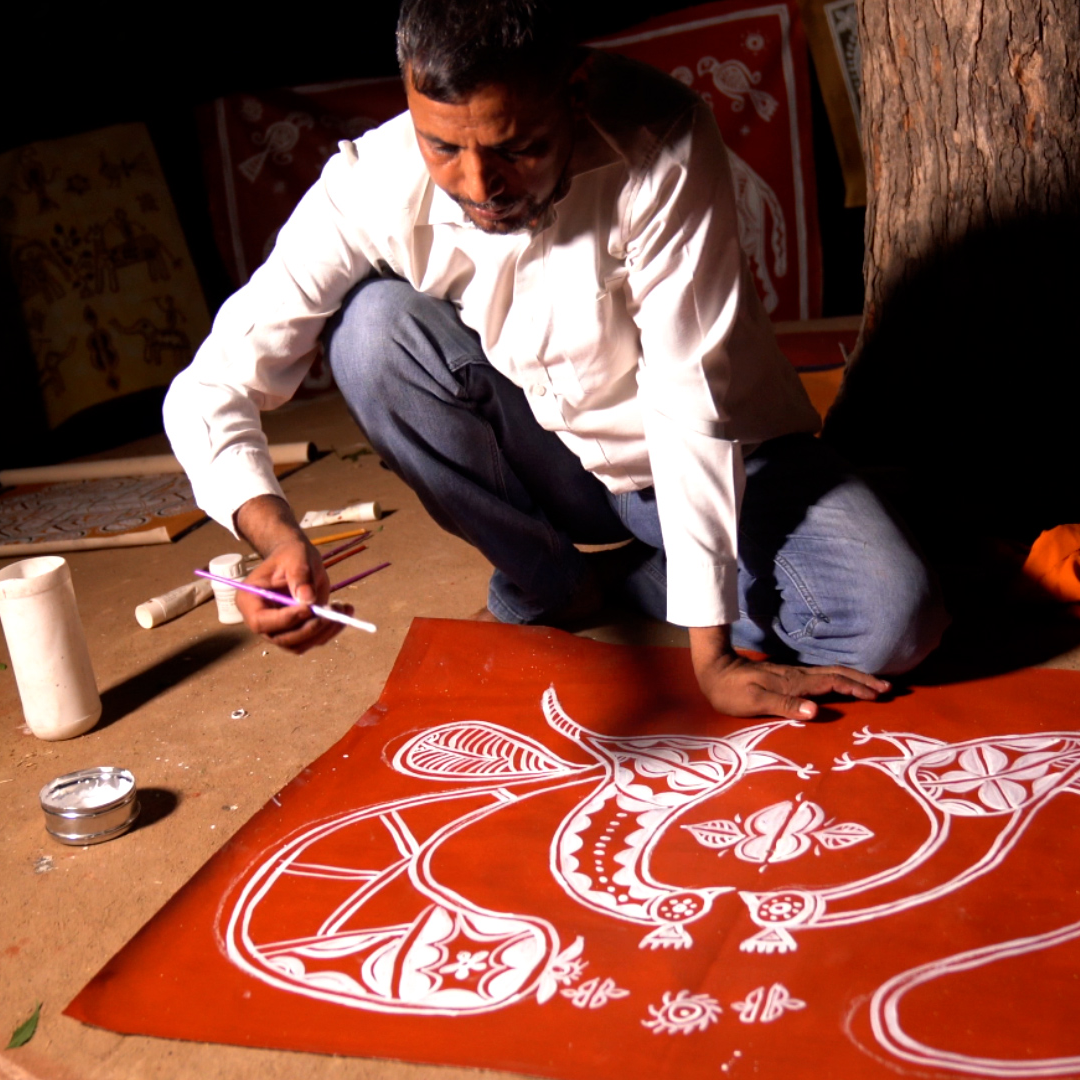
About Mandana The traditional wall and floor painting of madana art is one of the most prized possessions of the original Indian tribal art from Rajasthan and Madhya Pradesh. This art is predominantly performed by women of the Meena community and is sacrosanct, handed down through the generations towards retaining cultural identity and ancient customs.Mandana paintings are usually made on walls and floors with white lime or chalk, and red clay (geru). Contrast white lines on the blood red ground make the paintings visually rhythmic and vivid. The patterns are mostly geometric, representing items, such as leaves, flowers, birds, and animals, like peacocks and elephants or shapes, as well as religious symbols and they are considered to bring good luck and prosperity to the household; used to ward off evil spirits.The practice of making Mandana paintings is a devotional, and is believed to gain, blessings, and spiritual protection from the deities.Though the art is on its verge of extinction, attempts are being made to promote Mandana Art via exhibitions and workshops, and even its uses are being discovered for modern art forms through which, the art will stay in trend to inspire generations to come.
Techniques and Materials
- The base is made with a combination of clay, cow dung,and water, creating a stable organic surface for painting.
- The designs are made with lime or white chalk powder against a dark red or brown background.
- Typically, objects like twigs, fingers, or cotton swabs are used to apply detail.
Techniques and Materials
- The base wall is plastered with mud, clay and cow dung for leveling.
- Coloring is made from natural pigments of minerals, stones, plants.
- Plant-based bristles and handmade tools are used to detail the work.
Themes and Motifs
Topics Bhitti Chitra deals include:
- Mythological Narratives – from the Ramayana and Mahabharata and stories of local folk lore.
- Natrure-Themed Patterns – Trees, rivers, sun, bird, expressing our respect for nature.
- Daily Life Scenes – -Vegetations, tilling, gatherings for the community painted as an art form.
- Spiritual and Religious Symbols – Idols of gods, astronomical image, motifs of temple used in holy sites.
Over the years, Bhitti Chitra has been developed in such a way that modern colours and contemporary designs have been adopted and new materials have kept it alive amongst the urban decor, commercial art and heritage conservation works.
Significance of Mandana Art and Bhitti Chitra
Both Mandana Art and Bhitti Chitra are active traditions of the Meenas, linking past traditions with contemporary culture. However, as Mandana Art is ‘transmitted down generations in folk culture’, Bhitti Chitra is embracing contemporary market tastes and demands, commercial applications, and heritage preservation purposes.Irrespective of changing times, these art forms still serve as vehicles of the Meena tribe that hold the essence of the artistic dexterity and rich cultural expressions of the community.
Themes and Motifs: Meena Painting, which traces its origins in the folk art of the Meena tribe of Rajasthan, is characterised by brightly decorated backgrounds and use of fine lines to fill the larger shapes. These patterns are more than just design elements, they are cultural, traditional and religious symbols that represent the way of life of the people.
Geometric Patterns: The typical designs developed in such designs are the main pattern mode in Meena painting and it is a great factor in structuring and harmonising the patterns. These motifs consist of circles, triangles, squares, and diamonds, woven in symmetrical fashion. These types of tattoos represent equilibrium, strength and freedom in life.
Floral Designs: One type of pattern much loved in Meena Painting is the floral. Lotuses, marigolds, creepers and stylized leaves are drawn and painted onto the floor to represent nature, beauty and prosperity. Flower shapes and designs not only provide decorative value, but also symbolize fecundity and rebirth. It seems the work of flowers and leaves is inspired from Meena tribe designing.
Mythological Symbols: Subject Meena art is inspired by religious as well as mythical motives. Traditional compositions often include symbols such as peacocks, elephants, cows, as well as gods and goddess’s including Krishna and Durga, amongst many others. These designs transmit spiritual experiences and tell the story of other Indian epics and myths. Peacocks stand for grace and divinity while elephants represent strength and intelligence.
Connection to Nature, Spirituality, and Folk Traditions
Nature and spirituality According to Meenas, they are acting as custodians of the forests, value trees and animals, and revere the black buck and consider themselves as deer who will die to save the cruel king. The interests are often related to seasonal,agricultural cycle, and festival. The country folkways are represented through pictures of village life, native dress, and everyday customs. The artwork acts as a bridge between traditional roots and modern-day interpretations, a legacy of the past that is told culturally through a visual narrative.
Famous Artists and Practitioners
Meena Painting as a distinct tribal art of Rajasthan has been maintained and supported by celebrated painters as well as the indigenous craftsmen. Their contributions have been instrumental in preserving this art and as well as in reviving it in the modern day.
Ramdev Meena
One figure in the domain of Meena art who had significantly contributed for the upgradation at academic and cultural levels. 2. He is working as Assistant Professor (Drawing & Painting) at Government College, Bundi (Raj.). He is instrumental in recording and conserving the Meena painting tradition at regional as well as national level through his research, teaching, and sustained involvement with the traditional aesthetics. 'Reference' is an Important Artist of Meena painting (Indian miniature painting) as an academic and cultural identity. He is currently working as Assistant Professor (Drawing and Painting) in Government College Bundi (Rajasthan). His research, teaching, and on-going involvement in traditional aesthetics has been instrumental in recording and disseminating Meena painting heritage at the regional and national levels. ​ The 120 feet long and 06 feet high Meena tribal painting made by Ramdev Meena was exhibited at Rajpath on the day of Republic Day celebration 2022 In addition, Ramdev Meena's work has been displayed at TRI Bhubaneshwar, TRI Ranchi TRI Udaipur Shilp Gram Udaipur, CRT New Delhi, Ravindra Bhavan New Delhi, Manav Sangrahalaya Bhopal, etc.
Sunita: Innovating Meena Painting for Modern Audiences
Professional illustrator Sunita has helped to promote Meena Painting in children and young people. Through the content of her books, and her illustrations, she has incorporated Meena designs and motifs in an unostentatious but genuine way. Her paintings are punctuated with white geometric shapes, dense patterns and dots, which are features of traditional Mandana art. In working with publishers like Tara Books, Sunita has also helped Meena Painting to reach outside of Rajasthan and enter a global market.
Techniques, Materials, and Styles in Meena Painting
- Preparing the Surface: The surface preparation is an important factor in Meena Painting to provide finish and for the design to be worked out with details. The Indian artists belonging to the ancient Meena are known to produce these beautiful paintings on walls, floors and ceilings of their courtyards and homes using natural pigments to add to the expression of the artistic works. Before the painting process can begin the surface must be cleaned, treated and prepared.
- Cleaning and Treating Walls or Floors: Wash It: The first and most crucial step in prepping a surface. Any dust, grease, or roughness in the surface may directly affect the painting. It has been conventionally believed that the surface—a mud wall, a lime-coated wall or a floor—is scraped and wiped with water or a wet cloth in advance. It has analogous impurity removal and even texture to the previous step.
- Basic Techniques: Meena Painting is a well-known traditional tribe of Rajasthan; they are specialized in its geometric patterns and vibrant use of color along with depicting the sensitive use of the line. This folk-art form, done primarily by women of the Meena community, is traditionally derived by each passing generation from one another. Among another’s Drawing with natural brushes or fingers, layer stacking, fill patterns, etc Ares the basic steps in the creative workflow. These methods are the criteria for the beauty and continuity of texture for Meena paintings found on walls, floors and on paper.
- Outlining with Natural Brushes or Fingers: The first and one of the most vital steps of Meena Painting. It determines the structure of the design and instructs the artist in how to fill in the patterns and motifs. The practitioners avoid commercially made brushes and draw the borders of the pictures with natural items such as twigs, brushes made of plant material, cotton cloth, or even fingers.
- The Process of Layering and Filling Patterns: After the outline is created, the artwork goes to layering, filling patterns and coloring to achieve more depth, volume and saturation.
- Filling Patterns in Meena Painting: Filling with the pre-imagined patterns is one of the important processes to obtain this type of appearance in Meena Painting. The designs are not only decorative but also carry symbolic meanings tied to the natural world, spirituality and tribal identity.
Colors and Materials Used
Traditional Colors and Their Sources
Traditionally, Meena Paintings used colours from minerals, vegetables and the likes. The colours chosen were not only aesthetically pleasing but they also carried deep symbolic and cultural significance.
- White – One of the primary colors of Meena paintings, white was obtained from lime (chuna) or a paste made from boiled rice. It was also symbolizing purity, peace, and prosperity and therefore it was used as an outlining color or to stylistically bring out designs.
- Red – Made from red ochre (geru) this colour represents strength, energy and celebration. Ochre The red was made from naturally derived ochre that already contained iron oxide and was plentiful in the arid land of Rajasthan.
- Black – Black pigment was made with charcoal, or soot of oil lamps.Darkening was needed in hash and disparities and to define patterns.
- Yellow: Sourced from turmeric or yellow ochre, it conveyed fertility, light, and wealth. It is chiefly employed in floral, and geometric patterns.
- Green – Green was created using crushed leaves, plant-based dyes, and powdered stones and was symbolic of nature and renewal. It was, however, frequently used in tree, vine and animal representation.
- Blue – A less common color in traditional Meena Painting, blue was sometimes made from indigo or mined from lapis lazuli rock and represented the sky and water.
Water, gum or buttermilk was then added to this mixture to hold it to walls, floors, and surfaces. The earth colours and natural pigments harmonised magnificently with the rural settings of homes in the village to give them a look and feel that are both in-sync and long acting.
Materials and Tools Used in Traditional Meena Painting
- Walls and Floors as Canvas – The most popular surfaces for Meena Painting were walls and floors, that were given a smooth surface and coated with a first layer of cow dung and clay for an adhesive coating.
- Brushes Made from Natural Fibers – Preserved as above; artists made brushes out of twigs, bamboo sticks, or cotton cloth for fine lines and detailed patterns. Occasionally, the surface would be drawn on directly with the fingers.
- Cow Dung and Clay Mixture – This comprised a mixture of cow dung and clay and was used as the first coat to give longevity to the work and a natural matte texture to it prior to applying paint.
Conservation, Promotion, and Future of Meena Painting
Meena works, which were originally confined to the walls and floors of from rural houses, is now a part of contemporary art and decors. It’s an artform that's making progress even though it maintains its heritage, and is being realised as still contemporary.
1. Role in Modern Home Décor and Commercial Art
- Interior Design & Home Décor: Meena Painting as Wall mural, on furniture, decorative panels and as prints on fabric has added rustic but colorful elegance to contemporary interiors.
- Fashion & Accessories: Meena Painting’s detailed motifs are now transitioning to garments, jewellery, handbags, home furnishings and becoming contemporary life assets.
- Commercial Art & Branding: A lot of designers and brands have adopted Meena Paintings into packaging, logos and ads making it their own style yet not losing the folk-art touch in it.
2. Revival Efforts and Artisan Workshops
- Government and NGO Support: Meena Paintings, groups are conducting workshops and training programs on traditional Meena Painting to sustain it for future generations.
- Artisan Empowerment: Using online interface of gathering exhibitions, tribal artisans are also finding recognition and economic independence in their artwork.
- Fusion with Contemporary Art Forms: Meena paintings are also experimenting with canvas, digital art, and mixed media that has taken this tribal art to other states from Rajasthan.
In such endeavours, Meena Painting is also not only surviving, but thriving in the contemporary world, balancing itself between tradition and modernity.
Promotion of Meena Painting
Meena Painting: the age-old art form is being increasingly sought after, courtesy a cover from the government and on-the-rack support from the museums and digital medias. Special efforts are being taken to develop art-form– Its conservation and growth across the world.
1. Government Initiatives and Museum Exhibitions
- Handicraft fairs, workshops, and other advocacy works have been initiated by the Rajasthan Government and cultural departments to encourage Meena artisans.
- Meena Paintings are also exhibited in museums such as the National Museum in New Delhi and the City Palace Museum in Jaipur, and help to spread and popularize awareness among the public.
- Government-sponsored art residencies and fellowships incentivize artists to break new ground while preserving the traditional craft.
2. Digital Documentation and Global Recognition
- Meena Painting designs are being scanned by organizations and researchers, which helps in creating archives for the future reference.
- Artisans selling their work for customers from anywhere in the world, through websites like India Handmade, Amazon Karigar, Rajasthan Haat.
- Meena painting has gained exposure to international crowd from the series of international exhibitions and cultural festivals which re-established its place in the colours of Indian art.
Such endeavours are a great step to keep Meena Paintings alive in all pockets of Nation and even Global.
Conclusion
Meena Painting - A rich tribe art of Rajasthan Meena a tribal group of Rajasthan. In this course, we followed its historical development, classic techniques, contemporary interpretation and conservation and development of this very special art genre. Belonging to the Meena community, this style of painting is strongly connected to the religious beliefs, social customs and day-to-day lives of the masses. It has now moved beyond its ancient ritualistic origins to become a staple in modern art, homes, and commercial environments in using traditional methods such as canvas, paper and fabric.We had a discussion and were informed about the conservation issues, the government programme, its current cultural significance and promotional activities to be kept alive of Meena Art. Next In the following module, we're going to do some practical and hands-on work with workshops, quizzes and discussions on Meena Painting.