

Kapadaganda
Dive into the rich history of the Kapadaganda, the holy embroidered shawl of the Dungaria Kondh tribe. This in-depth course examines its cultural, religious, and economic diversifications fully, offering in-depth exploration into its creation, meaning, and practice. This course is ideal for students, designers, and cultural practitioners interested in authentic tribal textile knowledge.
 Most Viewed

What you'll learn
- Origins and Identity of the Dungaria Kondh : Understand the tribe’s sociocultural structure, spiritual beliefs, and deep-rooted connection with the Niyamgiri Hills.
- The Sacred Kapadaganda : Discover the symbolic and spiritual importance of the Kapadaganda shawl and its role in Dungaria Kondh rituals and identity.
- Design Language and Symbolism : Explain nature-based geometric patterns and their color symbolism.
- Embroidery Techniques and Skill : Discover the chronological embroidery process with traditional materials, tribal equipment, and design building.
- Ritual and Festival : Learn how Kapadaganda is integrated into marriage rituals, dances, festivals, and social events.
- Adornment, Identity, and Gender : Discuss how dress and ornamentation symbolize gender roles and community expression.
- Revival, and Worldwide Spread : Research the socio-economic contribution, GI tagging initiatives, and market acceptance of Kapadaganda.
Couse Features:
- Expert-Led Modules : Teaching sessions by field-experienced cultural researchers, tribal artists, and textile historians.
- Hands-On Embroidery Workshops : Live demonstrations and hands-on sessions to learn stitches and motifs of traditional Kapadaganda shawls.
- Case Studies and Visual Archives : Detailed accounts, photographs, and videos of real Kapadaganda shawls, festivals, and rituals.
- Interactive Discussions with Tribal Artisans : Exposure to Dungaria Kondh women and master trainers to learn from their experiential knowledge.Artisans Exposure to Dungaria Kondh women and master trainers to learn from their experiential knowledge.
- Project-Based Learning : Capstone project on creating a piece inspired from Kapadaganda aesthetics with a cultural research element.
- Certification : Earn an advanced-level certificate acknowledging your knowledge of tribal textile heritage.
- Resource Access and Reading Materials : Downloadable resources, pattern library, and access to exclusive ethnographic literature and GI documentation.
Who Should Enroll
- Textile design students and researchers
- Anthropologists and ethnographers
- Heritage and cultural conservationists
- Fashion and craft entrepreneurs
- Art historians and museum professionals
- Practicing textile artisans or master weavers
- Policy makers in craft development and GI tagging
Description
Introduction to the Dungaria Kondh Tribe
The Dungaria Kondh tribe is introduced in this module, including their social structure, various festivals, and their rituals, along with the cultural meaning of their traditional dress and ornaments. They give us a peak into their culture and lifestyle.
1.1: History and Overview of the Dungaria Kondh Tribe
Kapadaganda is an ancient art which is already handed down by tribesman from generation to generation as part of Dungaria Kondh tribe’s cultural heritage. Dungaria Kondh or Dungaria Khond are a tribal group of people in India. They are one of the subdivisions of the Khond tribe which is Odisha's largest tribal group.
Spread and Habitat
The Niyamgiri Hills cuts across the districts of Rayagada and Kalahandi in Odisha, and home to the Dungaria Kondh. The hills are covered in thick forests, teeming with wildlife, and homes to many natural resources that the community relies on for their livelihoods and cultural traditions.
Cultural Activities and Heritage
This close bond is essential for the cultural practices of the Dungaria Kondh:
Embroidery work: The community women are known to make the traditional shawl called Kapada ganda which has embroidery work done on it. With bright hues and designs of the same geometrical patterns symbolic of some aspect of their culture and beliefs, this handloom product makes use of careful craftsmanship.
1.2: Sociocultural Structure
Social Organization:
A council of elders known as Jani, Disari, Bismadhi and Mandal run each village, manage village affairs and settle disputes. These councils are important in ensuring social cohesion and adherence to customary practices.
Language:
The listed tribe communicates through the Kuvi language, an oral communication with no written text. The linguistic tradition plays an integral part in helping Dungaria Kondh retain a sense of identity and continuity.
Religion and Beliefs:
At the heart of their belief system is the worship of the God of the mountain, Niyam Raja, who presides over law and order. The Niyamgiri hills have sacred significance among the tribe, and their spirituality is intertwined with nature. The Niyamgiri festival, like many other festivals marked on a yearly basis, is celebrated with all fervour in India, which again reminds them of their relationship with the land and the Gods.
Economy and Livelihood:
Most of the Dungaria Kondh are subsistence farmers and horticulturists, growing crops such as millet, and vegetables. Moreover, those also practice forest occupation, and harvest forest produce, and other traditional crafts.
1.3: Festivals and Rituals
Kadru Parab:
Kadru Parab) is one of the major festivals of the Dungaria Kondh, closely associated with agricultural cycles and the appeasement of their deities. The festival is a communal event, with the entire village participating. Ritual specialists such as the Dishari (shaman) and Bejuni (female ritualist) play key roles, often entering trances accompanied by the rhythmic beating of drums. Dance is central to Kadru Parab and other Dungaria Kondh festivals. The dances are performed collectively, with both men and women participating.
The movements are rhythmic and energetic, often accompanied by traditional drumming and singing. The dancers may use axes and other implements, reflecting their daily life and connection to the land.
The Bejuni, or female ritual leader, often leads ritual dances, especially during trance states, believed to channel spiritual energy and blessings. These dances are not merely entertainment but are deeply embedded in the tribe’s religious and social fabric, serving as a means of communication with their deities and ancestors.
Ghanta Parab:
It is observed communally in the month of Baisakh for three days. Ghanta means earthen pot, and each such pot with flour cake is offered to Takrani-Penu along with a sacrificial animal by the vow-taker who suffers from small-pox and cholera.
Salangi Puja (Hada Puja) :
Domesticated animals are to be saved from the predations of wild animals and ravages of diseases. To save them, Sala-Penu, the deity of the cowshed (Hada sala) must be worshipped in the month of Jet (May-June) by the head of the household.
Mandia Rani:
This festival is observed individually and also communally in the month of Shravan (July-August) before harvesting of ragi. The objective is to get a bumper yield of ragi and other varieties of millets. It is observed for two days-on the first day, it is observed communally and on the second day individually.
Pidika :
Insects are locally called Pidika, who are harmful to the free growth of castor plants. For eradication of the insects a ritual is observed in honour of Jatrakudi Penu who is believed to save plants if, properly appeased. Due to the economic importance of castor seeds more emphasis is given to satisfy the deity with a buffalo, three fowls and a pig.
Punapadi :
Millet crops, like-Kosla, Arka, Jana, Ganthia etc. are eaten ceremoniously for the first time after harvest, and for that this festivals, observed. Before eating, these crops are ceremoniously offered to Jatrakudi Penu and to the ancestors. This is observed for a day in the month Kartika (Dewali-Lenju). The Bejuni propitiate the Jatrakudi Penu on this occasion.
Meria Puja :
It is the biggest festival observed communally in anyone of the villages of a Mutha for 8 days in the month of Magha (January-February) where all People of a Mutha and people of other Muthas too, participate. If there is no bumper crop, the festival may be postponed to the next year as it involves lot of expenditure.
The purpose of this festival is mainly to appease the Supreme Goddess, Darani Penu, and Her disciples. At the same time steps are also taken to appease all other deities and spirits of various clans present in the Mutha.
1.4: Traditional Adornments and Clothing
TheDungaria Kondh tribe is an indigenous community residing in the Niyamgiri Hills of Odisha, India. Their traditional attire and adornments are rich in cultural significance, reflecting their deep connection to nature and heritage.
Traditional Clothing:
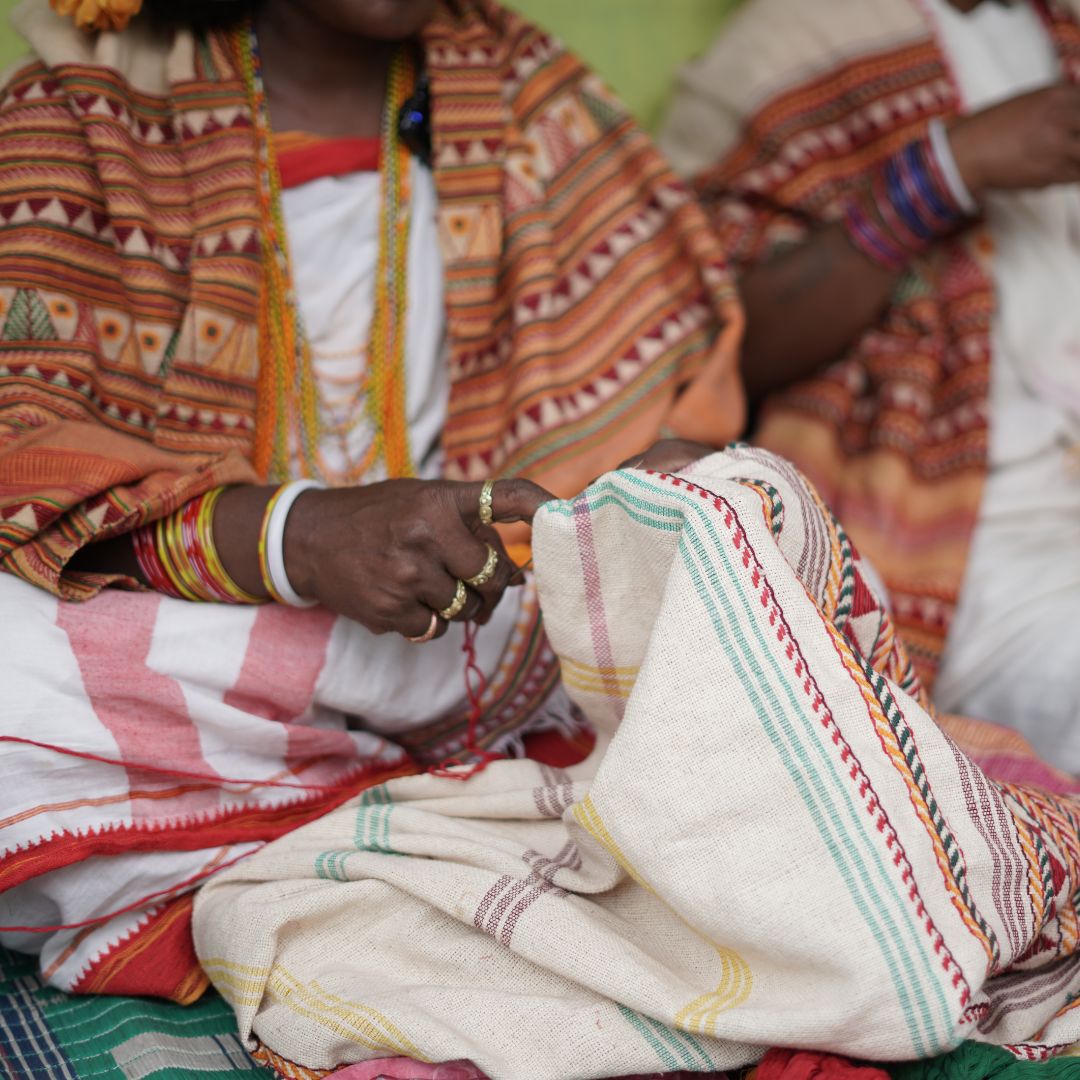
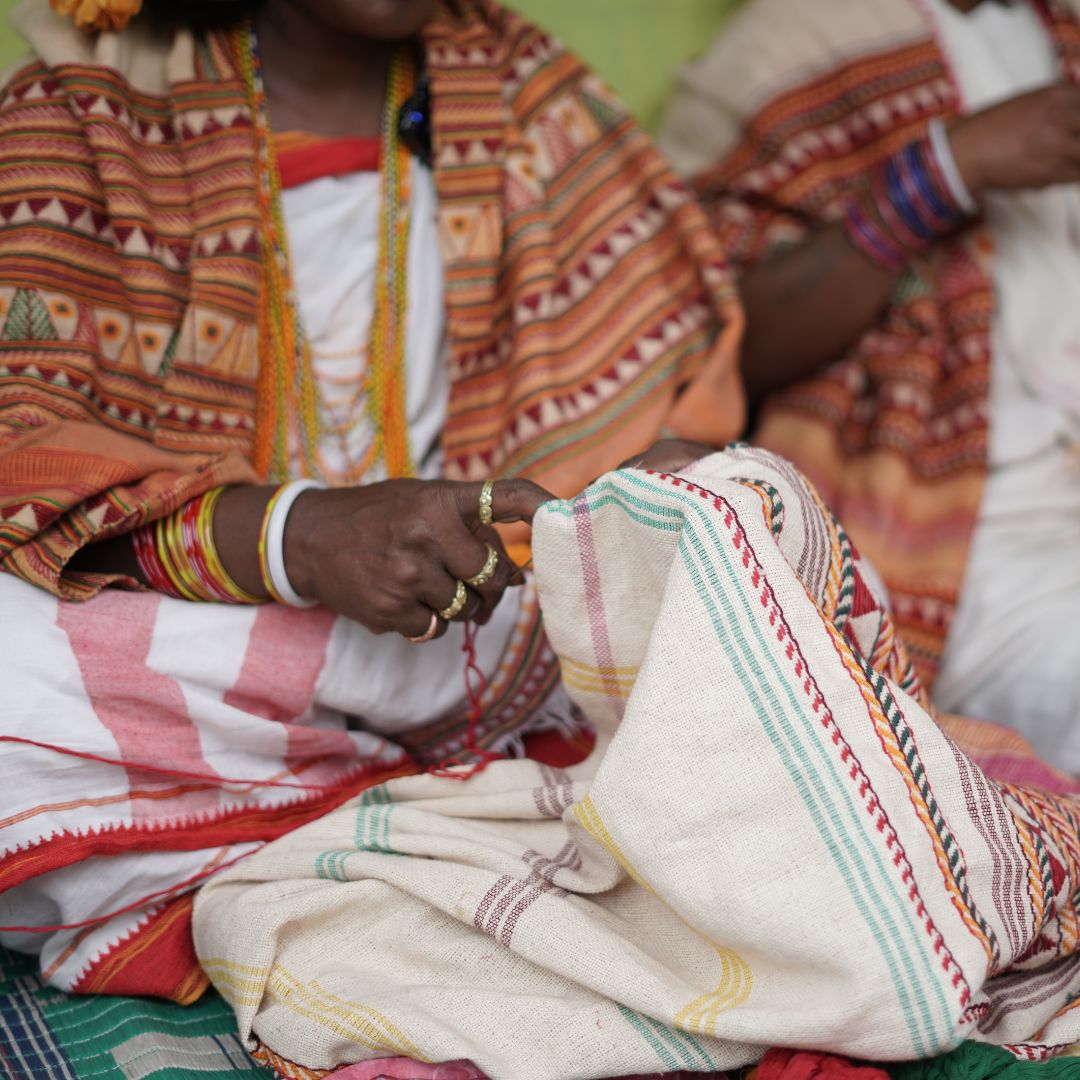
Kapadaganda Shawl:A hallmark of Dungaria Kondh attire is the Kapadaganda, an intricately embroidered shawl crafted by women. These shawls are woven on primitive looms, with the base fabric typically purchased from local markets. The embroidery features vibrant colors—red, green, yellow, and brown—each symbolizing elements of their environment and beliefs. The designs include motifs like 'Kandaba' (triangular shapes resembling temples), 'Keri' (a combination of red and yellow), and 'Wata' (straight lines in multiple colors). The embroidery process is meticulous, often taking several months to complete a single shawl.
Men's Attire:Dungaria Kondh men traditionally wear a loincloth known as 'drili,' with embroidered ends hanging in the front and back. This garment is complemented by other traditional clothing items; though specific details are less documented.
Kakawa (Comb made of Buffalo Horn)
As the comb is prepared by the Dungaria male himself, a specially made knife (Kakawa Katri) and a wooden stump (Kakawa badga) is required in its making. The comb is made of a small piece of buffalo horn having numerous teeth (Palka) on both the edges. The specially made knife has a wooden handle attached with a tin blade having a wavy edge. The wooden stump is split into two parts at the top to hold the piece of horn in tight grip during its making.
Sipna (Hairpin)
It looks like a scissor having silver blades fastened at the middle. At the head end, two silver strings are coiled round to form two rings. It is made by the Ghasis as well as blacksmiths. It is pinned to hair lock form the side. It is used mostly by old ladies and sometimes by married woman.
Kilamodi (Hairpin)
The ornament is made of a single piece of silver wire bent to make it ‘U’ shaped. This hairpin is made by the Ghasi caste. It is pinned in the hairlock along with the scissor like hairpin.
Kagudi (Necklace)
Both iron and silver are used for making necklaces. The shape of the ornament is more or less circular. The look at one end is fitted to the ring when it is used. It is made both by the blacksmiths and Ghasis. It is a common ornament used by Dungaria women. As many as eight to twelve such necklaces are found to have been worn in some cases.
Daura (Talisman)
The object is a curved piece of brass, pointed at one end, having a small cavity to contain the roots of wild plants given by the magician. Three pairs of hooks are fixed on the upper surface of it to tie it around the neck by means of a string. It is made by the Ghasi caste. The cavity contains medicines prepared from roots of wild plants given by the magician. It is usually worn by male children as Dungarias believe that fever and other diseases used by evil spirits will not attack the child. A thread is inserted into the perforated hook for hanging it around the neck or tying it around the arm. Except Mondays and Thursdays, other days are regarded as auspicious for wearing the talisman.
Tadwa (Armlet)
This is a brass ornament, with flattened surface, circular in shape. The flat surface is engraved with several designs. The ornament is worn in the arm and kept tight by pressing both the ends together. It is specially used by newly married women. The ornament is brought along with her from her parent’s house during her marriage. When the ornament does not fit the arm it is used in the wrist.
Kwte (Ear-pin)
This is a brass ornament having two small pointed parts, one part having a small hole and the other having one small knob fixed to it. The earpin is made by the Ghasi.
Antasuta (Waistchain)
Both unmarried and married women are found wearing a type of waist band made of silver or alloy. Many women are found wearing four to five or more of such belts around the waist. They get this ornament done by the goldsmiths at the time of their visit to their villages.
2: The Kapadaganda Shawl - Production and Craftsmanship
This module will take you through the elaborate procedure of making the Kapadaganda shawl, from weaving the foundational fabric of the shawl, to the detailing of its embroidery. You will learn the meaning of the colors and motifs and the cultural significance of this traditional shawl.
2.1: Embroidery Process
Kapadaganda, an embroidered shawl made by the Dungaria Kondh tribe of Odisha. Embroidery is an intricate craft, which comprises multiple forms and then integrates to create the beautiful finish of the shawl.
Embroidery Process in Detail:
Step 1:Preparation of Base Fabric:The base fabric called Ganda/ Kapada is woven on pit looms conventionally by the Domb community. This rough grey fabric is what you sew the embroidery onto. This fabric is bought by the Dungaria Kondh women, where the size of the ever-used shawl is 2 to 2.5 meters long and 1 to 1.5 meters wide.
Stitches Used for Embroidery:Vibrant patterns are crafted using different stitches that are mainly satin stitches. The artisans use a variety of motifs, each with its own cultural significance:
Wata: The work of embroidery sets-in with Four straight lines of brown, red, yellow and green color symbols of the nature and environment with the tribe.
Kralikana:Small triangles made of red thread, representing the axe, a culturally valued motif.
Hipa:A design element incorporated in the fabric.
Keri:A motif using green, red, and yellow threads, adding to the visual appeal.
Khandba:Triangular shapes embroidered with red thread, contributing to the geometric patterns.
Kahan:Medium-sized triangles divided by a straight line, adding complexity to the design.
Karpi:Lines at a 30-degree angle touching the lateral lines of a triangle, enhancing the geometric patterns.
Kanka:Semi-rectangular or circular shapes embroidered, here they use red, brown, yellow, green etc, with various colors, adding diversity to the design.
Hahant:Medium-sized triangles divided by a straight line, and 30 angle straight line touching the two lateral lines of triangle known as karpi.
The motifs are stitched with colored threads, mainly red, green, yellow and brown that represents various aspects of the tribe and nature.
Finish and Use:The lush appearance of the embroidered creation is achieved with a time-consuming hand process that seeks maximum perfection in its details. Depending on the labour invested and the expertise of the artisan, a single shawl may take anywhere between 15 days to six months. When completed, the instrument is played in traditional ceremonies, festivals and rituals and represents cultural identity and artistic expression.
2.2: Symbolism of Colors
The Kapadaganda shawl, crafted by the Dungaria Kondh tribe, is rich in symbolism, with each color and motif carrying deep cultural meanings. These elements are carefully chosen to reflect the tribe's relationship with nature, spirituality, and their societal values. Here is an in-depth look at the symbolism of the colors and motifs used in the embroidery of the Kapadaganda:
Symbolism of Colors:The colors used in the embroidery are highly symbolic:
Red: Symbolizes blood, sacrifice, battles and war.
Green: Represents woods, plants, and agricultural land.
Yellow: The color of turmeric fields, peace, and serenity.
Brown:Symbolizes hills, mountains, strength and masculine power.
They are familiar not only to beautify the shawl, also to keep in a sense of uniqueness and touch of culture.
2.3: Tools and Materials
To make the Kapadaganda shawl, the Dungaria Kondh tribe uses particular tools and raw materials that signify their traditional art and cultural heritage. Detailed textile art is made through both handmade and natural resources through generations. This is a brief insight into the various tools and materials that are used in the embroidery and weaving of the Kapadaganda shawl:
Materials Used:
Cotton Thread:The shawl is woven and embroidered using Thread as the main material. The Dungaria Kondh like to employ base fabric and embroidery threads of locally available hand spun cotton. These threads are organic, long-lasting, and perfect for the fine and complex needlework involved.
Natural Dyeing:The tribe also dyes the threads using natural dyes which are extracted using local plants found on the region. These are natural dyes and are obtained from roots, vegetables, flowers, etc, they are well-regarded because they have a nature feel in addition to being highly sustainable.
Tools Used:
Needles:
This process is carried out by hand needles which are the key components for the making of fine and exquisite stitches. These needles are usually metal coated.
Katri:
The katri is an indigenous cutting tool has multiple uses. It is used by women for cutting thread or cloth while doing embroidery work. For women it is a utility tool that serves many purposes, so, women keep it fixed to their hair as a clip.
Pit Loom:
Pit loom, stand loom and frame loom are three kinds of looms predominantly used by the handloom weavers.
The pit loom is a loom situated on the ground / floor with a pit having two peddles set in the pit for the weaver to operate.
Yarn:
First cotton is collected from the field to make yarn and the yarn is prepared by hand spinning.
The raw material i.e. yarn is very coarse and grey in colour. The base off white cotton coarse cloth is prepared by the Dom community which is purchased by the Dungarias
The count size of basic fabric used is always the same that is 10 which is a uniqueness of Kapadaganda.
By combining these toolsand materials, the Dungaria Kondh are able to create the Kapadagandashawl, a piece of art that reflects their deep connection to the land, their spirituality, and their rich cultural heritage.
3: Cultural Significance of the Kapadaganda
This module talks about the cultural significance of the Kapadaganda shawl along with its traditional uses and functions in the Dungaria Kondh community.
3.1: Traditional Uses and Functions
The Kapadaganda shawl made by the Dungaria Kondh tribe has great cultural importance and is used in multiple functions of peoples' lives. These functions are closely aligned with tribe's spiritual belief, social practices, and life style.
Traditional Uses and Functions of a Kapadaganda Shawl
Ceremonial and Ritual Use:
Sacred Significance:The Kapadagandashawl is often worn during religious ceremonies, including rituals dedicated to their deities, especially Daranipenu(the earth goddess)
Rites of Passage: It is used for significant life events such as weddings, birth ceremonies, and initiation of young tribal members. During the wedding, both the groom and bride will wear the shawl, which together serves as the promise of unity, a new and prosperous family, and the continuation of family descendants.
Social and Cultural Events:
Community Gatherings:The Kapadagandashawl is worn during significant community events, such as festivals, harvest celebrations, and feasts. It is a way for the tribe to display its cultural pride and collective identity. The shawl is often worn by the elderly, who are seen as the custodians of tradition and knowledge.
Folk Performances and Dances:In some cases, The Kapadagandashawl is worn during folk dancesand performancesthat are part of the tribe’s cultural festivities. The movements of the dance, combined with the intricate design of the shawl, create a visual spectacle that emphasizes the tribe's artistic expression.
Symbol of Status and Identity:
Tribal Identity: The Kapadaganda shawl is a distinctive symbol of the Dungaria Kondh tribe. Wearing one signifies the cultural significance of the tribe and the right to wear one often belongs to tribal leaders and respected elders and are worn during community gatherings and celebrations. Utilization of the shawl represents how the tribe preserves and expresses unique history.
Artistic Personality: Every Kapadaganda shawl reflects the personality of his/her maker. The colors that are used often have significance. The shawl, therefore, is not just an article of clothing but a page out of the history book telling the tales and a demarcation of the customary aesthetics of the tribe.
3.2: Traditional Adornments and Clothing
The garments worn by them and various ornaments on their bodies are an important part of their culture and traditions and are a complete representation of their closeness to nature.
Dungaria Kondh Ornaments: Adorning Tradition
The Dungaria Kondh people adorn themselves with a variety of traditional ornaments that are integral to their customary attire. These pieces are worn on different parts of the body, enhancing their distinctive look.
Head Ornaments
Mila Sapa, Daba Sapa, Sapa: These ornaments are specifically worn on the head.
Ear Ornaments
Kute, Murma, Jamli, Sapa:A selection of ornaments designed to be worn on the ears.
Hair Adornments
Khosa: Used for styling hair into a bun.
Lamodi, Sapa: General accessories for the hair.
Neck Wrist Ornaments
Mekodika: An ornament worn around the neck.
Gaju, Mudi: These pieces are worn on the wrist.
3.3: Significance of Kapadaganda
- The Dungaria Kondh uses this kind of shawl, as an ornamental traditional cloth which has socio-cultural implications.
- Both the male and the female wear the Kapadaganda or shawls at the time of their marriage, traditional festivals, fairs and rituals as auspicious symbol and as a part of their rich culture
- The Kapadaganda is made with excellent craftsmanship and it is prepared by spinsters of the community who gift it to their beloved ones as a token of love. It is also presented by them to their brothers and fathers as a symbol of affection.
- During Meria Festival the male youths throw the shawl directly on the girl of his choice. It is held that if the girl accepts the shawl, then it would mean that she approved the love request of the boy. If the girl promptly sheds off the shawl thrown on her body, it would mean that the girl is not interested in the boy.
- The village headman like Jani, Disari, Bismajhi and Mandal put shawl on the shoulder during the traditional village council meeting.
- In marriage ceremony the boys and girls during dance exchange their shawl with whom he/she interested to make him/her as life partner.
4: Economic Impact and Challenges
4.1: Economic Role of Kapadaganda Production
Kapada ganda shawls are not only made from solitary male cocoon but they are also an important source of economic support for the livelihood of Dungaria Kondh. These shawls, which eventually become symbols of culture and have high sustainability potential for income generation (especially for tribal women) are traditionally embroidered using local threads and regional cloth. Kapada ganda shawls under GI tag are known widely now, which have paved a path of better business opportunities in and outside the country.
It appreciably makes the craft more marketable and produces a larger consumer base ensuring better prospects for demand. That said, and for the sake of long-term economic sustainability, skill development schemes need to be sector-specific. These training initiatives help Dungaria women refine their embroidery techniques, enhance product quality and develop marketing capabilities to ensure better access to wider markets.
Meanwhile, the government needs to intervene and keep extending hand holding support to help in any way to save this age-old craft from perishing as well as give economic viability to the artisans. One way of conserving and at the same time improving the livelihood of Dungaria Kondh is by marketing Kapada ganda shawl from the foothills of Niyamgiri to rest of the country and the world.
4.2: Diversification of Products
Product diversification is essential in preserving the traditional embroidery craft, such as the Kapadaganda shawl, without hindering its continuity due to changing consumer adapted to different market values and the demand.The project seeks to promote the artform outside its traditional usage and generate new local employment for the makers.
With the evolution of tribal outwear over decades, usage of Kapada ganda shawls has reduced to a great extent in day-to-day life. Acknowledging this difficulty, the State Government has taken initiative in these regard to improve the quality of production and broaden the scope of usage of the embroidery. Young Dungaria Kondh women have undergone specialized training to improve their hand-embroidery and to make it viable on different products. So, trained artisans become master trainers, educating the other women of the community and thus enhancing the quality and marketability of the product.
However, the originality of the Kapada ganda embroidery is maintained even after these innovations and the craft is 100% handmade and there are no machines involved. Finally, now that Kapada ganda has been awarded the GI tag, there is more potential in terms of recognition, protection and promotion so that the Dungaria Kondh community can conserve their cultural heritage and also be offered diversified livelihoods (Ministry of Textiles 2023).
5: Kapadaganda’s Future and Global Recognition
5.1: GI Tagging and Global Recognition
The Kapadaganda shawl from Odisha has been granted a Geographical Indication (GI) tag,recognizing its unique cultural and artisanal significance.This achievement highlights the efforts of the Odisha government and local communities in preserving and promoting tribal heritage. The GI tag ensures the authenticity and uniqueness of the shawl, protecting it against counterfeits and affirming its origin.
Importance of GI Tagging for Kapadaganda
Prevention Of Heritage: By obtaining GI tagging, Kapadaganda is protected from diluting its uniqueness and authenticity as it is now, by law, associated with the Dungaria Kondh tribe along with the region in Odisha.
Preventing Imitation: GIs can prevent outsiders or mass market producers from exploiting the name of the locally produced products. Due to the GI registration only the artisans of the Dungaria Kondh tribe can sell products under the Kapadaganda name.
Economic Sustainability: GI also helps in fetching higher prices for Kapadaganda products bringing better incomes and enhanced livelihoods to the artisans.
Preservation of Traditional Crafts: GI boosts the promotion of traditional processes like hand weaving, natural dyeing, or delicate embroidery so that they can continue into future generations.
Market Expansion — It opens doors for Kapadaganda to tap into international markets, mobilising cultural tourism and exports
5.3: Challenges Way Forward
The Dungaria Kondhs embroider beautiful shawls (Kapadaganda) using traditional thread and cloth. The product is generally used to show their respect and affection towards elders. To expand production of theses culturally rooted shawls, steps should be taken to not only preserve the heritage-oriented skills of PVTGs, but also, they should earn sustainable livelihood by embroidering the shawl.
With the GI tagging of Kapadaganda shawls, this rare work of fine arts needs to be promoted and popularized throughout the world, from the foothills of Niyamagiri to different parts of the country and abroad. Specialised skill trainings need to be imparted to the Dungaria women for different product diversification of their embroidery works and shawl designs and marketing of their products. This Kapadaganda shawl is one of their cultural identities, which needs intervention and handholding support of the government to safeguard their culture and skills.
Conclusion
As we followed this detailed course on the Dungaria Kondh Tribe’s Kapadaganda Shawl, we have taken a deep dive into the heart of a community that is the essence of culture, connection, heritage and sustainable way of life. Now, we started to understand the Dungaria Kondh Tribe, their complex socio-cultural structure, their festive life full of colors and vivacity. The tribe's unique identity is beautifully reflected in their traditional adornments and clothing, which are not just expressions of beauty but also symbols of their cultural and spiritual beliefs. Kapadaganda Shawlis an embroidered shawl on an off-white coarse cloth with red, yellow, and green colored threads, crafted by women of the Dungaria Kondh tribe.The shawl is a symbol of the tribe's cultural heritage and craftsmanship, with intricate motifs that reflect their traditions and connection to nature.