

Baiga Karma Dance
This course provides a rich introduction to the Baiga Karma dance, a traditional art form of the Baiga tribe. It explores its origins, historical and cultural significance, essential dance elements, and musical accompaniments. Participants will engage with techniques, performance practices, and preservation strategies. The course combines theoretical and practical insights, fostering an appreciation for this unique cultural expression while equipping learners with foundational skills and understanding.
 Most Viewed
What you'll learn
- Historical Context : Discover the origins and significance of Baiga Karma dance and the Baiga tribe.
- Dance Elements and Music : Learn basic steps, postures, rhythms, and beats.
- Costumes and Language : Understand traditional attire and the role of body language.
- Performance Techniques : Master group and individual dance techniques and rehearsal practices.
- Preservation and Modern Relevance : Explore conservation methods and the dance’s role in contemporary culture.
Couse Features:
- Expert Guidance : Learn from seasoned instructors with deep knowledge of Baiga Karma dance.
- Step-by-Step Tutorials : Detailed demonstrations of dance movements and musical integration.
- Interactive Learning : Engage in activities, assessments, and live Q&A sessions.
- Multimedia Resources : Visual aids showcasing costumes, instruments, and performances.
- Certification : Earn a certificate upon successful course completion.
Who Should Enroll
- Enthusiasts of traditional and cultural dance forms.
- Performing arts students or professionals.
- Researchers of indigenous cultures and tribal heritage.
- Educators seeking to enrich their curriculum with traditional dances.
- Advocates for the preservation of cultural traditions.
Description
BAIGA KARMA DANCE
Introduction and History
Baiga Karma Dance is the cultural legacy of the baiga tribe of Madhya Pradesh. With this dance they express their strong faith in nature, tradition and community life. After harvest, especially Karma dance is specially organized to protect nature and to explain the significance of nature. This tourney dance is a colorful pageantry of the ethnic culture and spiritual ethos of the Baiga tribe. It's a unique vision — men and women decked in colorful costumes, and jewelry doing one mass dance to the sound of drums. Every step and beat of the dance through representing the diversity of nature carries the message of oneness and togetherness in the society.
What is Baiga Karma Dance?
Now first of all we know what is Baiga Karma Dance? Baiga Karma Dance: This is a Karma dance performed by the Baiga tribe residing in Madhya Pradesh. Baiga tribal dance is a tradition unique to the Baiga tribe. It shows the amount of love they have for the earth and the lifestyle they live. They often do this dance to celebrate their work when they have harvested their crops. This dance even conveys a good message about planting trees and protecting nature. In this dance, when the men start drumming and the woman dresses up in colors with beautiful neat clothes and metal jewelry around the neck. They express themselves by moving around, grouped in a large circle where they dance together. Baiga dance — It depicts how the baiga tribe is in love with nature. The movements and poses are based on aspects of nature, trees and animals or other elements in nature. The dance also demonstrates the tribe having fun while overcoming the mundane. For Baiga people, Karma dance is not only a dance but a method of transferring tradition to their children and grandchildren.
History
Let us now know the history of Baiga Karma dance.Long ago, when the Baiga people lived in the forests and lived close to nature, they started performing a special dance called Karma dance. They liked this dance so much that they started performing this dance on every important day of their life. Even now Karma dance is very important for the Baiga people, just like it was a long time ago. This special dance helps them remember their traditions and teaches their children about their culture.
History of Baiga Tribe
Let us now be aware of the history of Baiga Karma dance.The Baiga people used to inhabit the forests and remained in a primitive way of life long ago, Karma dance coming into existence when they began to live in close proximity to trees and nature. This dance was something they loved so much that they kept performing this dance on all important days of their own life. The Karma dance is still of utmost significance to Baiga people even today, like it used to be many decades ago. Doing this unique dance preserves their memory and spreads the word to their children about their tradition.History of Baiga TribeNow let us aware of the background of Baiga tribe, so Baiga tribe is a primitive tribe of the Dravidian group and this tribe is also one among the most ancient tribes of India. Baiga people are Indian people mainly live in Madhya Pradesh. Baiga tribe has following the unique social system and culture. Baiga culture is as ancient as the Baiga tribe itself. Baiga tribe : The tribe maintaining its cultureThey follow a very simple lifestyle and food habits. The Baiga tribe people worship trees and Budha Dev and Dulha Dev as their god. There is the practice of exorcism and belief in witchcraft among the Baiga. Their attire is very minimal. Baiga men wrap a loincloth and towel on his head while woman of Baiga used a sari and polkha. However, all of the young males in the plains these days have begun wearing shirts and slacks also.The women of thisi tribe are very fond of jwelery. Baiga women also used to have tattoos apart from jewellery. In their culture, tattoos are significant. Tattooing is done on different parts of body of Baiga women. These people are primarily engaged either in collecting wild goods — forest produce, animal feed — small scale farming — or else they work as exorcists. Even the culture of Baiga tribe is being modernized in the modern period. Baiga are now coming out of dense forest, caves and hunting. They have adopted plain living agriculture. But they declare themselves the king of the jungle and the first human. They claim to be the creation of Lord Brahma.This tribe is been going through a lot of backward state and they are afraid of coming in contact with humans who are civilized. The tribe lives wild away from civilisation, and seeks to live part of its life in the wild with the group. This tribe composed of inaccessible hilly regions. The men of this tribe wear nothing but a long loincloth, their hair is as black as coal. They carry bows and arrows and axes, dangling from their shoulders.This tribe dwells in the Satpura mountain ranges of the Mandla, Balaghat and Bilaspur districts of Central India and their homes are at high and dense forests where only a single footpath is seen to access. Hence, only when they have business with a trader, or somebody who deals in money, are they spotted; at other times, they never; seldom are they to be met with.Even now Baiga witnessed not just wearing dhotis but also acquisitions of apparel and slowly and gradually modification is noticed within their daily life. And Baiga tribe is a primitive tribe and this tribe also like to live alone.There is no historical proof to this fact, only an estimation based on mostly folk tales regarding the origin of this tribe. Various legends on the origin of Baiga tribe exist e. g. In the beginning God made Naga Baiga and Nagi Baigin, Naga Baiga and Nagi Baigin moved to the forest etc. Both of them after a while had two babies. The first-born child was called Baiga and the second-born child was called Gond The two children took their sister as wives. From these two couples, the human race later came. Baiga is the ancestral child of the first couple and Gond of the second one.Now as we talk about this tribe, they believe that Naga Baiga is their ancestor but its hard to prove the location and origin of Naga Baiga as there are no historical facts that Naga Baiga resides here. Lastly, according to a legend of Baiga, there is a belief about the origin of the Baiga tribe that – in the beginning, there was only water and a God was sitting in a leaf. Then, when God was finding the earth But he did not get Then Brahma ji created a crow from the dirt of His chest And said to the crow, Go And look into the world And the crow flew away. In-flight, he saw a crab, the crow went up to the crab and said do not lie and give me the soil of the earth. The king of the underworld gave the soil to the crow, which stuffed into its mouth and flew to the crab. The crow came to God with the Mother Earth (soil), and the crab came out of Purga with the crow. You scatter the soil it became earth by it self as GOD.As God went over to see the earth, the earth started trembling. Now God made Agaria, Agaria made iron nails and in four corners to hammer them God made Naga Baiga. So then Naga Baiga drove in nails all around the earth, hence Baiga is also protecting the earth. This legend states that Naga Baiga who is guarding the earth made by Brahma Ji. Naga Baiga are a shikaar for embodied Lord Shiva.The concept that is popular in the Baiga habitat areas that informs people about their origin is as follows- In the beginning, there was water all around. The water had only 1 lotus flower and some leaves. Gods used to sit on the leaves.A powerful wind had once blown, and the leaves were saturated and the gods became soaked with rain. It made the gods angry and they found a way to cure this and started looking for land on the water but the land was not found. While looking for lands one day they came across an island inhabited by Naga Baiga. Naga Baiga each used his heart, the gods and went to the promise that he would find the land, the gods in place. Naga Baiga knew zero about the land. Naga Baiga thought of the crow and the crow was there in minutes. Then crow was asked by Naga Baiga to search the land.The crow opened its body as large as possible and flew. Years passed, that crow would not stop flying. It spotted a mound to perch on that resembled a tower. You see, that tower used to be home to a crab. At that time, the crab was busy worshipping the Sun. The jaw cracked, unable to support the weight of the crow, crushing the crab. With its other jaw, the angry crab caught the crow by its throat.The crow told an entire back-story. The crab listened to the story and agreed to help the crow for his friendship. The crab traveled with the crow and some time later, they both reached King Hadan. The snake girl they saw there, as both thought, the earth. The crab attempted to seduce her and so they moved along as the girl cranked her inner thighs. During the journey, they met a demon called Kechua who swallowed the girl with a spell. When the crab and the crow did not find the girl with them, they became worried and started searching here and there, at the time, an aunt squirrel guided them towards the demon. The jaws of the crab stabbed the gut of the earthworm and it released the girl. Once the girl was returned to both of them, they both started walking forward again. The crab and the crow brought the girl to the gods, whom welcomed the crow and the crab.So Gods decided to put a swayamvar for her on water. All gods were shocked, when the girl did not choose the god. She honored Naga Baiga as the lady selected Naga Baiga. Naga Baiga was a sadhu and he used to use ash on his body as well.Naag Kanya garlanded Naga Baiga around the neck. Naga Baiga got angry at this. He claimed to have regarded her as a daughter. How could she have made such a horrible mistake? In flip, Naga Baiga firstly were given indignant and used a cleaver to chop the Naag Kanya into two items. The blood of the girl scattered in the water and Baiga and gods cast patted on the blood and the blood became solid after sometimes. And that became the crust of the planet. Mountains were made from the high places and from the low places came seas and lakes Baiga was the Naga God who made the land, therefore he was known as Bhumiya. Naga Baiga, Earth is Baiga's daughter so Baiga do not plough the chest of the earth. But now it is time to take a wife of Earth.For the earth, the groom was chosen as the cloud. The cloud began to arrive all gleeful, hosier, and at the same time a gale blew and blew the cloud away. So the hill came to mountains that carry the cloud. So then hill blocks the cloud so there is rain and earth blossoms.
Elements of Dance and Music, Instruments Basic Steps and Postures
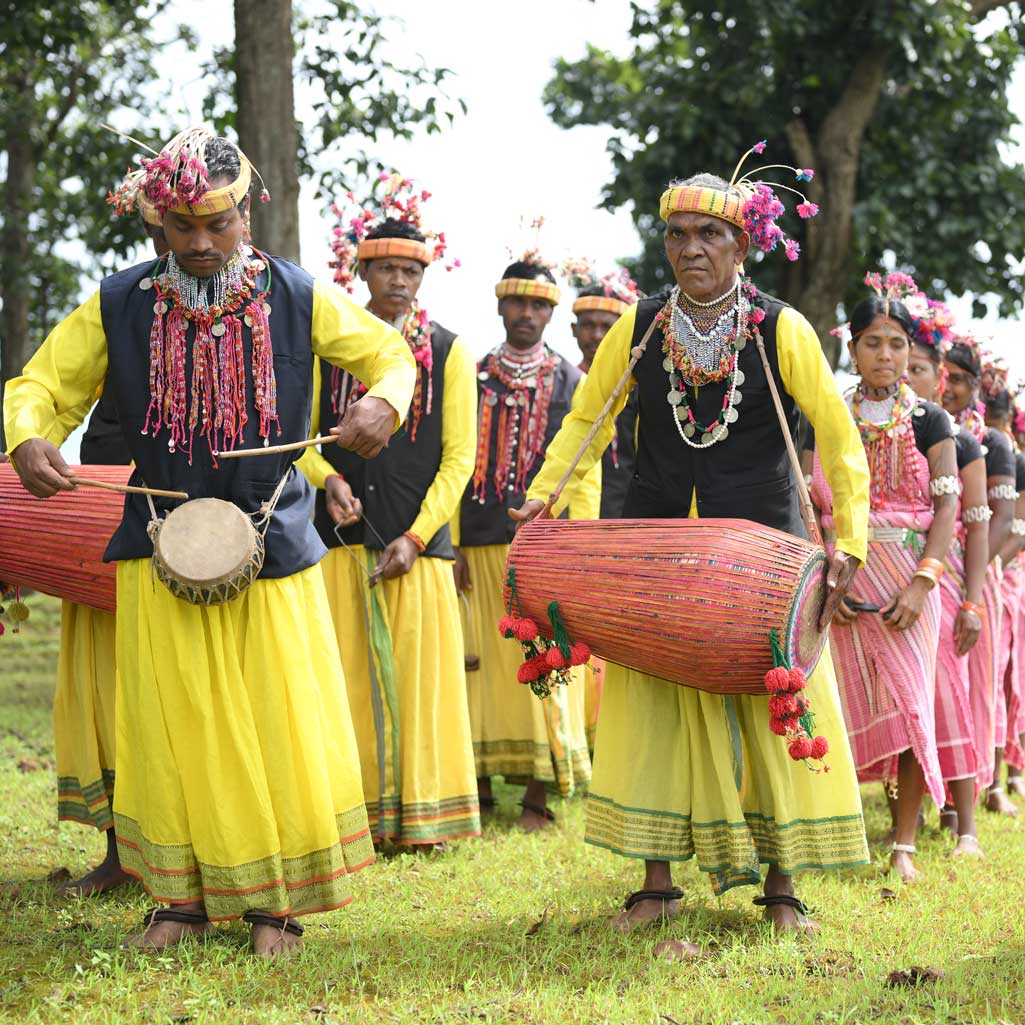
Let us now understand the essential steps and positions of Baiga Karma Dance. It also takes off with dancing in a circle. Two of the dancers are staged in an orderly circle and dance as one. Unity and togetherness as a community are symbolized with the circle. The dance steps are based upon the beats of the drums. The dancers move to the beat. The tempo of steps becomes increasingly speedy, injecting energy and enthusiasm into the dance. The dance is performed to alternating right and left steps. The dancers take a step forward with the right foot, then follow with the left foot. This is crucial, in order to keep the pace and rhythm of the steps. The dancers also twist and turn into some of the postures to incorporate in the dance during the movement itself. This makes the dance appear to be livelier and eye-catchy. Dancers perform the flips with their bodies turned in one direction and back to the circle. The dance is also characterized by the use of hand gestures. The dancers lift their arms in various positions. Moving Hand Gestures make the dance colorful and alive.
Mudras of Baiga Karma Dance:
In this dance, a lot of mudras represent the forms of nature. The dancers contort their hands and bodies to mimic trees, plants, flowers and other natural elements. These mudras emphasize the cultural background of the dance. Certain mudras are meant for prayer and respect. With their arms all raised in a special condition—similar to hands pressed together begging forgiveness or blessing—this manifests religion and spirituality. Some of the mudras used by the dancers are also a means of communication between them during the dance. These mudras help in their communication and reveals the collective mood. Mudras of Karma dance also shows joy and enthusiasm. It is such an effectively festive spirit filling the dance that is expressed in the mudras of the dancers giving up the celebration in the form of the forms of movement among them. And therefore these fundamental steps and mudras of this dance not only provide a tangible shape to the dance but also are an expression of cultural and religious feelings of this community.
Rhythm and Taal
Karma Baiga dance rhythm and taal now we will speak about below Baiga Karma dance Become a coordinated experience of a completed and lively rhythm and taal.In this dance first we will know about rhythm and taal, the taal tune which is in this dance is created by drums and other all instruments. The beat and tempo of the dance are set by the resonance of the drums and the jingle of the manjiras. The taal is vigorous and spirited to encourage the dancers to dance with a specified rhythm. The dance steps are rhythmic and dancers move according to the rhythm. The dance movement stays smooth and tight while taking steps according to the rhythm. The dancers link their footwork with the taal and melody that creates an organic beat in the dance.
Dance tempo and transitions:
As for the tempo and where you transition in the dance – the Karma dance tends to begin at a slow pace and then quickens over time. This change is the dancers step it up a notch in speed and vigour. With increasing rhythm intensity, the step also becomes faster, making the dance livelier and more enthusiastically. The spin, the somersault of, But marking time, also a part of the dance. The movements are actuated in accordance with the rhythm and impart dynamism to the dance. The dancers display grace while moving in a circle, a pattern reminiscent of a joint community, an embodiment of social cohesion.
Collective rhythm:
It places a great premium on the concept of collective rhythm in this dance. The dancers match their movements to rhythm which reveals the sense of unity/collectivity among the dancers. This rhythm will keep all the dancers in relative rhythm with each other and give the dance a musical quality.
Traditional Costumes
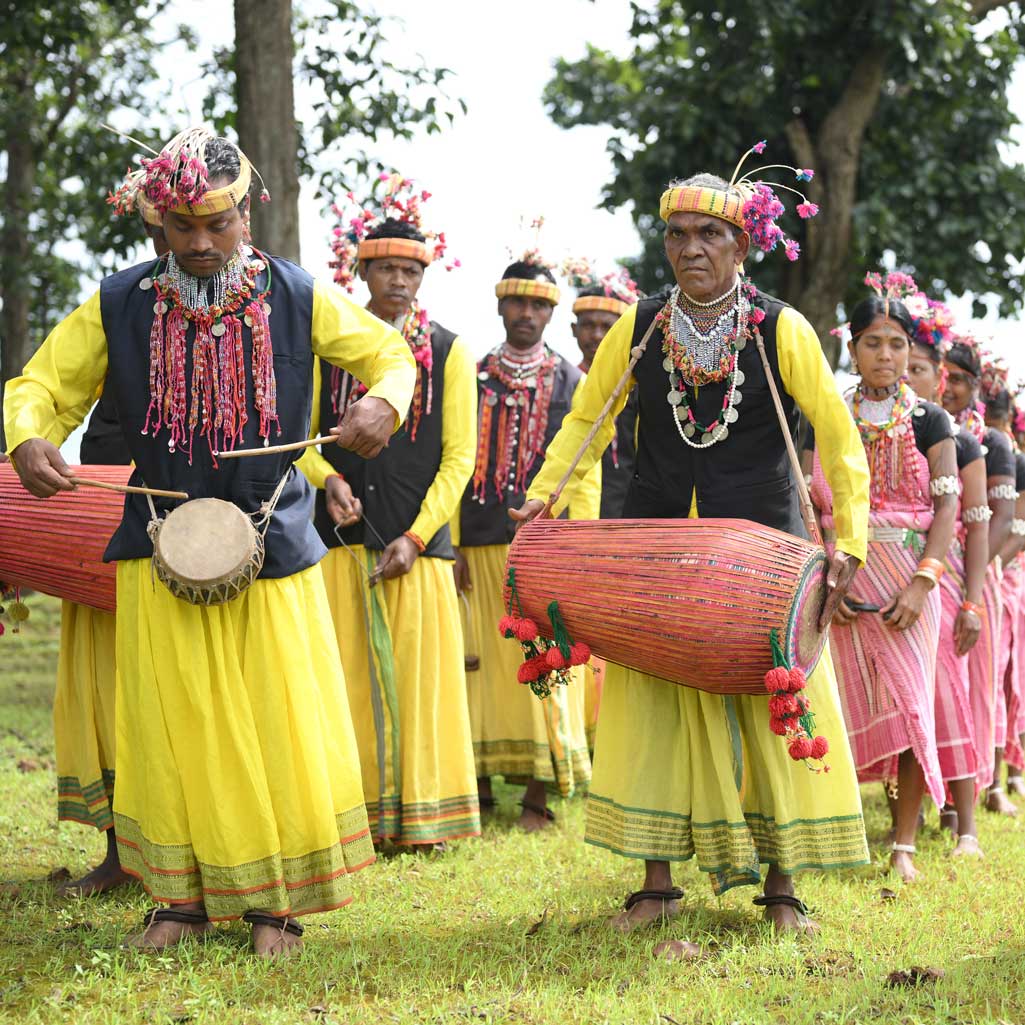
Traditional Costumes for Baiga Karma Dance Here, the attire of the dancers indicates the religion and cultural aspect of this dance.They do not perform the dance with bare face and they have the special costumes to do the dance. Certain Baiga dances and songs are performed in groups by both men and women. This dance song has the men wearing a skirt-like flared saaya around the waist. They wear their salukha (shirt) and black jacket. On the head a chaka-like turban, 'peacock feather plume' on it, coral necklaces of varied colors round the neck, 'rupee' in the ears made of gilt or brass coins and pearls and iron or brass anklets on the feet. They tie a pichora with red and blue prints from the back. They have thikki in the hand. Women, used to wear a mungi lugra on the body, as in the case of dance. Young girls, meanwhile, pile on the hair decorations They do a bun like in the head and put a peacock feather plume.A chain-like bunch of 'ladda' made by joining small rings of Bagai grass is tied in the bun which hangs down to the waist. After adorning them with colourful necklaces around the neck, earrings made of pearls and coral in the ears, gilt bangles in the hands, Mundri on the fingers, Pairi or anklets on the feet, pinches on the toes etc. you will see them dance and song the songs.
Decorations and Features:
Fabrics are prominently used in making the costumes of this dance. The essence of this dance is translated into energy into the costumes worn by the dancers. There are traditional colours of red, green and blue which are important. The costumes are also a part of cultural symbols. The dancer will have symbols which embody his or her culture and religion, and so express unique spiritual sensations while dancing. The costumes of dancers are made unique by the traditional art and embroidery that is done on the costumes. They are used by the community to clarify the cultural context of the dance and demonstrate the artistry of the community. The cultural identity of the Baiga Karma dance is reinforced through this costume. The dance depicts the cultural value, tradition, belief of the dancer who performed it. In the religious field, traditional dresses represent honor and admiration. The dancers wear costumes that show their respect to the gods and the beliefs. Traditional dresses on this dance are symbols of cultural identity of dancers, show Lotus for religion and colourfulness of the dance. The costumes of male and female dancers are mouth-watering as for the choreography turn ans also keep the culture lives.
Language and Body Language
Next, let's move on to the language and body language for the Baiga Karma dance. Integrations of the language, gestures, movements, and expressions of the body and the slogans made during this dance reflect the specialty of this dance which is a part of the cultural heritage of the Baiga tribal society.Traditional folk songs and melodies are sung during this dance, which are an integral part of this dance. These songs are sung in the local language of the Baiga community mainly in Baiga language or local dialects of Hindi. They sing of the rhythm, beat and emotions of the dance and reinforce the cultural identity of the community.Their folk songs often sing about nature, gods, crops, and tribal way of life. These songs lament the emotive nature of the dance whereby some given emotional connection to dancers in the dance. And their songs are full of messages about working together as one for a common goal. These songs is showing the social values and traditions of the community.
Dance Postures and Gestures:
The dance form has its own language, and postures and gestures are very significant in this language. These postures convey specific feelings and social messages that the dancer narrates during the dance. Most of the postures shown in the dance depicts the images of nature such as trees, plants, flowers, and animals. These postures represent this community respect and closeness to nature. Likewise, a few positions additionally reflect spiritual and religious signs. Through their posture of hands and body dancers express the feelings of worship, prayer and blessing.Foot movements and rhythm — In the dance, foot movements are made with rhythmic movements of the body while in accordance with the rhythm. Alternate right and left steps keep the rhythm and rhythm of the dance. When you step in a circle you begin to see collectivism and community. The dancers are in a circle, a symbol of unity working together.Posture and Movement of the Body: the dancers hinge their bodies and twist to and fro while the dance takes place from time to time that provides the appeal of being dynamic. Together, they energize the dance and enchant the audience. As the dancers dance by waving their hands and bodies, it imbues a grace and flow to the dance. Their body language makes the movement graceful yet soft.Smile: Facial expression and facial impression of the dancer represents happiness and excitement. Happy, dancing smiles and glistening eyes and smiling explosions on faces convey the joyfully festive spirit of the dance. Some of the stances and faces represent piety and belief. The dancers have a certain emphasis on seriousness and reverence in their faces that displays the dance's religious aspect.Teamwork: Dancers work together and need to be in sync with one another. Visceral signals, like giving each other signals, moving in sync, suggest a greater sense of community and social cohesion.
Performance and Technique
Baiga Karma dance has a significant place for group dance. It is not just an art form but also a beautiful display and representative of the social structure, cultural identity, and collectivism of the tribe of baiga as a dance form. Dances of this nature demonstrate solidarity, collaboration and a sense of community, as well as having social and religious significance. In circles, all the participants dance, an expression of their togetherness and unity.
Performance Techniques
Performance technique of baiga karma dance is as: It is the performance and technical aspects that make the Baiga Karma dance unique. This dance has social and religious significance and the performance techniques contribute to the effectiveness and attractiveness of dance.Formation and Statage of Dance:- Baiga Karma dance generally starts with a traditional introductory song and music. According to that music, the dancers slowly circle back-in or who joins in on the dance. The first section sets up the religious and cultural context of the dance. Baiga Karma dance is characterized by dancers chanting in rings. Here the dancers come together to dance in a circle showing collectivity and unity in motion. While keeping this circular formation, the dancers move in sync step and pose.There are different kinds of steps and postures in this easy dance. Jhoomar, tipka, and whirl are among the steps the dancers practice. These steps depend on the rhythm, beat of the dance, and to maintain the speed and balance of the dancer in a good manner. The dancers practice different poses that carry a religious and cultural note. These positions elucidate the emotional nature of the dance and express the dancer's emotional state.Closer to music and rhythm: The music like dhol, mandar, manjira etc played from instruments during this dance directs the steps and movement of the dancer. The dancers keep in sync with the music and move based on the rhythm. And dancers practise how to correctly follow the rhythm and beats. By doing these steps and postures with the right timing as per the rhythm, the dance becomes more effective and the performance becomes very smooth.
Preservation and Summary
Next market will be for preservation and promotion of Baiga Karma dance. The preservation and promotion of this dance is necessary as it plays an important part in the cultural heritage of the dance to pass on to the next generation.
Preservation Measures:
This dance should be reflected in terms of its music and traditional performance costumes, and it's noteworthy that it must be included within the definition of cultural heritage. The videography, photography, and written documents of its many performances and rituals Therefore, documenting this dance is essential to secure the art form of the dance and the techniques involved. The younger generations should be taught the ways of traditional dance so it can live on within their heritage. Instructors and traditional dancers carry out workshops and training programs where young dancers are taught every bit of this dance.
Promotional Measures:
We have to arrange cultural events and festivals to promote this dance on a large scale. The dance is manifestly performed in different cultural festivals, shows and exhibitions to local, national and international level News and exhibitions of the dance can be exchanged by means of current media and advanced stages. Social media, YouTube, and other platforms release dance videos, articles, blogs. Cultural courses and studio workshops offered in schools and colleges teach the importance and technique of the dance. Thus, the dance becomes involved in education and research. Through cultural exchange with other cultural groups and foreign countries Baiga Karma dance could reach to the international level. International cultural exchange programs and travel helps the Baiga karma dance to be available on different cultural platforms and receive global acknowledgment and appreciation.
Challenges and Solutions:
The flip side is that — as we all know if we have completed read any books or learned about modern-day lifestyles and modifications — the form of this dance can be affected. Keeping the traditionalism alive by adding a touch of dance to contemporary content and serving traditional content based on traditional pieces of the dance form. There is little access to sustaining economic resources for preservation and promotion. Sure, a required financial support can statisfy through private funding, and cultural sponorship. This could lead to discounting the significance of the dance, cultural heritage, and/or costume. Education programs, publicity in the media, and cultural workshops can raise awareness.
Conclusion
Now let us talk about Baiga Karma dance summary. Baiga Tribe Dance It is a folk dance of baiga tribe in Madhya Pradesh showing there close range with nature. It is a folk dance performed during the time of harvest or a special festive time. The total dancers move from one village to another village and do the dance. These are from a time when the dancers have always been well taken care by the villagers and full arrangements of food and drinks are served for the dancers. In Karma dance men and women come into a circle and perform the walk which is mimicking the things in nature like trees and birds and wave of water. The dance becomes livelier with folk songs sung along with dhol, mandar and kartal. The dancers decked in traditional dresses and jewellery, long skirts with multiple colors, gives us a small sneak – peak into their culture and traditions. The Baiga tribe have their own culture which they express through this dance and respect nature which is part and parcel of their life.