

Keekri Instrument
This beginner’s module introduces the Keekri, a traditional percussion instrument of the Thoti tribe, exploring its cultural roots, structure, and sound mechanics. Participants will learn about the Keekri’s role in rituals, celebrations, and social events while gaining hands-on experience in playing techniques. The course emphasizes the preservation of this art form amidst modernization, fostering a deeper appreciation of the Thoti community's musical heritage.
 Most Viewed

What you'll learn
- Cultural Significance : The historical and social role of Keekri in Thoti culture
- Instrument Design : Structure, materials, and sound mechanics of the Keekri
- Playing Techniques : Basic posture, rhythms, and traditional beats
- Ritual and Social Context : The Keekri’s importance in ceremonies and community bonding
- Preservation Efforts : Challenges and initiatives to sustain the Keekri tradition
Couse Features:
- Foundational Insights : Comprehensive introduction to the Keekri and Thoti traditions
- Practical Learning : Step-by-step guidance on playing basic rhythms
- Interactive Exploration : Discussions on cultural, social, and ritual aspects of the Keekri
- Preservation Focus : Examination of efforts to revive and sustain the Keekri tradition
- Creative Assessment : Hands-on projects and Q&A sessions to solidify learning
Who Should Enroll
- Aspiring musicians exploring indigenous percussion instruments
- Cultural enthusiasts interested in Thoti traditions
- Researchers of tribal music and rituals
- Artists and educators promoting traditional art forms
- Conservationists passionate about preserving indigenous cultures
Description
Keekri Instrument
Introduction to Keekri
‘Keekri’ is no more than a music instrument, it is an important cultural symbol which represents not just the Thoti tribe but also the Pardhan community, a tribe of Gond community’s traditional poets across the old Adilabad and Kumram Bheem-Asifabad district in the State of Telangana and erstwhile district of Adilabad. Kingri The Keekri, also called Kingri, is used as a medium for narrating tales and maintaining Thoti orally transmitted literature. This paper focuses on the configuration, meaning and cultural activities of Keekri and underlines its significance as a vital component of Thoti life.
Overview of the Keekri Instrument
It is Thoti traditional tribal instrument and the Kingri (or Keekri) is a sacred instrument played by the Thotrro tribe who are closely associated to the Gond tribal community. It is significant in that it contributes to the perpetuation of the oral traditions of Thotis, the bards (bardal), who perform for their Gond patrons (dhanis).The Keekri, like almost all Indian knives, is characterized by a dual-system: a combination of two parts named the “dobra” and the “kujja.” The dobra is made from a mixture of bamboo, and wood; with strings that bring about melodious sounds when played. The kujaa (the kujja is made from bison horns) is decorated with metal bells and it adds a rhythm to the music. This device is employed in such ritual objects and storytelling performances as the ones where the Thotis tell the myths, legends and songs that maintain Gond history and culture.The Keekri’s uniqueness lies in its ability to reflect more than the music, the semblance of a way of spiritual and a way of cultural life of the Thoti tribe. The Keekri has always been reserved for the older men who teach the younger boys the legends of their ancestors so they don’t die with the older generation, the oral history of the tribe must live on.
History and Cultural Significance:
The Thoti people are one of the oldest indigenous communities of India who predominantly live in the former Adilabad district and the Kumram Bheem Asifabad district, both in the Indian state of Telangana. They are also present in areas of Karimnagar and Nizamabad districts. The Thoti Raj, who are connected with the Gond people, and whose main functions are to serve as bards to their Gond patrons. In this connection, the Gonds regard Thoti as "bardal" (recipient) and Thotis consider the Gond as "dhani" (giver).Through their songs, the Thoti keep the oral history of the Gondwana kingdom alive with legends that are centuries old. Gondi, their dialect, is a vehicle for the perpetuation of their culture pattern. Estimation of Thotis in Telangana, India as per the 2011 census of India, the number of Thotis in India is around 4,811 and their native language is Lamani with a literacy rate of 62.77%. They have been a nomadic people, travelling from site to site singing songs and reciting stories of the past.The keekri (also spelled kingri) is a significant folk instrument of the Thoti and Pardhans, particularly from the Gond tribal culture in and around the former Adilabad district [Telangana, India]. It has been derived from their hereditary profession – the Bhaats (bard) of the Raj Gond, a prominent tribal community in Central India. The Thoti community have been traditionally acting as the care takers of history, mythology and folklore of the Gond people, who in a range of songs, mythology, epic recitals and dances sing and perform the keekri as the keelro. The genesis of the Keekri is related to the Thoti community serving as the custodians of the cultural patrimony of the Gond tribe. The Keekri, in its own right, is constructed of two components – the dobra and the kujja – both of these make a considerable contribution to the sound of the instrument.
Music and Rituals of the Thoti Tribe
For the Thoti community, music forms the very foundation of their cultural identity and is the essence of their festivals, rituals and ceremonies. In this domain, Keekri is also the principal instrument which forms a spiritual as well as social sound track for all occasions in life and activities of the community.Cultural identity and the art of storytelling: Music as a form of storytelling ensures that the oral history of the Thoti tribe is not lost. It is played during important occasions, including funerals, the harvesting festival and seasonal festivals to narrate legends and stories about the ancestors. This culture perpetuates a collective identity and coherence through social bonding within the tribe.Spiritual Relevance: The playing of songs and the Keekri usually is an invocation rite, calling the spirits, gods the tribe believes in. In rituals of deities, especially when a ritual concerns the snake god Persapane (Nagoba), the Keekri is played for blessing of protection.Seasonal festivals: The music is essential in Thoti festivals that celebrates transitions and slides in various festivals throughout the year. The Sana Geet and Sadarbidi are traditional songs which are features for such ceremonies, in which create a joyous mood and these also have a ceremonial aspect to it. It is not simply entertainment – these rituals are central in demonstrating gratitude to nature and the gods, the relationship the tribe have with the environment and the spiritual plane.In this module we were introduced to the Keekri, the signature musical instrument of the Thothi people, its evolution and cultural relevance.In the next section, we will get to know how the Keekri works and the mechanism to produce sound in the Keekri instrument. "This will be an exploration of what is going on sound-wise, what will be used to craft it, what you can do with that sound, classic plays, a chance to get yourself hands on a rhythm and some percussion in a jam session.
Structure and Sound Production of Keekri
The Keekri is a folk instrument used by the Thotis, and is the only member of the harp-lute family of Indian string instruments. Consisting of wood and animal hide the Keekri is often hollow in its cylindrical case and produces a sound when struck.
Design and Construction of Keekri:
Keekri is an indigenous drum played by the Thoti tribe in the former Adilabad district of Telangana, which is located in the Deccan region in India. It has everything - that mixture of workmanship, cultural importance, and acoustics.
Structure of Keekri
The Keekri is a composite instrument with two main parts: the dobra and tamrazema.
Dobra
The dobra is a vertical instrument, 30 inches in length and two components, a bamboo tube and a wooden vessel. The top half is a 20 in. bamboo tube attached to an identical length wooden dobra, which is a rectangular conical cask. The open mouth of the dobra is thinly covered with an inner membrane or uthri of an intestine of a cow killed by a tiger. This special wrapping is said to improve the musicality of the instrument.Keekri consists of two parts, connected by three strings — iron and two horsehairs. These strings run from the wood riser or whip on the dobra to the mod (or pidi) on the bamboo tube. Three wooden rollers, called pidi (also about 10 inches in length), are inserted into the bamboo tube to provide tension and improve sound quality. These are the rollers which are used to change the tension of the strings so that one can get the sound of one's choice.
Kujja
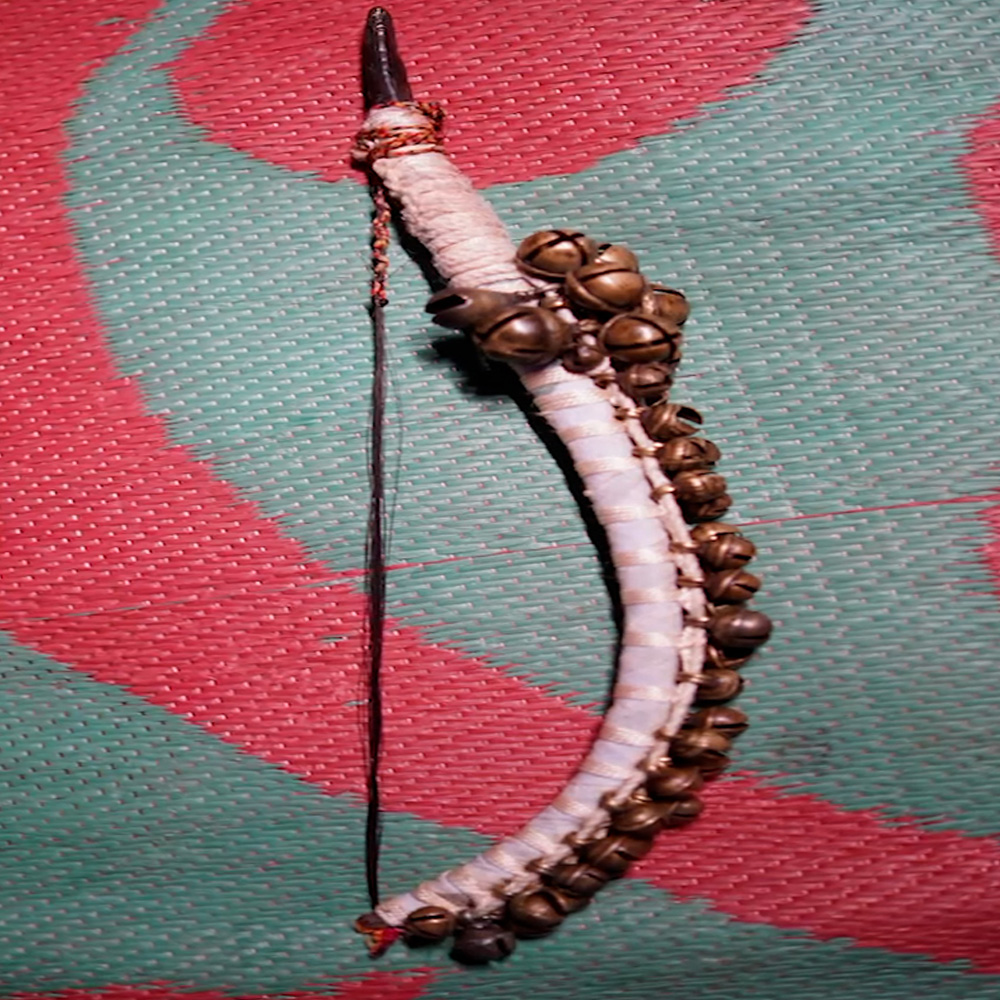
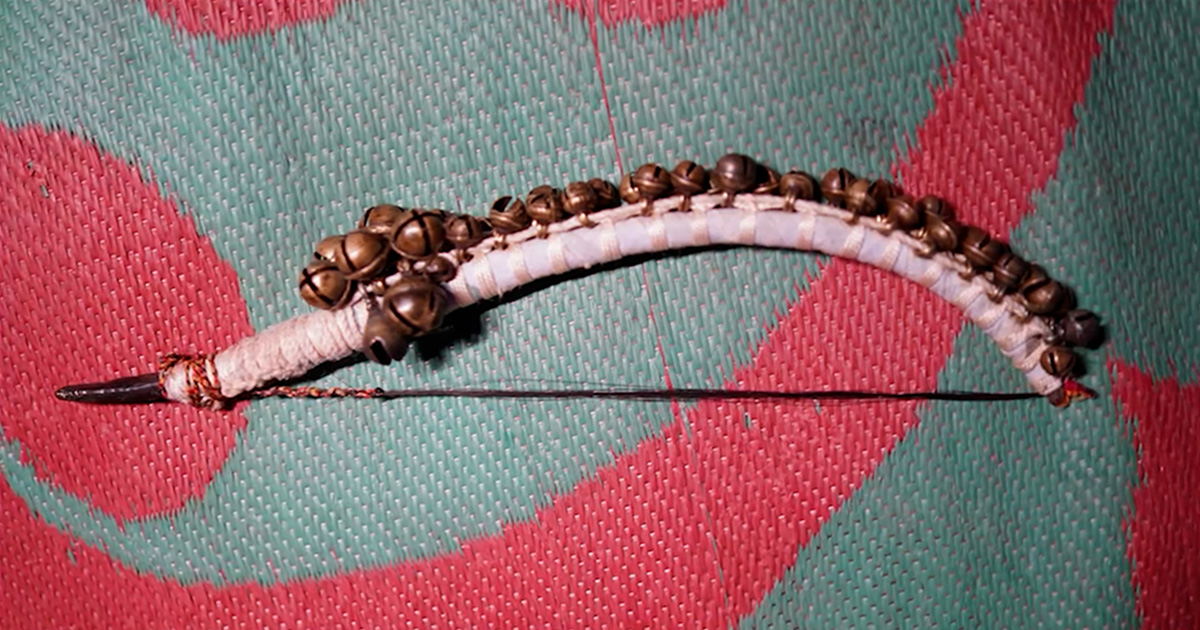
The second item, kujja, is of bison-horn, and forms a segment of the sickle. Both ends of the kujja is there folded up, and tied, with a hair string of the horse, into a knob, as a handle. Small bells (chuduk gagarang) are attached to the spine of the kujja and larger bells (parasang gagarang) are attached to the portion between the spine and the handle which form a collection of rhythmic tinkles when the kujja is played. The count of the large bells match with the account of velpas, traditional deities, the bhats worshipped. For example, a bhat who follows a faith that worships four deities, will tie four big bells to his kujja.
Materials Used:
Dobra:
indo the dobra is usually composed of a tambilawan wood/bamboo raft. The bamboo element, about 20 as preload id throbbers long, was hollowed out to make a resonating body. Maybe there is some sort of a rectangular sound box or wooden container that amplifies the sound. The use of bamboo is a socio-ethnographic statement for the Thotis as well: It represents the natural resources of their environment, shown off openly as well as signifying to others, a strong connection to the life around them.
Kujja:
- The kujja, another important part of the Keekri is fashioned out of the horns of the sharpedged bison. No other horn can play Keekri like this horn can. It has horse hair strings, which get other notes played.
Strings:
- It is made up of one string of iron and two strings of horse hair stretched to produce different notes. The strings are very important for generation of music and are finely tuned to generate melodious music notes.
Membrane:
- the open end of the dobra is lined with a fragile inner membrane also derived from cow intestine, preferably taken from an animal killed by a tiger in proper period fashion. This rare material is responsible to good sound of the Keekri!
Bells:
- The kujja has small and big bells attached to it that jingle and give rhythm to the instrument. The number of big bells represent the number of gods the bard worships, indicating religious value of the instrument.
Craftsmanship:
Keekri is crafted using a technique that has been handed down for generations. The process involves:
- Selection of materials: All Bamboo or Wood used are carefully selected for good acoustical and durability.
- Craftsmanship: Bamboo: is carved and sanded into the desired shape. The wooden shell is cut into a rectangle to enhance the sound properties.
- Stringing and tuning: the strings are tied in place and brought up to the pitch needed and this requires in depth knowledge of musical theory and acoustics.
Sound mechanics and acoustic characteristics of the Keekri
The novelty of the Keekri, which is a traditional Thotia drum, lies in the amazing co-ordination of materials, design and playing technique which lead to the particular tone of the drum. How the Keekri Sounds The sound of the Keekri is determined by how the instrument is made, how it produces sound, and by several properties of the acoustic that it generates.
Sound Production Mechanism
Construction The kekri is generally made of materials which can help to resonate the sound, such as wood or bamboo (bansuri) and is mostly little hollow to amplify the sound It is most often made of bamboo or wood. When you hit the Keekri the surface vibrates, and we hear Sound waves reaching our ears. These oscillations can be thought of as quick repeated movements of the material, which create sound waves with particular attributes of amplitude, frequency and wave length.
- Vibrations and sound waves: When the player knocks on the Keekri with a kujja, the impact of the knock is transferred to the surface of the kismat leading to vibration. This motion disrupts the air around it which creates sound waves that travel to the ear. The loudness or volume of the sound is proportional to the amplitude of these waves and the pitch is determined by the frequency. In visual A Keekri creates a deep tone from low frequencies and a shrill call with high frequencies
- Acoustic characteristics: The Keekri timbre or the timbre of the sound of Keekri is determined by the construction of the instrument and the way it is played. Different ‘keekris’ may possess different acoustic properties, depending on their size, shape and the materials used. Thicker or denser materials, for example, may provide a richer sound, lighter materials may provide a brighter sound; of course, any of these principles may be combined with each other. The interplay between fundamental frequencies and harmonics is what makes the overall sound so sonorous and rich
Playing techniques
How a Keekri is held and played also dramatically effects its sound. Musicians concentrate on a multitude of techniques to create complex tones and rhythms by playing the kujja in different hand positions or angles. The resulting variety of tone colours is a product of how the player plays and of the instrument's design. "Its mechanism is such that one can produce much complicated beat combinations, putting a peculiar charm into the songs and making the Keekri, a very important entity of Thoti cultural music landscape.
Traditional Playing Techniques of the Keekri
Playing Skills of the Instrument the Keekri is a tradtional percussion instrument of the Thoti tribe and has a very unique playing style that resembles the rich cultural history of the community. Muscle control should be learned as it is vital in playing the keyri properly.
Basic hand positions
- Grip technique: The player of the Keekri seems to grip the cylindrical part of the instrument (wooden) with the side of one hand – while the other hand takes responsibility for using the strings by the kujja. The grip should be both firm and yet loose and one that accommodates quick note changes.
- Finger position: The fingers should be placed correctly in order to produce a clean voice. The strings are generally played with the index and middle fingers, although the thumb may also support the bottom of the whistle. This setup provides a good blend of strength and delicacy, allowing the player to deliver tender lines as well as forceful chords.
Playing Posture
- Seating Position: Players are usually sitting in a relaxed position, sitting cross-legged on the ground or a low stool. This position stabilizes and frees the arm, which must move naturally.
- Alignment and Comfort: Keeping a straight back and relaxed shoulders is conducive to breath control, which gels well with keekri performances, often done in singing too. When you are able to sing for 2-3 hours without getting tired, it will be easier to sing and breathe properly during shorter sets, when you actually focus more on vocal technique.
Rhythmic Patterns
- Basic Rhythms: The normal rhythms and models for dancing and other ritual elements. Such patterns can be basic rhythms or one beat ( in a variety of subdivisions) or they can range more complex sequences of patterns, for example, patterns such as ta-ka are similar.
- Improvisation: A mastery-level player may improvise, adding their own touches to established rhythms. This test not only exposes the strength of each person, but also the ability to 'duel' with the crowd and other artists.
- Collaborative Playing: At times a group of Keekri players play together, synchronizing their beats together to create harmony. Its social context and the manner in which it is performed highlights the communality of Thoti music which reinforces the sense of unity and social cohesion in the community on festive and ritual occasions.
Practice Session: Basic Rhythms and Rhythms on the Keekri
In this practice students will be taught exercises/sung kavi’s to lean the basic beat patterns for the Keekri which is essential to playing traditional Thoti music. The rhythmic modes of the Keekri provide a foundation for dance, narrative and communal activity. This hands-on experience should not only help students to improve on technical skills, but also to develop their understanding of the cultural and social meaning of the rhythms.
Objectives of the Practice Session
- Understand basic rhythmic patterns: Pupils will get a familiar feel of a few principal rhythmic cycles in common use during keekri performance. re are the elemental beats which constitute thoti music and which can then be manipulated to other contexts rituals, festivals, ceremonies.
- Develop coordination and timing: As you follow along with the instruction on the video, you’ll develop the coordination and timing required on all percussion instruments. This exercise will also underscore the value placed by thoti musicians on rhythm being coordinated with voice (or other instruments) because thoti music is a team work.
- Encourage improvisation: In class the main emphasis will be on learning the basic patterns but improvising will also be encouraged, varying learned phrases. This area of practice will emphasize the living quality of the tradition, with room for individual expression.
Practice Step
- Warm-up exercises: Start by using some warm-up drill which consists of students making the feel of Keekri and its strings. Over time this may be broken down into striking the dobra then positioning the fingers but it just varies depending on the student may also poetically just isolate the finger position without any specific rhythm to increase comfort.
- Learning basic beats: Teach 3-4 fundamental rhythms like the following:
- Single beat pattern: Drum a steady “thump” on the dobra, then bounce off the strings once, sharply.
- Syncopations: Using rhythm that is off the beat, and pausing to produce more complex rhythms that reflect the whole suspense of this musical character of thoti.
3. Group practice: Put students in small groups and have them practice rhythm together. This will support cooperating and offer them an opportunity to listen to how various parts can play together nicely.”
4. Performance and feedback: At the end of practice each group will perform their rhythm to the class and give constructive feedback. This is a crucial step to solidify learning and to improve performance skills.
In this module we learned about Keekri, a music instrument, Structure, Material used, Sound produced. Acoustics of Keekri Sound, traditional techniques of Keekri playing, hand-holding positions and the rhythmic patterns of Keekri were explained. Students next practiced rhythm and tempo.The next lesson is about the social and religious significance of the Keekri. It will discuss the religious rites of the Thoti tribe, the Keekri as a symbol of unity and the Keekri's role in mail occasions like maruages.
Social and Ritual Significance of the Keekri
The Keekri instrument of the Thoti of Telangana carries with it deep social and religious meaning, and is a vital part of the cultural identity of the community and a symbolic reference to its sense of community cohesiveness. Keekri's role: The Keekri of Thoti community is not just a musical instrument but symbolizes the spiritual spirit of the people of Thoti and has a significant place in the religious activities, festivals and the life of different important ceremonies. At the harvest festivals, during weddings and other social functions, the rhythmic thumps of the Keekri spread happiness and the sense of belonging, bringing the community together in participating together in a cultural form.
Ritual significance of the Keekri
Ritual significance There are religious elements and punctured holes for circulating air within the Keekri instrument which are consider as part of the faith of Thoti community and which are a part of their religious rites and seasonal ceremonies. This part investigates the significance of the Keekri in the religious life of the Thoti, with focus on its part in rituals and festivals.
Role in religious rituals
- Spiritual connection: Keekri is a part of several religious events, the drum is played to get blessings from gods and ancestors. The spiritual energy that is generated by the Keekri fills the air, giving the feel of sacred vibrations that connects the worldly with the spirit world. Whereas in many rites the music enables congregants to enter into a trance, open new spiritual connections and bind together as a community.
- Ceremonial functions: During events in the life, like marriages, child birth or initiation, Keekri performs a vital role. It is performed along with prayers and offerings, as an expression of the community's thankfulness to and worship of gods. During the harvest festivities, for instance, the Keekri signifies the harvest is celebrated by rhythmical music that prompts collective participation.
- Mythological narratives: Mythical themes Music played on the Keekri often dictates the myths which are important to the Thoti. These narratives are recited in ritual, and serve to redream cultural values and a shared past. Keekri is thus also a means of preserving these stories, so that they continue to be an integral part of the spiritual life of the people.
Role of Keekri in Social Events and Ceremonies
Keekri Local Context the main role of the Keekri is in many of the social function’s ceremonies performed in the Thoti tribe community. And it is part of life’s great moments – a way for us to celebrate together, a key plank in cultural continuity. This is where the Keekri comes in and strengthens those social bonds.
1. Keekri at Weddings
- Ceremonial Music: Among the Thoti people, wedding ceremonies cannot be complete without the Keekri. In the classical sense, its beats are traditionally associated with the bridal form of a procession, rituals and celebrations. The sound of the Keekri are also said to punctuate significant moments of the ceremony, and serves to enhance the celebratory atmosphere, while acting as a beckoning call for family and friends.
- Cultural Importance: At weddings, the Keekri, acts as both a musical instrument and a cultural object to unite families. Everyone loves a game of Keekri and the dance is shared by families and friends, as it is a game for communities as well as the individual.
Community bonding activities
- Festivals and celebrations: It is an important part of various community celebrations like harvest and religious festivals. Its rhythmic patterns serve as a common denominator for participants, that both solicit the collective's interventions and offer common emotions. Keekri is played collectively in the Thoti community; The playing of Keekri collectively is a social bonding and is effective to also maintain cultural traditions and solidarity within the tribe.
- Expression of identity: The Keekri is symbolic for the Thoti people during the events, and helps them in preserving and expressing their cultural identity. In times of community celebrations, the Keekri acts as the conduit for storytelling, handing over history and tradition to the new generation. This form of culture is a paramount concern for the tribe's social solidarity and identity.
3. Rituals of Connection
- Healing and Unity: The keekri music has a healing role to play - getting the community together in hard times or after a dispute. The music of the Keekri is thought to have curative properties, bringing the tribe into fellowship and balance. It reinforces the notion of community unity and conservancy.
- Educational Role: The Keekri does not only have celebratory functions but also an educational purpose. At these social events, the young are taught to play the instrument, thereby reproducing musical traditions and styles. This serves to unite the generations and develop pride in their heritage
In this module, we were taught about the religious and social role of the Keekri in the Thoti tribe. the Keekri in Thoti community is a symbol of unity and is integral to religious functions, marriages and social gatherings, facilitating cohesion within the community.In the following unit, we shall explore about the decadence and contemporary problems of Keekri tradition. Conservation efforts, the part played by cultural bodies and the community, the "profile" of Keekri's artisans and the prospects of its preservation at the hands of the new generation will also be the topics of the day. Finally, some conclusions will be drawn.
Conservation and Revival of the Keekri Tradition
The Keekri tradition amongst the Thoti community from Telangana is crying for immediate conservation and revitalization as it is prone to obsolescence due to the boom of technological advancements in the world. The decline of rural economies, technology and shifting cultural norms have reduced the traditional use of the Keekri, imperiling its place in community rituals and ceremonies. There are, however, efforts underway to bring this cultural heritage back to life, to make sure that the music of the Keekri does not subside with the past.
Conservation initiatives
The preservation and resurgence the tradition of Keekri among Thoti is carried out by different groups of stakes holders such as cultural organizations, NGOs and community. Through these projects, the decreasing Keekri instrument will be countered and the heritage will be preserved for the next generations.
1. Community-driven initiatives
- Cultural events and workshops: Local community groups frequently conduct cultural events and workshops which stress the significance of the Keekri in Thoti customs. It also allows the younger generation to find out more about the instrument, and get involved in hands-on playing sessions and meeting older musicians who teach them skills and traditions.
- Storytelling and oral traditions: The Thoti community have an oral tradition of storytelling as a means of maintaining their heritage. Through narratives about the Keekri, villagers work to secure the salience of meeti in questions of identity. These epic narratives are generally performed by storytellers to the accompaniment of live music to be exchanged between the performative-aspect and story-tellers.
NGO Involvement
- Financial and Support : Many NGOs work for cultural preservation and donate money for projects that develop the Keekri and other tribal music. This money is usually used to create festivals, craft markets and learning opportunities in Keekri’s name in the community.
- Documentation and Research: NGOs are also involved in documenting the Keekri tradition, thereby initiating long-term research to learn more about the cultural context. This work on the Keekri may serve to create more awareness and understanding of the Keekri, beyond limited nongovernmental efforts, which could result in conserving and doing justice to its heritage.
Profile of Keekri Craftsmen
- Challenges faced by artisans: Keekri craftsmen face several hurdles, including an insufficient supply of traditional raw materials and a lack of recognition for their skills. It is difficult to source and many artisans rely on scarce local supplies, risking the extinction of the instrument if not treated immediately.
- Efforts to sustain craftsmanship: The craftsman banjara are now working for the NGOs to bring back life into these crafts and to sell keekri in different markets. Through exhibitions of their art at cultural festivals and on social media, the craftspeople hope to generate interest in and preserve the spirit of Keekri in contemporary settings.
Conclusion
Towards the end of our journey with Keekri, their traditional percussion instrument, which belonged to the Thoti tribe, in Telangana, we must not leave without pondering the cultural significance of the drum, its struggle, the change initiatives, and steps that each one of must take to bring it back, in loose translation, “back from the brink.” For the Thoti, the Keekri isn’t just a musical bowel, but a cultural barometer reflecting the character, ethos and collective soul of the people that sound it. Appreciating its importance involves knowing the background in which it developed and appreciating the countervailing pressures it faces.The soul of Keekri is the culture of the Thoti tribe. It has been a vital one in their festivals, rituals and collective celebrations through the generations. The endocal sound distinctive to the instrument complements the traditional dance forms as well as story-telling performances around love, harvest, and social unity. The Keekri, by music makes people feel that they are the children of the community and that has ensured their continuity with their ancestors. It is their language of emotion or stories which enfold the emotional shades and narratives of the Thotis and is a part of their cultural structure.